The landscape of the digital agency world is undergoing its most significant transformation since the inception of the commercial web. As artificial intelligence moves from a novelty to an operational necessity, the challenge for agency founders is no longer just about survival—it is about radical reinvention. At the heart of this shift is rtCamp, a 17-year-old enterprise WordPress powerhouse that has moved beyond traditional scaling to embrace an "AI-first" mandate.
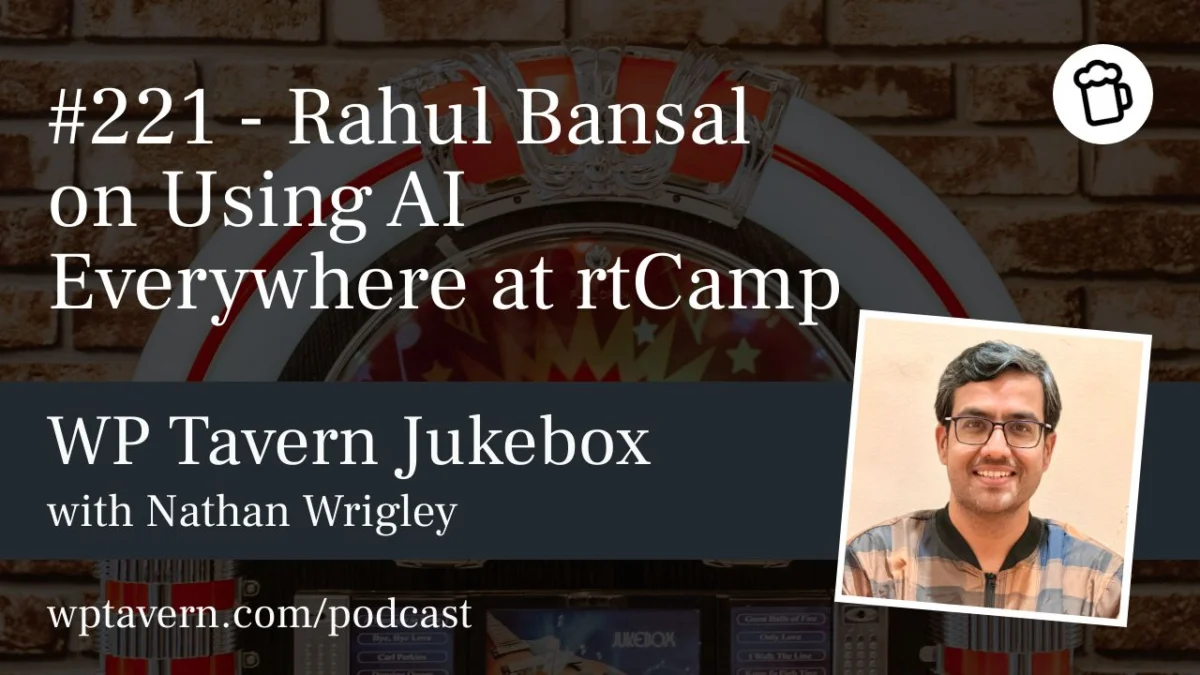
In a recent appearance on the WP Tavern Jukebox Podcast, rtCamp founder and CEO Rahul Bansal shared deep insights into how his firm is navigating this volatile era. By moving away from human-intensive growth and toward an automated, AI-augmented operational backbone, rtCamp is setting a blueprint for how agencies might survive and thrive in the competitive landscape of 2026 and beyond.
The Evolution of an Enterprise Powerhouse
Founded in 2009, rtCamp emerged at a time when the WordPress ecosystem was nascent. What began as a media and blogging company eventually pivoted into a premier agency, solving complex technical challenges for Fortune 500 companies and tech giants like Google.
Bansal’s journey is defined by a willingness to steer into favorable winds. In the early days, rtCamp’s differentiator was simple: they were one of the few players in India committed exclusively to WordPress. While competitors chased various PHP frameworks or content management systems, rtCamp doubled down on a single, open-source stack. This singular focus allowed the company to master the intricacies of high-traffic scaling and performance long before "managed hosting" became a household term.
Today, however, the market is saturated. As Bansal notes, simply calling oneself a "WordPress agency" is no longer enough to stand out. The agency’s current strategy involves hyper-specialization—drilling down into niches like WooCommerce integrations, payment gateways, and back-office ERP systems—to maintain the premium status that enterprise clients demand.
Chronology of Change: From Blogs to AI-First Consulting
The history of rtCamp is a study in iterative adaptation. In the beginning, the agency was essentially a media company running a high-traffic tech blog. The transition to an agency happened organically; as they optimized their own site for speed and traffic, other tech entities began seeking them out to replicate that success.
- 2009–2015: The "Blogging Era." rtCamp builds its reputation by managing its own high-traffic assets, learning the nuances of scaling WordPress in the process.
- 2016–2021: The "Scale Era." Following the global digital boom, the company scales its headcount to over 200 employees, focusing on enterprise-grade development and staffing solutions.
- 2022–2024: The "Internal Refactoring." During the post-COVID period, rtCamp makes the strategic decision to adopt Frappe ERPNext, centralizing all business processes—accounting, payroll, project management, and CRM—into a single source of truth.
- 2025–Present: The "AI-First Era." Leveraging the unified data structure created during the refactoring phase, the agency implements AI across every facet of its operations, from proposal writing to technical proof-of-concepts.
The Philosophy of the "Complementary Set"
One of the most enduring lessons from Bansal’s tenure is his hiring philosophy, which he traces back to mathematical set theory. When scaling an agency, founders often suffer from "founder bias," hiring people who mirror their own strengths. Bansal argues that this is a critical error.
"Initially, you should find people who are the opposite of you," Bansal explains. "If you are engineering-heavy, hire someone who is sales-heavy. If your communication is weak, find someone who is polished." This approach creates a "complementary set" of skills that covers the agency’s blind spots. According to Bansal, this is not just a growth strategy; it is a timeless survival tactic that remains effective even in the age of AI.
Operational Efficiency: The 70-80% Mandate
Perhaps the most striking revelation from the podcast is rtCamp’s aggressive stance on AI adoption. Bansal has issued a firm internal mandate: if a task can be performed by AI, it will be.
This is not merely about using ChatGPT to write emails; it is about systemic cost reduction. Because rtCamp unified its operational stack using open-source tools years ago, they possess a "single source of truth." This allows them to feed clean, structured data into AI models, resulting in efficiency gains that most agencies—scattered across Jira, QuickBooks, and disparate CRM tools—cannot match.
Bansal estimates that in the coming two years, the agency will see a 70% to 80% reduction in build time and operational costs. This does not mean the agency is shrinking; rather, it is shifting its value proposition. They are moving away from hourly billing and toward "fixed-output" projects where the value lies in consulting, creativity, and the ability to deploy complex solutions in a fraction of the time.
Implications for the Future of Agencies
The implications of rtCamp’s pivot are profound for the broader WordPress ecosystem.
1. The Death of the "Coder-Only" Role
Bansal predicts that the traditional entry-level developer role is under threat. If AI can handle the repetitive coding tasks, the value shifts to "Growth Engineers"—individuals who can bridge the gap between business requirements and AI-assisted execution. The ability to prompt, refine, and oversee AI output is becoming more valuable than the ability to write raw syntax from scratch.
2. The Rising Tide of WordPress
Counter-intuitively, the AI boom is creating more demand for WordPress, not less. As businesses seek to migrate away from proprietary, locked-in platforms like Adobe Experience Manager, they are looking for the flexibility of open source. Because AI is exceptionally good at parsing and migrating open-source data, WordPress becomes the natural destination for enterprise migrations.
3. The New Sales Funnel
The traditional sales process—PPT presentations, weeks of discovery, and manual scoping—is being replaced. rtCamp now uses AI to generate functional prototypes and "vibe-coded" demo sites in hours rather than days. This allows them to win business by showing, rather than telling, potential clients exactly what is possible.
Official Stance: Optimism Over Pessimism
Bansal’s outlook remains strikingly optimistic. While many in the industry view AI as an existential threat to the service model, he sees it as a lever for expansion. By reducing the cost of entry and the time to delivery, rtCamp is effectively opening the enterprise market to a broader range of clients who were previously priced out by the high costs of agency labor.
"Our job is to apply AI, not invent it," Bansal emphasizes. He warns against "vibe coding" projects that have no commercial viability, urging agency owners to focus on solving "boring" problems—migration, data mapping, and project management—with extreme efficiency.
Conclusion: Adapting to the New Reality
The story of rtCamp is a testament to the power of preparation meeting opportunity. By deciding to unify their back-office systems years before the AI explosion, they inadvertently built the perfect infrastructure to capitalize on the new technology.
For other agencies, the path forward is clear but demanding: simplify your internal systems, hire for complementary skill sets rather than replication, and stop viewing AI as a competitor. As the industry evolves, the successful agencies will be those that embrace the "AI-first" mandate, leveraging machines to handle the heavy lifting while focusing human talent on the high-value consulting and strategic direction that clients will always crave.
As Bansal concludes, the pie is getting bigger. The question is no longer whether AI will change the agency business, but whether agency owners are willing to change their business to meet the AI era.