For over a decade, the WordPress ecosystem has grappled with the logistical and financial hurdles of internationalization. Translating a website was once a luxury reserved for large corporations with hefty budgets—a process defined by slow human-led workflows, costly localization agencies, and complex database management. However, as the industry enters the mid-2020s, the paradigm has shifted dramatically. Thanks to the integration of Artificial Intelligence, the "should we translate?" debate has been replaced by a new reality: if you aren’t making your content globally accessible, you are already falling behind.
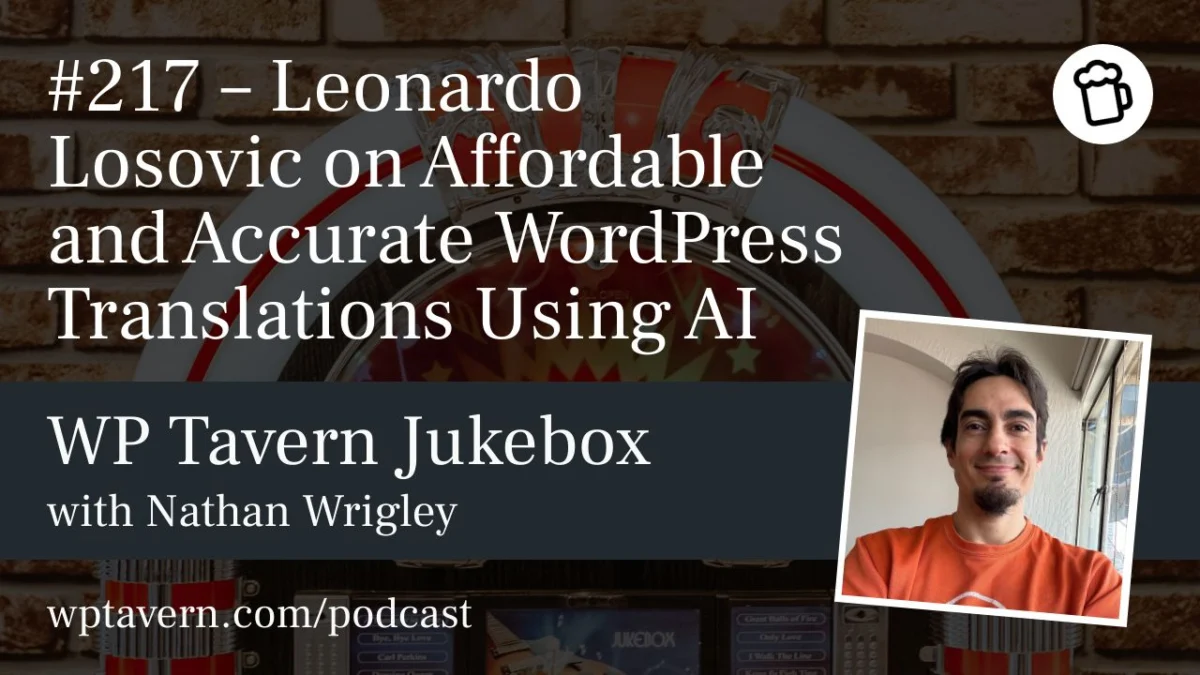
In a recent episode of the WP Tavern Jukebox podcast, host Nathan Wrigley sat down with veteran developer Leonardo Losoviz to discuss the evolution of WordPress translation. Losoviz, the creator of Gato GraphQL and Gato AI Translations for Polylang, provided a comprehensive look at how AI is democratizing multilingual content and why the future of the web is inherently global.
The Evolution of Translation: From Costly Service to Automated Efficiency
A decade ago, the path to a multilingual WordPress site was paved with obstacles. Business owners had to identify translatable strings, hire human translators, negotiate rates, and manually input the resulting text back into their content management systems. This was not only expensive—often costing hundreds or thousands of dollars per project—but it was also time-consuming, creating a bottleneck that discouraged many bloggers and small business owners from expanding their reach.
"The pricing tag that you have now compared to five years ago has gone down dramatically," Losoviz explains. By leveraging APIs from major AI providers like OpenAI, Anthropic, and Google’s Gemini, developers can now translate entire websites for a fraction of the cost. "It can be like cents on the dollar," he notes, contrasting this with the traditional model where professional translators might charge $50 to $100 per hour.
This dramatic reduction in overhead has fundamentally changed the calculus. Where a site owner might have previously chosen to translate into one primary secondary language to comply with local regulations, they now have the capacity to localize their content into a dozen languages, opening up vast, untapped demographics across the globe.
Chronology of Change: The Shift Toward AI Integration
The transition toward AI-driven translation has been a gradual process that reached a critical tipping point around 2024–2025.
- Pre-2020: The era of manual translation and static plugins. Success required heavy investment in professional services and manual data entry.
- 2020–2023: The rise of machine translation services like DeepL and Google Translate. While faster, these tools often struggled with nuance and technical terminology.
- 2024–Present: The AI revolution. Generative AI models provide near-perfect contextual translations, handling complex phrasing and technical jargon with high accuracy.
Losoviz highlights that while AI isn’t infallible—especially in highly specialized industries like physics or biochemistry—it is reliable enough to handle roughly 99% of general web content. The remaining 1% of work, which involves polishing and verifying technical accuracy, is now the only part of the process that requires professional human oversight, significantly reducing the "time-to-market" for multilingual content.
Supporting Data: Why "Just Do It" is the New Standard
The most striking takeaway from the discussion is the shift from a "value-add" strategy to an "essential survival" strategy. Losoviz posits that as the barrier to entry vanishes, translation is shifting from a competitive advantage to a baseline expectation.
"If you’re the only one who is translating your site to 20 languages, you will be far ahead of everyone else," Losoviz observes. "But because it’s easy for you, it’s easy for everyone. And if everybody does the same, you’re just running to stay in the same spot."
This "arms race" of accessibility means that businesses can no longer afford to ignore international markets. If a competitor uses AI to translate their product documentation or blog posts into a potential customer’s native language, that customer is statistically unlikely to engage with an English-only site. The cost of inaction—lost traffic, lower conversion rates, and reduced brand authority—far outweighs the negligible cost of AI token usage.
Technical Implementation and WordPress Strategy
For site owners, the technical execution of these translations remains a critical decision. Plugins like Polylang and WPML offer different architectural approaches. Losoviz, who built his translation solution on top of Polylang, explains that the plugin works by creating separate post entries for each language. This approach has distinct benefits for SEO:
- Statically Generated Versions: By creating distinct posts for each language, the site becomes easier to cache, resulting in faster load times.
- SEO Integrity: Search engines can easily crawl language-specific versions of a page, such as
mysite.com/fr/orfr.mysite.com, and usehreflangtags to understand the relationship between the original and translated content. - Cleaner Data: Keeping translations separate prevents the database from becoming bogged down with complex, runtime-generated string replacements, which can be computationally expensive.
However, Losoviz offers a word of caution: the "set it and forget it" mentality is a recipe for disaster. His advice is to finalize the source language content completely—checking for typos, header structures, and media constraints—before hitting the translation button. "The main way to waste your time and money is to translate a draft, then go back and change the original, and then have to re-translate everything," he warns.
Implications for the Future: Collaborative Editing and Phase 4
The WordPress roadmap, specifically the ongoing development of Gutenberg, promises to further blur the lines between human and AI interaction. With the introduction of collaborative editing—often compared to the real-time functionality of Google Docs—the potential for AI-human interaction within the editor is immense.
Losoviz looks forward to a future where AI can act as a collaborator rather than just a batch-processing tool. "Imagine a scenario where you translate everything and then you edit the translated post," he says. "You might have windows with a kind of sticky note pointing to a word, saying: ‘Hey, I’m not sure if this is the right translation. Please check it out.’"
As WordPress moves toward Phase 4 of the Gutenberg project—which will focus specifically on deep, core-level multilingual support—these tools are likely to become standard features rather than third-party add-ons.
Conclusion: The Moral and Practical Imperative
Ultimately, the argument for multilingualism in the AI era is twofold. Morally, providing content in a user’s native language is a matter of inclusivity and respect for a global audience. Practically, it is a necessary evolution for any business looking to survive in a digital landscape that is becoming increasingly borderless.
The technology exists, the costs are minimal, and the infrastructure within WordPress is maturing rapidly. As Losoviz concludes, the question is no longer "How can we afford to translate?" but rather, "How can we afford not to?" For developers and site owners, the time to build a truly global web presence is now.
For more information on Leonardo Losoviz’s work, including his plugins Gato GraphQL and Gato AI Translations, visit his website or listen to the full interview at WPTavern.com/podcast.