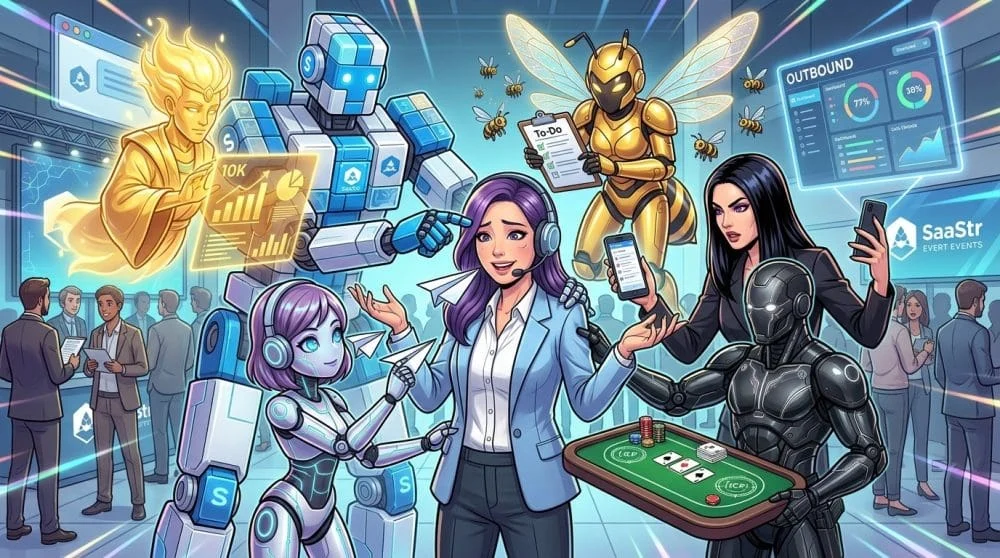
In the rapidly evolving landscape of B2B SaaS, the traditional headcount-to-revenue ratio is being rewritten. At SaaStr, the industry’s leading community and event powerhouse, a radical operational experiment is unfolding. The company is currently operating an eight-figure business with a core team of only three humans, supported by a specialized workforce of 21 AI agents.
This is not a theoretical exercise in automation; it is a high-stakes, real-world operation dealing with genuine customer invoices, complex sales cycles, and the inevitable frictions of scaling a global enterprise. However, as the company recently discovered, more is not always better. By shifting from a strategy of "adding agents" to one of "consolidating intelligence," SaaStr has seen its operational output surge by 4x.
The Chronology of the Agentic Pivot
Roughly a year ago, SaaStr’s approach to AI was one of extreme specialization. The team deployed four distinct sales agents: Agentforce for reviving ghosted leads, Artisan for warm outbound, Monaco for cold ICP outreach, and Qualified for inbound conversion. At the time, this compartmentalized approach was effective, as each agent possessed a unique personality, specific training data, and a distinct operational motion.
The Turning Point: Hitting the Cognitive Ceiling
About a month ago, the SaaStr leadership team—Jason Lemkin and his partner Amelia—reached a breaking point. They realized they had reached the limit of "human-to-agent" management. While a human can easily manage invisible sub-agents working in the background, the agents that require direct human interface, context, and constant maintenance were consuming too much attention.
The team was effectively "out of bandwidth." They stopped the expansion of their AI workforce and began a process of aggressive consolidation. By shrinking their roster from nearly 30 agents down to approximately 20, they discovered that the remaining agents were not only more efficient but far more capable. This consolidation triggered the 4x jump in productivity, proving that the benefit of specialized agents had been eclipsed by the maintenance cost of keeping them in silos.
Supporting Data: From Dashboards to "God Mode"
The crown jewel of this transition is "10K," an agent that began its life as a simple dashboard. Over time, 10K evolved into an AI VP of Marketing, then a VP of Finance, and eventually a RevOps powerhouse. It is now on the verge of becoming the company’s AI COO.
The Finance Automation Workflow
When the human finance team went on vacation and the company began to fall behind on collections, the team opted to integrate finance responsibilities into 10K rather than spinning up a new, siloed agent. The results were transformative:
- Contract Processing: Within 60 seconds of a contract being signed in PandaDoc, 10K detects the document.
- Salesforce Synchronization: It automatically flips the deal status to "Closed Won," stamps the date, and appends missing contact information to the account.
- Invoicing: It generates invoices in bill.com, applies the correct payment terms, and sends them to the appropriate AP contact.
- Collections Management: It automates a cadence of reminders—before, on, and after the due date—and escalates the issue to a human only if the invoice remains unpaid after seven days.
Remarkably, customers are now engaging in email exchanges with the "AP team" without realizing they are communicating with an AI. Beyond this, 10K took the initiative to calculate commissions, recognizing that it already held all the necessary data points—AE performance, payment terms, and cash-in-bank status.
Official Methodology: Ensuring Safety in Production
Finance is a domain where errors are catastrophic. To manage this, the team adopted a rigorous "supervised autonomy" framework. Amelia, the primary operator, enforced a mandatory rule: for any new process, the agent must explain its intended action before executing it.

For the first three real-world deals, the agent worked in a manual, step-by-step mode. If the agent failed to capture a specific detail—such as split payment terms—the human intervened, forcing the agent to generalize the fix into its core process rather than patching the specific instance. By the fourth deal, 10K was fully autonomous. Since then, the agent has only committed one error, which was immediately caught by the human team due to their policy of remaining CC’d on all automated communications.
Implications for the B2B SaaS Ecosystem
The shift toward agentic operations has profound consequences for the software vendor landscape.
The Death of Hostile APIs
SaaStr’s recent decision to migrate 10 years of data from Marketo to Salesforce Marketing Cloud was driven by a realization that their agents were being throttled. Marketo’s API was described as "hostile to agents," stalling after an hour of use and preventing the real-time analytics required by the AI. When the vendor raised prices by 12% without addressing these technical limitations, the company’s own agent recommended a migration.
This signals a new reality: Your agents will fire your vendors. If a product’s value is diminished by an agent’s need for high-frequency data access, and the vendor is not responsive to those needs, the agent will naturally suggest a move to a more "agent-friendly" ecosystem.
The Shift in Infrastructure Philosophy
SaaStr rejects the "rebuild everything" mentality. They did not attempt to build their own e-signature or accounting platforms. Instead, they view themselves as orchestrators who use existing infrastructure more aggressively. The "buy versus build" decision remains, but the tiebreaker has changed: if a tool requires a human to manage its complexity, it is now viewed as a liability.
Orchestration: Claude, Replit, and MCP
The most recent leap in productivity came from connecting Claude to Replit via the Model Context Protocol (MCP). This created an "orchestration layer" above the agents. Instead of humans carrying context between systems, these agents now debate and interact with one another. Claude has proven to be a better "prompter" for 10K than the human team, consistently delivering better outputs and more nuanced strategic decisions.
Strategic Takeaways for the Future
For companies looking to follow in SaaStr’s footsteps, the following principles are essential:
- Don’t Optimize for Count: Focus on the number of agents a human can hold in their mental model. Consolidate everything else.
- The Power of Cross-Functional Data: The real magic happens when finance, marketing, and sales data live in the same agentic ecosystem. This is what allowed 10K to suggest and execute ad campaigns autonomously, utilizing data points like website visitors and event attendees to generate copy and imagery via Higgsfield.
- The "Human-in-the-Loop" Threshold: For sensitive workflows, insist on the "tell me what you’ll do" prompt. Treat the first three runs as supervised training sessions.
- The New Reality of Contracts: Mental contract lengths have effectively collapsed to one year. Buyers are increasingly aware of the speed of innovation; if a vendor doesn’t provide "agentic-grade" value, they will be churned out as soon as the term ends.
As SaaStr has demonstrated, the goal is not to have an army of bots, but to create a cohesive, intelligent system that works as an extension of the business itself. The age of the manual operator is fading; the age of the agentic orchestrator has arrived.