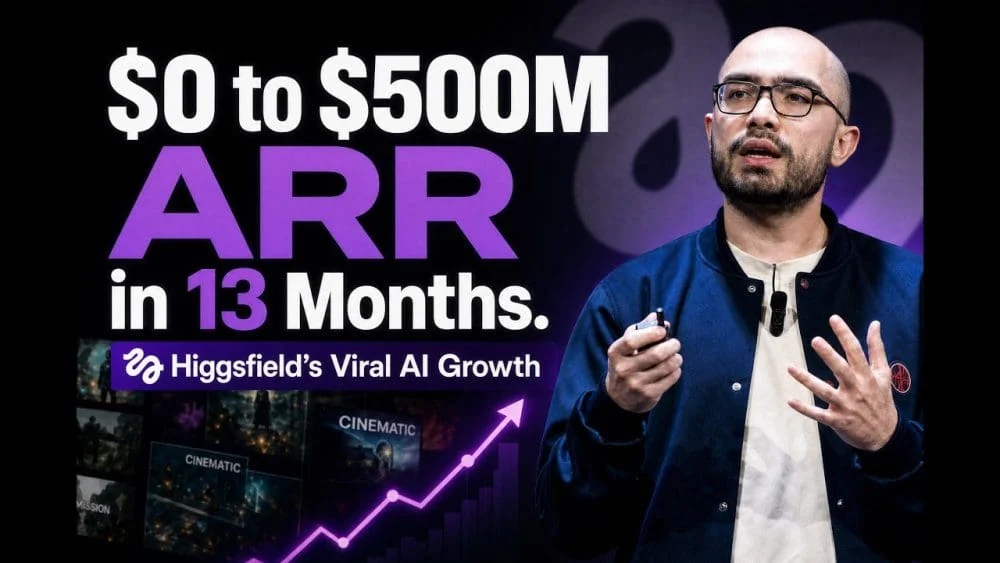
In the fast-moving world of generative AI, where "unicorn" status is often achieved on the back of hype cycles and speculative valuations, Higgsfield has emerged as a rare breed of company: one that prioritizes raw, functional utility over vanity metrics. In just 15 months, the platform has surged from a standing start in March 2025 to an annualized revenue run rate (ARR) of $500 million. As of mid-2026, the company is reportedly in discussions to raise capital at a $5 billion valuation—a trajectory that has left even the most seasoned industry observers stunned.
But Higgsfield is not merely an AI success story; it is a case study in ruthless, user-centric iteration. By transitioning from a proprietary model-builder to a high-powered aggregation engine, and by shifting its focus from simple creative tools to complex, agentic marketing workflows, Higgsfield has redefined what it means to be a modern software company in the post-LLM era.
The Chronology of a Meteoric Rise
The company’s origins are rooted in the experience of co-founder and CEO Alex Mashrabov. Having previously led generative AI efforts at Snap following the $166 million acquisition of his previous venture, AI Factory, Mashrabov arrived at the startup scene with a deep understanding of the intersection between computer vision and user engagement.
Higgsfield did not exist before March 2025. By the end of that year, the company had reached a $200 million ARR—a pace of growth that defies traditional SaaS benchmarks. When Mashrabov sat down for a candid interview at the recent SaaStr event, the company was tracking at a $300 million run rate. A mere 60 days later, that figure had climbed to $500 million.
This growth hasn’t been a linear climb but a series of deliberate, often radical, reorientations. Mashrabov admits that the product currently used by the vast majority of the company’s customer base bears little resemblance to the initial launch version. The company has pivoted three times in its short life, each time abandoning a "darling" feature set to follow the actual behavior of their power users.
Data-Driven Efficiency: $500M on 150 Heads
Perhaps the most startling metric regarding Higgsfield is its lean organizational structure. With a total headcount of approximately 150 people—split evenly between engineering and a creative/product team—the company maintains a level of operational efficiency rarely seen at this scale.
The Engineering-Creative Feedback Loop
While many AI startups lean heavily on prompt engineers, Higgsfield has taken a different approach. Mashrabov intentionally paired his 60-strong core engineering team with over 70 professional filmmakers, advertisers, and creative directors. This isn’t just for marketing; it is the core of their product development cycle.
Every asset Higgsfield produces is generated on its own platform. If a model fails to deliver professional-grade lighting or camera movement, the creatives immediately flag the defect. The engineers then fix the model, not based on theoretical benchmarks, but on the practical reality of commercial production. This tight loop is the primary reason the company has achieved an estimated $5 million in ARR per engineer—two to three times the industry average for large-scale software companies.
The Shift to Professional-Grade Stability
Mashrabov is candid about the limitations of the "move fast and break things" mentality. As the company scaled toward the half-billion-dollar mark, the "vibe coding" approaches that helped them ship features in 2025 became insufficient. The company had to shift its focus toward deep infrastructure, security, anti-fraud measures, and, most importantly, reliability. "Speed gets you to $50M," Mashrabov notes. "Craftsmanship keeps you there."
The Pivot to Aggregation: Why "Model-Agnostic" Wins
Higgsfield’s initial strategy involved launching its own proprietary video model. However, the team quickly realized that the pace of innovation in the AI space made this a strategic liability. With new, superior models arriving from research labs almost weekly, tethering their success to a single internal model proved to be a "losing game."
The "Thin Wrapper" Fallacy
Critics often dismiss companies like Higgsfield as "thin wrappers"—interfaces built atop foundation models that the company does not own. Mashrabov rejects this framing entirely. He argues that in the coming years, almost every software company will rely on models it does not own. Therefore, the "moat" is not the model itself; it is the platform’s utility.
By allowing users to run Google Veo, Kling, Seedance, and Higgsfield’s own models side-by-side, the company has transformed itself into an intelligent traffic controller. The platform selects the best model for a specific use case, shielding the user from the complexity of the underlying tech stack. This, combined with deep integration into ad networks through their new "Supercomputer" marketing agent, creates a sticky, network-effect-driven ecosystem similar to the trajectory of Figma or Canva.
Financial Architecture and Market Penetration
Higgsfield’s financial health is underpinned by an Average Customer Value (ACV) that is significantly higher than that of its peers. While a standard seat in a platform like Canva might cost a user $200 annually, Higgsfield commands upwards of $1,000 per user.
Moving Up-Market
The reason for this premium is simple: Higgsfield is not just a creative tool; it is a budget-replacer. When a customer uses Higgsfield to generate a professional video in 60 seconds, they aren’t just saving time—they are potentially replacing a multi-thousand-dollar agency contract.
Currently, 40% of the platform’s revenue is derived from high-level workflows—specifically their cinema and marketing studios. As companies see the ROI of these $10,000 experiments against their million-dollar marketing budgets, the upsell path from a "raw model user" to an "agentic workflow user" becomes almost automatic.
The Agency Paradox
Perhaps the most surprising demographic for Higgsfield is that 70% of its revenue comes from creative agencies. Rather than fearing AI, these agencies are using Higgsfield to become radically more efficient. By automating the production of variations, lighting adjustments, and actor swaps, agencies can now handle projects that once required full production crews.
Mashrabov notes that for larger agencies, Higgsfield is not a threat to their core business—which is media buying and consulting—but a tool to supercharge their output. The launch of the "Supercomputer" marketing agent marks the next phase, where the platform helps agencies not just create the content, but deploy and track it across global ad networks.
Defining Revenue in the Age of AI
One of the most contentious topics in the AI industry is the definition of "run rate." Many startups inflate their numbers with marketing credits or non-recurring discounts. Mashrabov has taken a hardline stance on transparency.
Higgsfield’s ARR is calculated by summing annual subscriptions, monthly recurring revenue, and four weeks of on-demand usage, then multiplying by 12. It is strictly recognized revenue—not speculative cash flow. By being this transparent, Mashrabov hopes to set a new standard for AI reporting, even suggesting that the company may soon share real-time Stripe dashboards to silence critics and skeptics.
Implications for the Future of Building
The Higgsfield story serves as a blueprint for the "second wave" of AI startups. The era of building a company solely on the strength of a proprietary model is fading; the era of building the "interface for outcomes" is just beginning.
The core lessons from Higgsfield’s 15-month journey are clear:
- Product-Market Fit is a Moving Target: Be prepared to pivot the entire company based on usage data, not roadmaps.
- Efficiency is the Ultimate Moat: A small, highly skilled team that integrates domain experts (filmmakers, in this case) into the engineering process will always outpace a larger, more bureaucratic organization.
- Pricing for Value, Not Seats: Move away from per-seat SaaS models and toward pricing that reflects the cost of the agency or contractor you are replacing.
- Stability over Speed: Once you hit the $50 million mark, the premium shifts from "can you do this?" to "can you do this reliably, safely, and at scale?"
As Higgsfield continues to expand, it stands as a testament to the fact that while AI models are the engine, the true value—and the true power—lies in the craftsmanship of the interface and the ability to solve, rather than just facilitate, the business problems of the user.