Main Facts
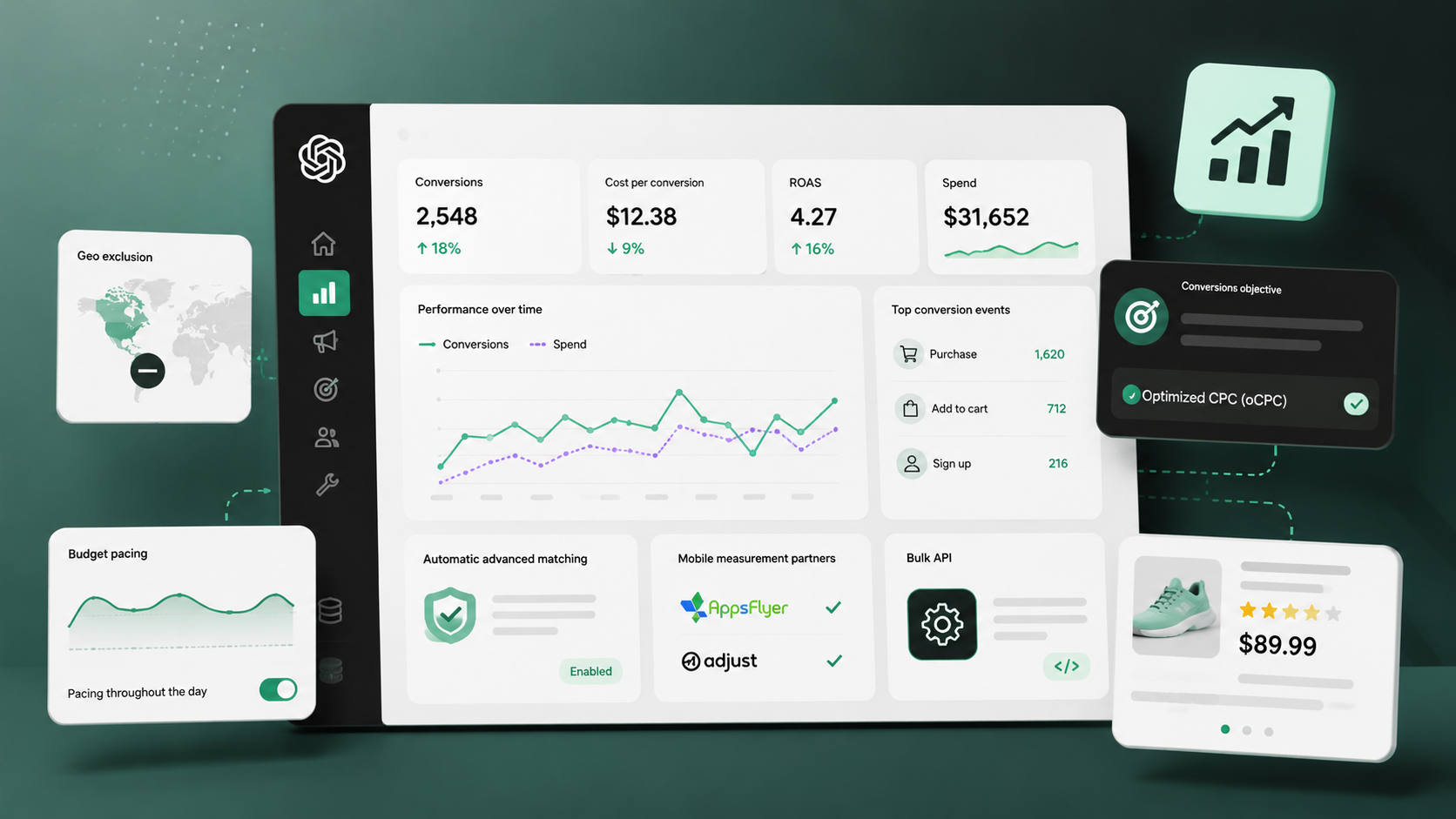
In a significant move to mature its digital advertising infrastructure, OpenAI has rolled out a comprehensive suite of new advertiser tools for its ChatGPT Ads platform. The update focuses on four critical pillars of modern performance marketing: smarter bidding, improved measurement, sophisticated budget pacing, and scalable campaign management.
Historically viewed as an experimental channel for early adopters, ChatGPT Ads is rapidly transitioning into a robust performance-driven ecosystem. The latest updates introduce highly requested capabilities designed to bridge the functional gap between OpenAI’s conversational interface and established digital advertising giants like Google Ads and Meta Ads.
The core features introduced in this release include:
- Conversion-Optimized Bidding: Moving beyond simple click-based optimization to target high-value user actions.
- Mobile Measurement Partner (MMP) Integrations: Seamless attribution tracking through industry-standard platforms AppsFlyer and Adjust.
- Advanced Budget Controls: The introduction of average daily budgets and sophisticated pacing algorithms to stabilize ad delivery.
- Enterprise-Grade Scalability: Bulk API support and advanced matching capabilities to facilitate large-scale, automated campaign management.
- Granular Targeting Controls: Enhanced geographic exclusions to prevent ad waste and improve localized relevance.
By delivering these features, OpenAI is directly addressing the primary pain points of performance marketers, making ChatGPT Ads a highly viable, scalable, and measurable acquisition channel.
Chronology: The Evolution of OpenAI’s Advertising Ecosystem
To understand the significance of this update, it is essential to trace the rapid trajectory of OpenAI’s monetization and advertising strategy from a subscription-only model to a sophisticated ad tech platform.
[Late 2022] ChatGPT Launches -> [2023] Subscription Model & API Monetization -> [Mid 2024] SearchGPT Beta & Contextual Ad Testing -> [Late 2025] Launch of ChatGPT Ads -> [Present (2026)] Performance Era: Bidding, APIs, & MMP IntegrationsPhase 1: The Subscription and API Foundation (2022–2023)
When ChatGPT launched in late 2022, OpenAI initially focused on direct-to-consumer monetization through its ChatGPT Plus subscription tier. This was quickly followed by the commercialization of its API, allowing developers to build custom applications on top of GPT-3.5 and GPT-4. At this stage, advertising was not publicly on the horizon, as the company prioritized user growth and model refinement.
Phase 2: The Emergence of SearchGPT and Contextual Placements (2024–2025)
As Microsoft integrated Bing search into Copilot and Google launched AI Overviews, OpenAI recognized the necessity of real-time information retrieval. The testing of SearchGPT in 2024 marked OpenAI’s entry into the search market. This shift naturally opened the door for native, contextual advertising. Early experiments involved displaying sponsored links and brand recommendations directly within conversational responses, matching commercial intent in real-time.
Phase 3: The Launch of ChatGPT Ads (Late 2025)
OpenAI officially formalized its advertising network under the "ChatGPT Ads" brand. The initial platform allowed basic keyword and contextual targeting, primarily optimized for clicks (CPC). While the reach was massive due to ChatGPT’s hundreds of millions of active users, sophisticated performance marketers hesitated to shift significant budgets to the platform due to a lack of robust attribution, automated bidding, and bulk management capabilities.
Phase 4: The Performance Era (Present)
The current release represents the maturity phase of ChatGPT Ads. By integrating with third-party attribution platforms, enabling API-driven bulk management, and shifting the optimization focus from clicks to downstream conversions, OpenAI has officially entered the performance marketing arena, positioning itself to capture market share from traditional search and social ad networks.
Supporting Data: A Deep Dive into the New Feature Suite
The latest update is not characterized by a single, flashy consumer-facing feature; instead, it introduces foundational ad-tech infrastructure that performance marketers rely on to drive return on ad spend (ROAS).
1. Conversion-Optimized Bidding
Until now, advertisers on ChatGPT Ads were largely limited to optimizing for impressions or clicks. The introduction of conversion-optimized bidding allows advertisers to feed downstream conversion data back into OpenAI’s machine learning algorithms.
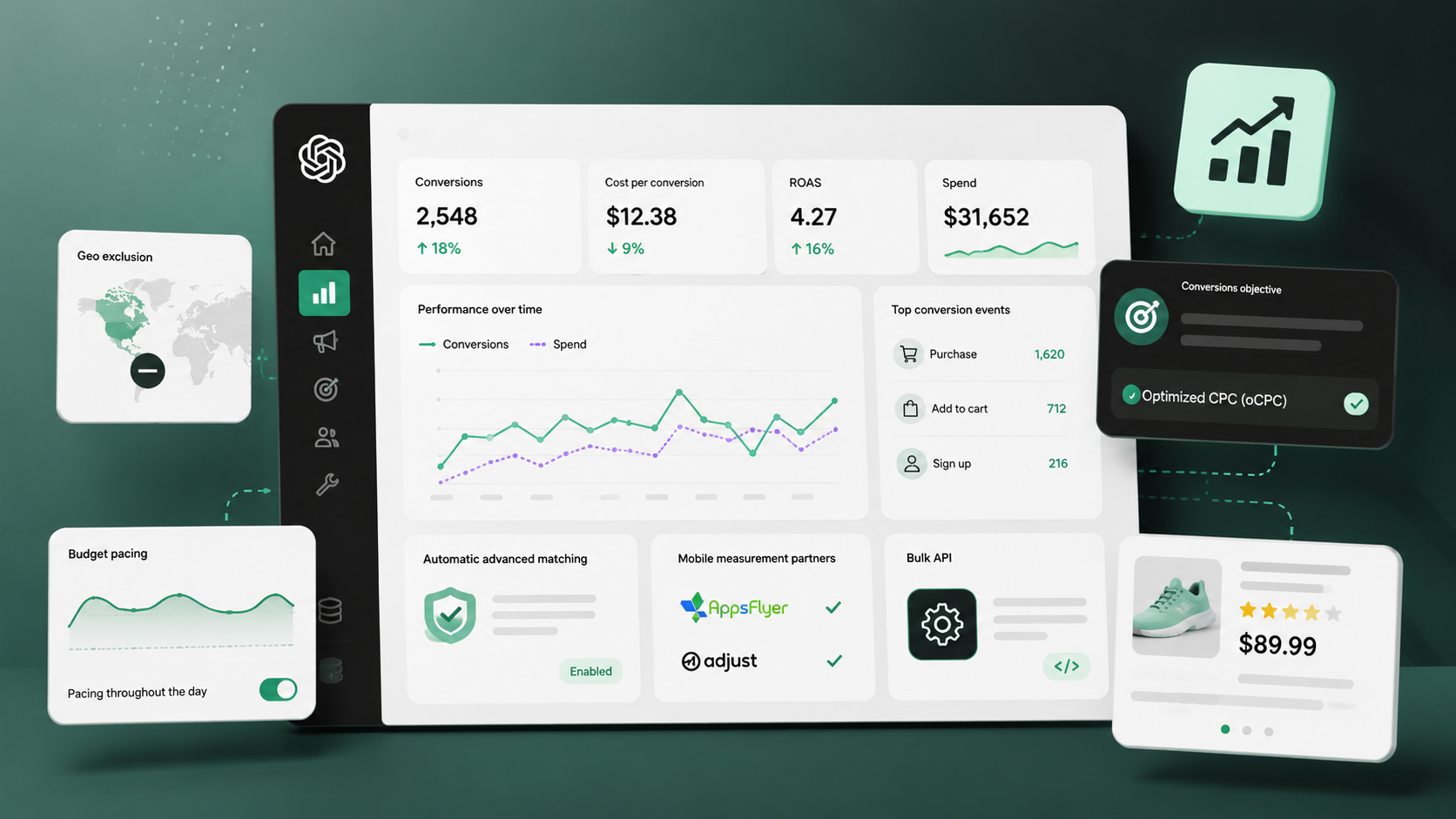
[User Query] -> [Ad Displayed] -> [Click] -> [On-Site Action (Purchase/Sign-up)] -> [Conversion Data Fed to OpenAI] -> [Algorithm Optimizes Future Placements]The algorithm analyzes the conversational context, user intent signals, and historical performance to predict the likelihood of a user completing a specific action (such as a purchase, lead form submission, or app download). This brings ChatGPT Ads in line with Google’s Smart Bidding and Meta’s Advantage+ bidding systems.
2. Third-Party MMP Integrations: AppsFlyer and Adjust
For mobile app marketers, attribution is the lifeblood of campaign optimization. Without third-party verification, calculating the cost per install (CPI) or return on ad spend (ROAS) is nearly impossible. By integrating natively with AppsFlyer and Adjust, ChatGPT Ads now allows mobile advertisers to:
- Track app installs originating from conversational ad placements.
- Measure in-app events (e.g., registrations, purchases, tutorial completions).
- Utilize deterministic and probabilistic modeling to attribute conversions accurately while maintaining user privacy compliance.
3. Budget Pacing and Average Daily Budgets
In the early iterations of ChatGPT Ads, budget delivery could be highly volatile. A sudden surge in user queries related to a specific topic could exhaust an advertiser’s budget within hours.
The introduction of average daily budgets stabilizes this process. The system now dynamically paces delivery across a 24-hour cycle, allowing for minor fluctuations (up to 20% overspend on high-traffic days, offset by underspend on slower days) to ensure optimal delivery and prevent premature campaign exhaustion.
4. Bulk API Support and Advanced Matching
For agencies and enterprise advertisers managing hundreds of campaigns simultaneously, manual dashboard management is a bottleneck. The new Bulk API support allows programmatic campaign creation, bid adjustments, and creative updates.
Furthermore, Advanced Matching capabilities allow advertisers to securely upload hashed first-party customer data (such as email addresses or phone numbers) to match against ChatGPT’s user base, enabling highly targeted remarketing and lookalike audience generation.
5. Geographic Exclusions
While basic geographic targeting was previously available, the addition of geo exclusions gives advertisers granular control over where their ads do not appear. This is highly beneficial for businesses operating under strict regional regulatory frameworks (e.g., financial services, healthcare) or those with localized distribution networks.
Industry Perspective and Market Response
While OpenAI has kept official press commentary highly focused on technical specifications, the digital marketing industry has reacted with a mix of enthusiasm and strategic calculation.
Performance marketing agencies, which have long been looking for a viable alternative to the Google-Meta duopoly, view these updates as a turning point.
"For the past year, ChatGPT Ads was a ‘nice-to-have’ experimental channel for our clients," says a Director of Paid Media at a leading global performance agency. "We could drive cheap traffic, but we couldn’t prove bottom-funnel business outcomes. With conversion-optimized bidding and MMP integrations, we can now justify shifting mid-to-high six-figure monthly budgets from Google Search to ChatGPT."
However, industry analysts note that OpenAI still faces challenges regarding ad inventory transparency. Unlike traditional search engines where ads are tied to static keywords, ChatGPT ads are generated dynamically within fluid, multi-turn conversations. Marketers are eager to see how OpenAI balances user experience with ad density, as over-commercializing the conversational interface risks alienating the platform’s core user base.

Implications: Reshaping the Digital Advertising Landscape
The maturation of ChatGPT Ads has profound implications for the broader digital marketing ecosystem, threatening established players and redefining how brands interact with consumers.
| Feature / Capability | Google Ads | Meta Ads | ChatGPT Ads (New) |
|---|---|---|---|
| Primary Targeting | Keyword Intent | Behavioral & Demographic | Conversational & Contextual Intent |
| Bidding Optimization | Smart Bidding (tCPA, tROAS) | Value-Based Bidding | Conversion-Optimized Bidding |
| Attribution | Google Analytics / Custom | Meta Pixel / Conversions API | Native + AppsFlyer / Adjust |
| Management Interface | UI, Editor, Robust API | UI, Ads Manager, API | UI, Bulk API |
1. The Threat to Google’s Search Monopoly
Google’s search dominance is built on the high-intent nature of search queries. When a user searches for "best CRM software," they are actively looking to buy. ChatGPT, however, captures this intent at an even deeper level.
Instead of just presenting a list of links, ChatGPT synthesizes information, answers follow-up questions, and guides the user through the research process. By placing highly targeted, conversion-optimized ads within this synthesis phase, OpenAI can intercept high-intent buyers before they ever visit a traditional search engine.
2. The Shift from Keywords to "Intent Streams"
Traditional PPC relies on bidding on specific keywords. ChatGPT Ads, however, operates on "intent streams." The conversational AI understands the semantic context of an entire conversation, not just the last typed query.
With the new advanced matching and conversion tools, advertisers can target users based on the complexity of their problem. For example, an ad for tax software can be triggered not just by the word "taxes," but by a user explaining a complex, multi-state freelance income situation to ChatGPT.
3. Lowering the Barrier to Entry for AI-Native Startups
By implementing bulk APIs and standardizing budget pacing tools to mirror the workflows of Google and Meta, OpenAI has lowered the cognitive barrier to entry for media buyers. Advertisers do not need to learn an entirely new paradigm of campaign management; they can apply their existing workflows, scripts, and optimization strategies directly to ChatGPT Ads.
4. Privacy-First Performance Marketing
As third-party cookies continue to deprecate, OpenAI’s first-party data ecosystem becomes incredibly valuable. Because users voluntarily share detailed, contextual prompts with ChatGPT, the platform possesses highly accurate, real-time intent data without relying on invasive cross-site tracking. The addition of advanced matching allows brands to leverage this contextual goldmine while maintaining compliance with modern privacy standards.
Conclusion
With this latest update, OpenAI has signaled that it is no longer content with being an experimental line item in marketing budgets. By introducing conversion optimization, third-party measurement integrations, and enterprise-scale management tools, ChatGPT Ads has transitioned into a legitimate performance marketing platform.
As digital advertisers look to diversify their spend away from traditional search and social channels, OpenAI’s rapidly maturing ad ecosystem is uniquely positioned to capture a significant share of global ad revenue.