In a modern world defined by high-performance, fuel-efficient transportation, the choice to rely on horse-and-buggy logistics would be considered absurd. Yet, in the high-stakes arena of digital advertising, a surprising number of marketers continue to operate with a "horse-drawn" mentality. They remain tethered to the manual labor of the legacy AdWords era, ignoring the sophisticated, AI-driven engines that now power the global digital economy.
The reality is stark: Google Ads has fundamentally changed. The platform is no longer a collection of levers and knobs for human operators to tweak; it has evolved into a self-optimizing, machine-learning ecosystem. For professionals clinging to manual bidding, granular match-type segmentation, and obsessive daily account adjustments, the message is clear: the choice to stay in the past is no longer an option.
The Paradigm Shift: From Manual Micromanagement to AI-Driven Strategy
For years, the professional "Search Marketer" was defined by their ability to manipulate match types, geo-targeting, negative keyword lists, and time-of-day bidding. Agencies built their value propositions on the frequency of account changes, positioning constant manual intervention as a badge of expertise. Today, this approach is not just outdated; it is actively profit-pulverizing.
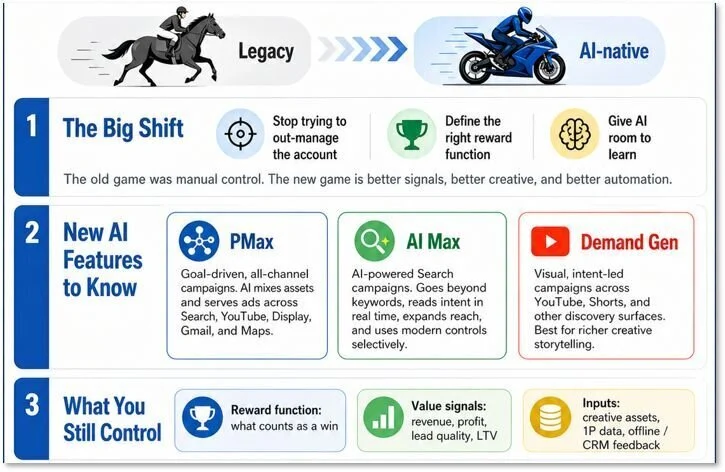
Modern performance marketing has shifted toward an "embrace and extend" strategy. By leveraging the vast computational power of AI, advertisers can achieve superior outcomes with significantly less manual input. Google’s current suite of tools—including Performance Max (PMax), AI Max, and Demand Gen—represent a fundamental departure from the past. Instead of managing individual keywords, marketers are now tasked with managing the "reward function."
In this new era, your role is to provide the AI with the right goals, high-quality creative assets, and accurate business value data. The AI then synthesizes these inputs, analyzing intent signals across Search, YouTube, Display, Gmail, and Maps to deliver ads where they are most likely to convert.
A Brief History of the Transition: The Rise of the Machine
The "AIfying" of Google Ads did not happen overnight, but it has accelerated at a pace that has left many agencies reeling.
- The AdWords Era (Pre-2015): The golden age of human control. Success was measured by "Quality Score" and the ability to find "long-tail" keyword opportunities manually.
- The Automation Inflection Point (2015–2020): The introduction of Smart Bidding and machine-learning-driven targeting. Advertisers began to see that algorithms could process more data points than any human analyst.
- The AI-Native Present (2021–Present): The birth of PMax and AI Max. The platform began to move beyond keyword-based intent to holistic intent analysis. "Brand" vs. "Non-brand" distinctions began to dissolve as the AI focused on the singular metric of business value.
The Core AI Offerings: Understanding the New Ecosystem
To survive this transition, professionals must master the tools that currently define Google’s infrastructure.
1. Performance Max (PMax)
PMax is Google’s "do-everything-everywhere" solution. By providing the AI with a budget, specific goals, and a library of assets (text, images, videos, and logos), the system handles the heavy lifting of multi-channel distribution. It is a radical departure from siloed campaigns, allowing the AI to optimize for the most efficient conversion path across the entire Google ecosystem.
2. AI Max
Designed specifically for search, AI Max discards the legacy obsession with match types. It operates in real-time, assessing intent far beyond the literal keywords typed by a user. By analyzing context and intent signals, it captures relevant traffic that traditional, keyword-limited campaigns would miss.
3. Demand Gen
Formerly known as Discovery ads, Demand Gen utilizes AI to deliver visual content across high-impact placements like YouTube Shorts, YouTube, and the Discover feed. It acts as an engine for demand creation rather than mere demand fulfillment, utilizing the AI’s ability to match video assets to the right user at the right moment.
Maturity Assessment: Are You a Tourist in the Present?
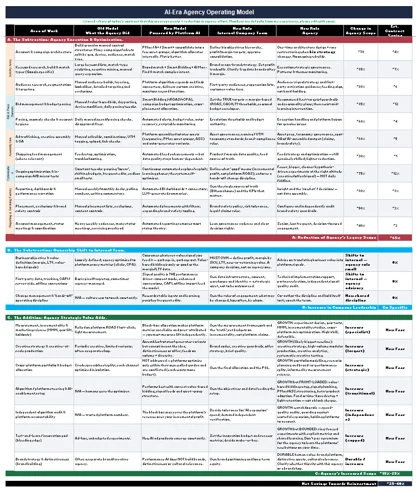
To determine whether an organization is truly AI-native or merely pretending, experts have developed maturity models that measure "Capability" and "Depth."
The Scoring Framework
- Capability (0-4): Measures the sophistication of your practices.
- 0 (Legacy): Manual bidding and archaic structures.
- 4 (AI-Native): Full integration of automated systems and advanced value signals.
- Depth (0-4): Measures how widespread your adoption is across the account.
- 0 (None): Zero adoption.
- 4 (Execution Default): 75%–100% of the budget is managed via AI-native processes.
The objective is to achieve a score of 85 or higher. Organizations that continue to optimize for "traffic" or "sessions" rather than "business value" are failing to leverage the core strength of modern AI: its ability to connect ad spend directly to profitability.
Measurement and Value: The Foundation of Success
If your measurement architecture is built on sand, no amount of AI-driven optimization will save you. The most critical dimension of the new maturity model is Measurement & Value Architecture.
AI is only as good as the "reward function" it is given. If you optimize for low-quality leads, the AI will deliver low-quality leads with terrifying efficiency. To succeed, companies must transition to:
- Enhanced Conversions: Providing the system with better data to improve bidding.
- Offline Conversion Imports: Connecting CRM data to Google Ads to ensure the AI knows what a "closed-won" deal looks like.
- Value-Based Bidding: Moving away from volume-based targets to profit-based targets.
When an organization stops obsessing over CPC (Cost Per Click) and starts focusing on LTV (Lifetime Value) or Profit, they finally start playing the game as it is meant to be played today.
Implications for the Workforce
The shift to AI-native advertising has significant implications for both agencies and in-house teams. The "soul-sucking" work of manual bid adjustment and keyword pruning is being automated away. While some fear this as a threat to their employment, it is actually an invitation to evolve.
The new marketer is a strategist. They are responsible for:
- Feed Quality: Ensuring the machine has the cleanest data possible.
- Creative Excellence: Providing the AI with diverse, high-performing visual and text assets.
- Strategic Governance: Defining the business goals and profit targets that guide the machine.
Agencies that insist on proving their worth by "making changes multiple times a day" are doing their clients a disservice. The goal is to provide the system with enough "room to learn." Micromanagement is now the enemy of optimization.
Conclusion: The Path Forward
The transition to AI-native advertising is not merely a technical upgrade; it is a cultural and professional evolution. It requires moving past the ego of the "expert operator" and embracing the role of the "architect of intent."
While AI will make mistakes—it is not perfect—it is consistently, demonstrably, and exponentially better than the manual methods of the past. The occasional misstep by an algorithm is a small price to pay for the ability to scale growth at a level previously thought impossible.
For those ready to move past the horse-and-buggy days of legacy AdWords, the rewards are substantial. By feeding the machine better truth, better assets, and better goals, organizations can unlock significant revenue growth. The future belongs to those who stop trying to out-manage the auction and start empowering the machine to win it for them. Carpe diem.