By the Editorial Team
Published in B2B Strategy & Insights
Main Facts: The Anatomy of Modern B2B Stalling
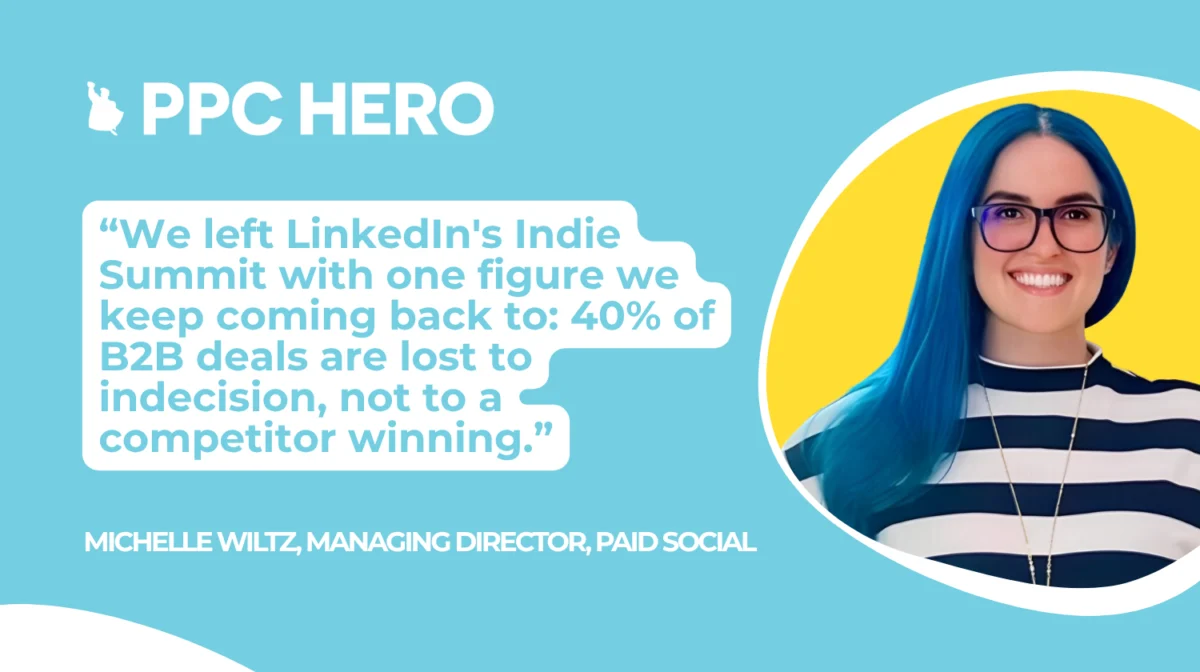
For years, the conventional wisdom of B2B marketing has revolved around a singular objective: find the decision-maker, deliver a compelling product comparison, highlight competitive advantages, and drive a conversion. However, fresh insights emerging from recent industry gatherings—such as LinkedIn’s Indie Summit—suggest that this foundational playbook is fundamentally broken.
The core issue is no longer about losing head-to-head battles against direct competitors. Instead, 40% of B2B deals are lost entirely to indecision.
When a deal fails to close, the knee-jerk reaction from marketing and sales leaders is to diagnose it as a product defect or a pricing mismatch. In reality, it is usually neither. The modern B2B buying committee has grown exponentially. On average, a enterprise buying group consists of roughly ten distinct stakeholders—including the Chief Marketing Officer (CMO), Chief Financial Officer (CFO), information security leads, department heads, and procurement specialists.
Each stakeholder enters the evaluation process with a unique set of priorities, risk tolerances, and internal metrics for success. When none of these stakeholders are actively opposed to your solution, but none are entirely convinced either, the deal does not pivot to a competitor. It simply flatlines.
Traditional B2B marketing campaigns are woefully ill-equipped for this dynamic. They are engineered to persuade one person, differentiate from rivals, and push a fast conversion. While that approach works when a single executive holds total budgetary power, it completely falls apart when ten skeptical professionals must independently—and collectively—reach a shared level of confidence, often without ever speaking directly to a sales representative.
Chronology: How the B2B Buying Journey Evolved
To understand how we arrived at this era of pervasive deal indecision, it helps to look at how corporate purchasing behavior has shifted over the past decade.
Phase 1: The Sales-Led Era (Pre-2015)
Historically, the B2B buyer’s journey was linear and heavily reliant on vendor interaction. Potential buyers would identify a pain point, issue requests for proposals (RFPs), and invite sales reps in early to educate them on capabilities. Marketing served primarily to generate top-of-funnel leads, leaving the heavy lifting of education and consensus-building to the sales force.
Phase 2: The Digital Content Explosion (2015–2020)
As the internet matured, buyers began conducting independent research online. White papers, eBooks, and gated case studies became the currency of B2B marketing. Companies built extensive content hubs designed to capture email addresses and funnel individual prospects into automated email sequences. Yet, these campaigns still largely targeted a singular "Buyer Persona"—treating a complex organization as if it were a single individual.
Phase 3: The AI and Committee-Driven Reality (Present Day)
Today, the buying landscape has fractured into a decentralized, anonymous group dynamic. According to data shared at LinkedIn’s recent industry events, 94% of B2B buyers now utilize Large Language Models (LLMs) and AI-driven search tools somewhere in their purchasing process.
Before a vendor’s marketing campaign ever reaches a prospective committee member, that committee has already utilized generative AI to map out the category, compare vendor lists, and formulate preliminary opinions. They arrive at your digital doorstep armed with preconceived notions, technical queries, and a healthy dose of organizational skepticism. Consequently, traditional consideration content—which focuses heavily on why "Brand A is better than Brand B"—has lost its edge, because the buyer has often already run those comparisons independently.
Supporting Data: The Metrics Rewriting the B2B Playbook
As modern marketing teams grapple with committee indecision, empirical data is pointing toward new formats, distribution channels, and creative strategies required to break through the noise.
The Rise of AI-Influenced Research
- 94%: The percentage of B2B buyers leveraging LLMs during their procurement research. This means your competitors are no longer just other companies; they are also the generalized summaries generated by artificial intelligence tools.
- 40%: The proportion of B2B transactions lost not to a superior rival, but to organizational paralysis and indecision.
The Power of Video in Consensus Building
When attempting to build institutional trust across a ten-person committee—many of whom will never schedule a demo—written assets fall short. A white paper is typically read by one person and filed away. Video, by contrast, possesses unique scaling properties:

- 1.6x: Members who view video ads are 1.6 times more likely to complete a lead generation form from the same brand compared to static ad viewers.
- 95%: The retention rate associated with video content, which is currently growing at a rate 60% faster than any other format on major professional networks.
- 20% YoY Growth: Agencies that have strategically transitioned their clients toward video-first B2B frameworks are reportedly seeing consistent year-over-year growth, while agencies relying strictly on traditional static banner and text ads remain flat.
Hook Optimization and Mobile Consumption
With 86% of professional network users accessing platforms via mobile devices, B2B creatives must capture attention within seconds on a constrained vertical screen.
- Data indicates a 36% lift in Click-Through Rates (CTR) when video hooks open immediately with a specific, hard-hitting number or statistical insight, rather than a generic brand statement.
- Emerging formats like LinkedIn’s BrandLink have demonstrated a 130% higher video completion rate compared to standard in-feed video placements. Furthermore, Connected TV (CTV) initiatives reach 94% of professional audiences, delivering a 2.6 times stronger brand awareness lift than linear television alternatives.
Official Responses and Industry Perspectives
Industry leaders and platform strategists emphasize that overcoming the indecision crisis requires a fundamental shift in mindset—moving away from promotional bravado and toward radical transparency and risk mitigation.
"When you have ten people in a room—explicitly or implicitly—trying to sign off on a software or service purchase, their primary motivator isn’t actually growth; it’s job preservation and risk avoidance," notes a prominent B2B growth strategist. "The CFO is worried about hidden costs. The security lead is worried about data breaches. The team lead is worried about adoption friction. If your marketing only talks about how fast your product is, you are answering questions nobody is currently asking."
Platform analytics experts echo this sentiment, pointing out that corporate buyers are actively searching for reasons not to buy.
"The brief has fundamentally changed," industry analysts report. "It used to be: ‘Here is why we beat the alternatives.’ Today, the winning brief is: ‘Here is why the specific risk keeping you up at night is not the insurmountable obstacle you think it is.’ That requires a completely different level of empathy and depth in your creative strategy."
Furthermore, marketing practitioners are rethinking production values. While corporate boardrooms historically demanded high-budget, ultra-polished commercial spots, modern B2B buyers often perceive high production value as a sign of inflated pricing or corporate detachment. Conversely, lo-fi clips, behind-the-scenes explainers, and candid team discussions signal authenticity—an invaluable commodity when a cautious committee is assessing whether a vendor is trustworthy enough to partner with long-term.
Strategic Implications: What This Means for Your Next Campaign Brief
If your pipeline is stalling and your close rates are tapering off despite steady lead volume, the root cause is likely structural. Your campaigns may simply be optimized for the wrong era of B2B commerce.
To adapt to the reality of the ten-person buying committee, marketing and demand-generation leaders must implement several key shifts:
1. Shift from Feature Comparison to Risk Mitigation
Stop assuming your audience needs another graphic proving you have more features than your competitors. Assume they already know what you do because they asked an LLM. Instead, build content that directly addresses organizational friction points: implementation timelines, security compliance, change management, and total cost of ownership. Name the elephant in the room before they have to ask about it.
2. Design Content That "Travels" Within the Organization
Because decisions are made collectively, your creative assets must be capable of moving across internal communication channels. A white paper stays trapped in one person’s browser tab. A well-crafted, highly specific video gets dropped into a Slack channel, played at the beginning of a cross-departmental sync, and reviewed by the CFO and procurement lead alike. Optimize your media mix for shareability and multi-stakeholder exposure.
3. Obsess Over the First Three Seconds
With mobile feeds saturated and attention spans compressed, your hook dictates your success. Ditch generic taglines and corporate jargon. Open your campaigns with hard data, counter-intuitive industry truths, or direct acknowledgments of daily operational pain points. If you don’t stop the scroll for the person who is already quietly worried about a specific workflow bottleneck, the rest of the message will never be seen.
4. Reframe Your Core Metric of Success
Before drafting your next campaign brief, ask your team the ultimate diagnostic question:
Are we building campaigns designed to convince one individual, or are we building assets comprehensive and trustworthy enough to get ten people comfortable enough to move forward?
Aligning your messaging around collective consensus-building rather than single-buyer conversion won’t just improve your engagement metrics—it will rescue your pipeline from the quiet killer of modern B2B commerce: organizational indecision.