In the landscape of modern media, sports stands as the final, immutable fortress of synchronous consumption. Last year, nearly every one of the top 50 most-watched telecasts in the United States was tethered to live sports. From the high-stakes drama of the NFL to the spectacle of international soccer, audiences are flocking to live events with a fervor that renders traditional scripted television a secondary consideration. The few exceptions—the 97th Oscars, the SNL 50th anniversary, a 60 Minutes interview, and the 67th Grammys—serve only to prove the rule: in an age of fragmented streaming, live sports remains the only cultural glue binding a splintered nation.
This reality has not been lost on the titans of industry. Streaming giants, once the disruptors of traditional broadcasting, are now aggressive acquirers of sports rights, recognizing that if they want to command attention, they must command the scoreboard. For marketers, this has triggered a gold rush. Budgets are being poured into stadium naming rights, jersey patches, high-production commercials, and exclusive hospitality suites. Yet, amidst the champagne toasts at Augusta National and the handshakes with celebrity athletes, a fundamental question is beginning to haunt the executive suite: For the $38 million we just spent, is this actually moving the needle on our bottom line?
The Paradox of Visibility
The irony of the current sports marketing boom is that brands are often paying a premium for the very environment that makes their message most difficult to convey. Marketing laws do not vanish when a brand enters a stadium; if anything, they become more unforgiving.
If a piece of creative fails to capture attention in the 1.2-second window of a TikTok scroll, it will suffer an even more ignominious fate when plastered on a stadium sideboard. During a match, the sport is the product; the advertisements are, by necessity, a distraction. Unless a brand’s story is as compelling as the game itself, it will be tuned out with clinical efficiency.
Consider the Seattle Seahawks, the Super Bowl champions who have maintained a single, consistent corporate logo on their uniforms for decades. Despite the ubiquity of this placement, most fans would struggle to identify the exact design details under pressure. This highlights the "spike and silence" trap: brands often rely on fleeting moments of exposure, hoping for a halo effect that never materializes because they fail to sustain a narrative long enough to leave an imprint.
The Measurement Evolution: From Vanity to Value
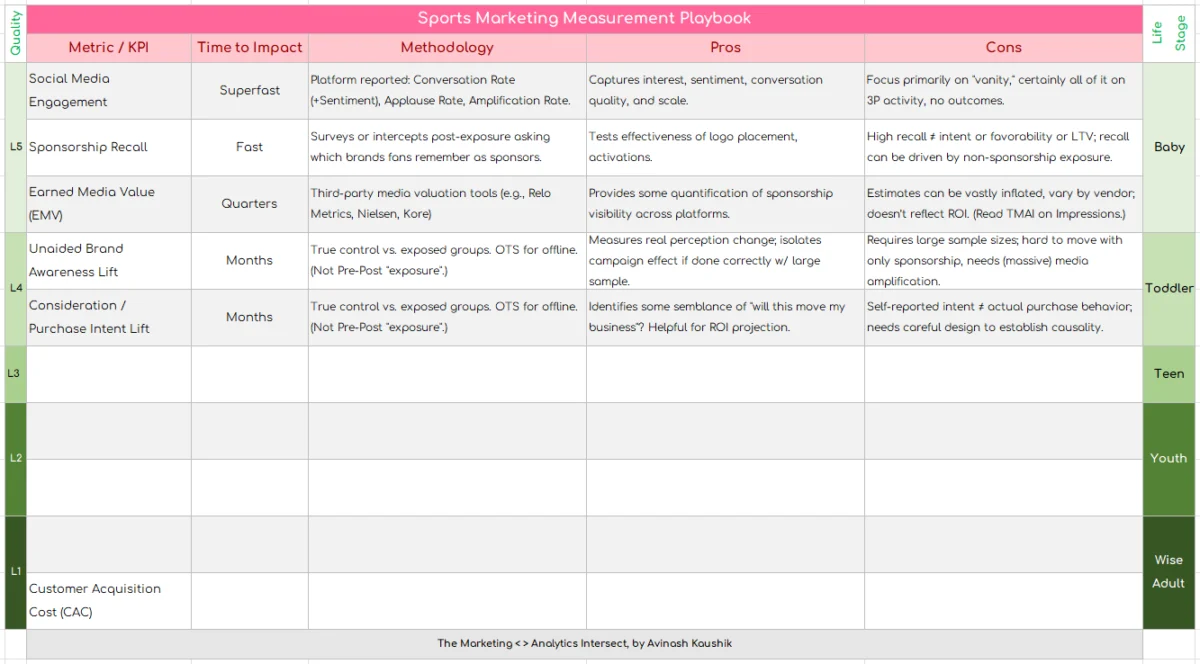
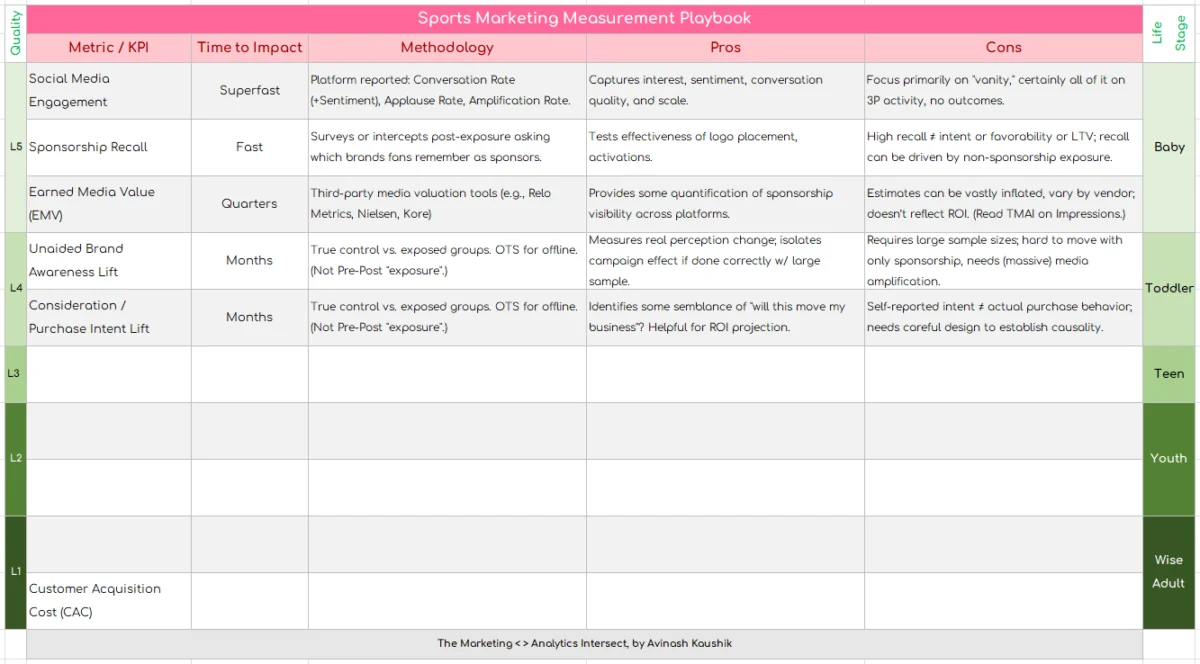
To move beyond the hospitality suite and into the realm of true business intelligence, leaders must transition from "vanity metrics" to "impact intelligence." The following hierarchy represents the five levels of sophistication in measuring sports marketing, moving from the superficial to the definitive.
Level 5: The Opening Gambit (Vanity)
Most organizations begin—and unfortunately, many end—at Level 5. This is the realm of "Big Numbers." Marketers here celebrate "450 million impressions," a metric that measures activity rather than outcome.
- Social Media Engagement: While monitoring conversation and applause rates is useful, it is merely the noise floor.
- Sponsorship Recall: Often relying on flawed, aided-survey methodology ("Did you know we are a sponsor?"), these metrics provide little insight into actual brand affinity.
- Earned Media Value (EMV): Frequently cited as a "con" in the industry, EMV attempts to assign a dollar value to logo placements by equating them to the cost of equivalent ad buys. It is a metric widely discredited by serious analytical professionals because it ignores the quality of the audience and the clutter of the environment.
Level 4: The Quest for Brand Impact
At Level 4, the objective shifts from counting eyeballs to measuring the human mind. This requires a rigorous test-versus-control methodology.
- Unaided Brand Awareness (UBA) Lift: Can the sponsorship move the needle on how people perceive the brand without being prompted? This is a long-term driver of revenue and requires a multi-year commitment to measure effectively.
- Consideration and Purchase Intent: This is where the CFO starts to pay attention. By using propensity score matching to compare exposed audiences against control groups, marketers can finally quantify the shift in consumer sentiment.
The Analytical Framework for Future-Proofing
The path to "Nirvana"—the ability to prove that a sports sponsorship is driving incremental profit—requires three additional, higher-order levels of analysis.
Level 3: The Heart and Mind Influence
At this stage, companies begin to understand the compounding effects of brand advantage. It moves beyond "do they like us?" to "how does our sports partnership influence their decision-making process over time?" This level provides the insights necessary to adjust the creative strategy in real-time, ensuring that the storytelling aligns with the evolving values of the sports audience.
Level 2: The First Digital Trace
Level 2 represents the bridge between perception and action. By utilizing sophisticated tracking, companies can identify specific digital behaviors—website visits, search queries, or newsletter sign-ups—that occur in direct response to sports-related activations. This marks the first time that "brand building" and "direct response" start to inhabit the same analytical space.
Level 1: The Gold Standard (Show Me the Money)
The apex of the pyramid is the measurement of true incrementality. Can you prove that a customer purchased your product because of your presence in the stadium? While the most difficult to achieve, it is the only way to justify the massive capital outlays associated with modern sports sponsorships. By utilizing Multi-Touch Attribution (MTA) and Marketing Mix Modeling (MMM), firms can isolate the specific contribution of the sports program against other market variables.
Implications for the C-Suite
The implications for Chief Marketing Officers are clear: the era of "sponsoring in the dark" must end. If a brand is to invest millions, that investment must be treated with the same scrutiny as a direct-response digital campaign.
- Stop the Short-Termism: Sports marketing is a long-game strategy. Investing for a single season is rarely enough to build the brand equity required to see a financial return.
- Creative Responsibility: Brands must recognize that they are not just buying space; they are borrowing the narrative power of the sport. If the creative is weak, the sponsorship is a waste of capital.
- The "Dirty Little Secret": The most profitable path forward is to acknowledge that if your internal creative team cannot tell a compelling story, you should offload that storytelling to the sport itself. Let the values of the athlete or the team become your brand values, provided you back that partnership with the paid media required to reach the necessary frequency.
Conclusion: Turning on the Lights
Sports marketing remains an immensely effective, often transformative, tool for growth—as evidenced by the enduring success of brands like Rolex in the tennis world. However, effectiveness is not a matter of luck; it is a matter of rigor.
By demanding more from their data, moving from vanity metrics to causal analysis, and treating sports sponsorships as a strategic asset rather than a corporate perk, companies can stop guessing and start growing. The data is available, the methodologies are proven, and the opportunity is waiting. It is time to turn on the lights.