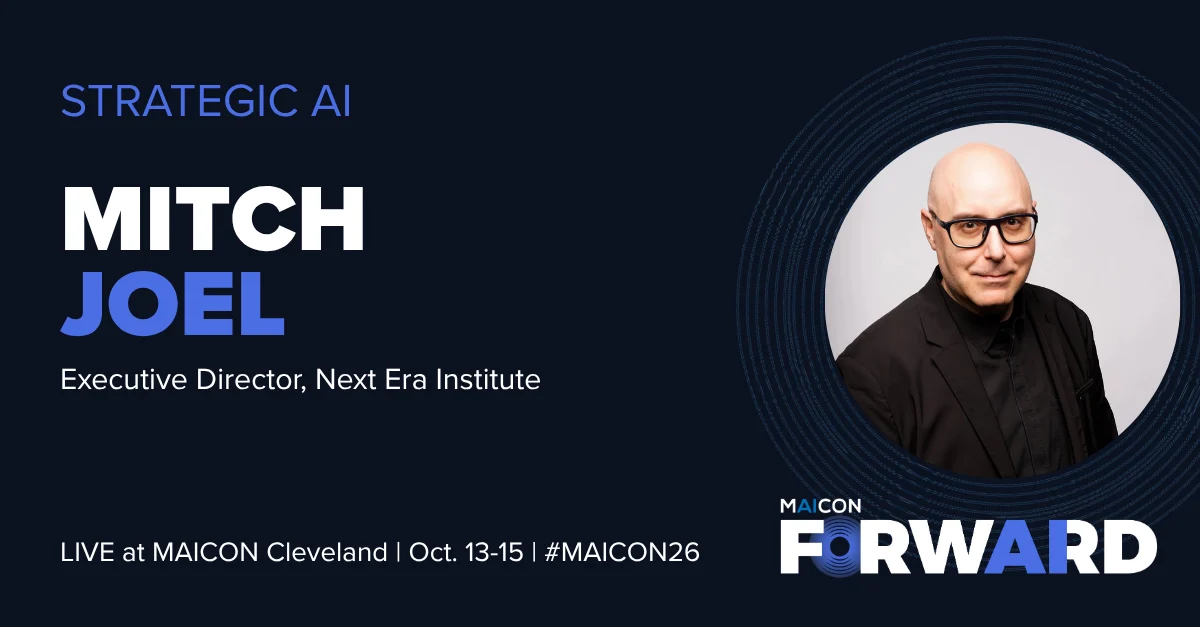
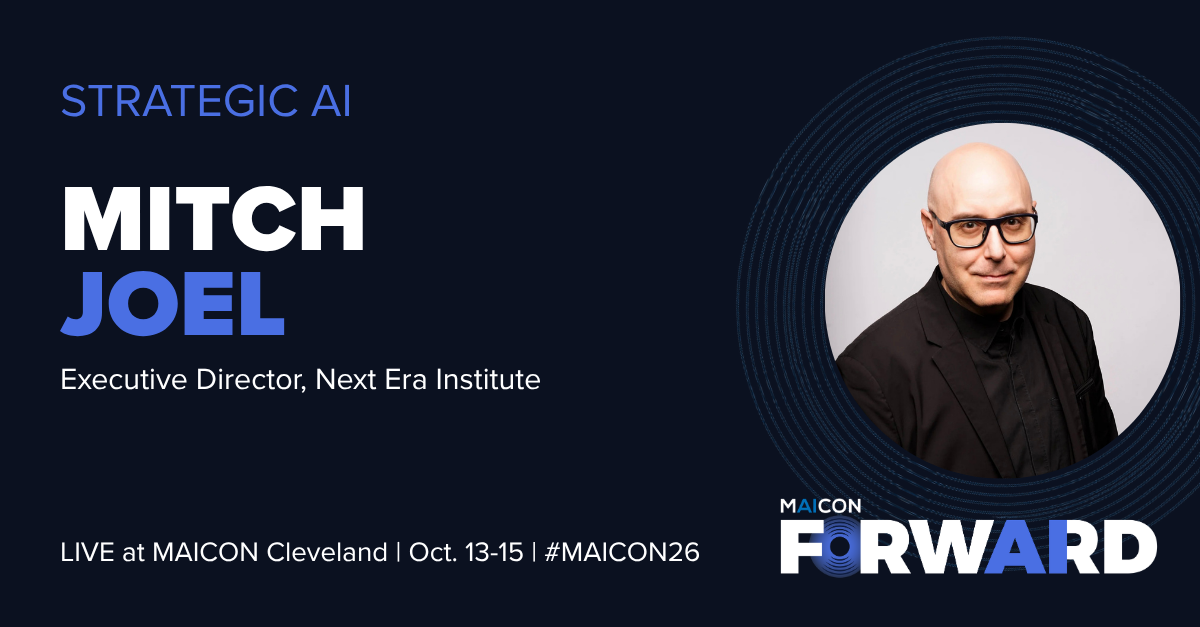
In the modern corporate boardroom, the conversation around Artificial Intelligence is almost always framed by a single, desperate metric: velocity. Marketing leaders are under relentless pressure to adopt new AI tools, automate workflows, and churn out content at a pace that would have been physically impossible just five years ago. However, according to Mitch Joel, a veteran digital strategist and the Executive Director of the Next Era Institute, this obsession with speed is a fundamental miscalculation.
“Saving time is not the goal of AI,” Joel asserts. “Spending it on something better is.”
As the marketing industry prepares for MAICON 2026, the global gathering for AI in marketing, Joel is set to take the main stage to deliver a keynote titled "Marketing Forward." His message is a sharp departure from the typical discourse on productivity gains. Instead of viewing AI as a turbocharged engine for content production, Joel argues that we are witnessing a structural shift in the very nature of human-brand relationships.
The Death of the Attention Economy
For decades, the digital landscape has been dominated by the "Attention Economy." Defined by reach, noise, and sheer volume, this era rewarded brands that could shout the loudest and occupy the most screen time. It was a world built for one-to-many communication, where the goal was to capture eyes by any means necessary, often sacrificing quality for the sake of impressions.
Joel, who has spent nearly thirty years at the forefront of digital marketing, argues that the Attention Economy is reaching a point of diminishing returns. As AI floods the internet with synthetic content, the value of generic, high-volume output is plummeting.
“We are moving out of the Attention Economy and into the Intimacy Economy,” Joel explains. “The new era is shaped not by reach, but by relevance, connection, and meaning.”
This transition represents more than just a change in jargon; it marks a fundamental change in the brand-customer dynamic. In the old playbook, the brand was a broadcaster. In the new, AI-enabled world, the brand must become a participant in a series of hyper-personalized dialogues.
From One-to-Many to One-to-X
The primary mistake current marketing leaders are making, according to Joel, is treating AI as a mere efficiency play. When companies use generative AI solely to create more blog posts, social media updates, and emails at a lower cost, they are simply pouring gasoline on the fire of the Attention Economy. They are creating more noise, which only makes the consumer’s job of filtering that noise more difficult.
Joel proposes a radical alternative: the "one-to-X" model.
“The opportunity is not infinite content,” Joel says. “It is infinite context.”
In a one-to-X world, AI allows brands to maintain scale while ensuring that every individual interaction feels tailor-made. It is no longer about how many people you can reach, but how deeply you can understand the specific, immediate needs of a single user. AI, when used correctly, acts as a bridge between massive datasets and human-centric empathy, allowing for a level of personalization that was previously impossible to achieve at scale.
The Three Cities of AI
To help leaders move beyond the "more is better" trap, Joel has developed a mental model he calls the "Tale of Three Cities." This framework provides a roadmap for navigating the complexities of AI integration, categorized into three distinct dimensions:
1. The Intelligent City
This represents the analytical backbone of modern marketing. It is the realm of predictive modeling, data synthesis, and machine learning. Here, the goal is to understand the "what" and the "why" behind consumer behavior. It is the foundation upon which the other two cities are built.
2. The Intimate City
This is the psychological and creative heart of the framework. If the Intelligent City provides the data, the Intimate City provides the resonance. This is where AI is leveraged to create genuine connection. It is the application of data to craft experiences that feel human, empathetic, and responsive.
3. The Integrated City
Finally, the Integrated City is where strategy meets execution. It is the seamless weaving of AI tools into the existing organizational fabric. It moves beyond "pilot projects" and "AI experiments" to create a cohesive environment where technology supports the brand’s long-term vision rather than distracting from it.
The P.A.C.E. Framework: A Durable Strategy
Technology is evolving at a pace that leaves even the most agile marketing teams breathless. New models are released monthly, and platforms that are dominant today may be obsolete tomorrow. To survive this cycle of constant disruption, Joel has introduced the P.A.C.E. framework, which he will unpack in its entirety at MAICON 2026.
The P.A.C.E. framework is designed as a "durable" decision-making tool. It is intentionally tool-agnostic, meaning it remains effective regardless of whether you are using OpenAI’s latest model, a bespoke internal AI agent, or a tool that hasn’t been invented yet.
“Marketers need this now because the technology will keep changing,” Joel says. “This framework helps leaders make better choices regardless of which tool or technology happens to be dominating the conversation that week.”
By anchoring decision-making in a consistent framework rather than the latest viral AI trend, leaders can avoid "shiny object syndrome" and stay focused on the ultimate goal: delivering genuine value to the customer.
The Strategic Imperative
The implications for marketing leadership are profound. If the goal is no longer to be the loudest voice, then the role of the Chief Marketing Officer must shift from "content overseer" to "experience architect."
When speed is not a strategy, direction is. Joel’s research suggests that organizations that prioritize depth over breadth in their AI adoption will likely win the long-term war for customer loyalty. While competitors are busy automating the production of mediocre content, forward-thinking brands will be busy automating the creation of meaningful context.
This shift requires a change in culture. It demands that leaders stop asking, "How many posts can we generate today?" and start asking, "What can we now understand, create, or deliver for the customer that was not previously possible?"
Looking Toward MAICON 2026
Mitch Joel’s upcoming session at MAICON 2026, "Marketing Forward," is poised to be a watershed moment for attendees. It offers a clear-eyed, pragmatic view of where the industry is headed. For those feeling the burnout of the current AI-adoption race, Joel’s session will provide a much-needed sense of clarity.
Attendees can expect to leave the session with:
- A deeper understanding of why the Attention Economy is failing.
- The vocabulary and strategic mindset to pivot toward an Intimacy Economy.
- A functional, durable framework (P.A.C.E.) to evaluate future technology investments.
- A roadmap for moving from volume-based content strategies to context-based relationship building.
As the industry converges at MAICON 2026, the question will no longer be how to use AI to keep up with the competition. Instead, the question will be how to use AI to redefine the competition entirely.
Conclusion: Reclaiming the Human Element
The paradox of the current moment is that the more "artificial" our tools become, the more important "human" resonance becomes. We are entering an era where being legible to machines is the baseline, but being resonant with humans is the competitive advantage.
Mitch Joel’s work serves as a reminder that technology is not the destination. It is the medium. By refocusing on the Intimacy Economy, marketing leaders have the opportunity to move past the noise and build brands that truly matter.
For those ready to move beyond the speed trap and start building for the future, the lessons provided by Joel’s framework will be essential. The journey to the Intimacy Economy is not about being faster; it is about being more present, more contextual, and ultimately, more human.
Join Mitch Joel and over 50 other AI and business leaders at MAICON 2026. Registration is currently open for those ready to shape the future of marketing.