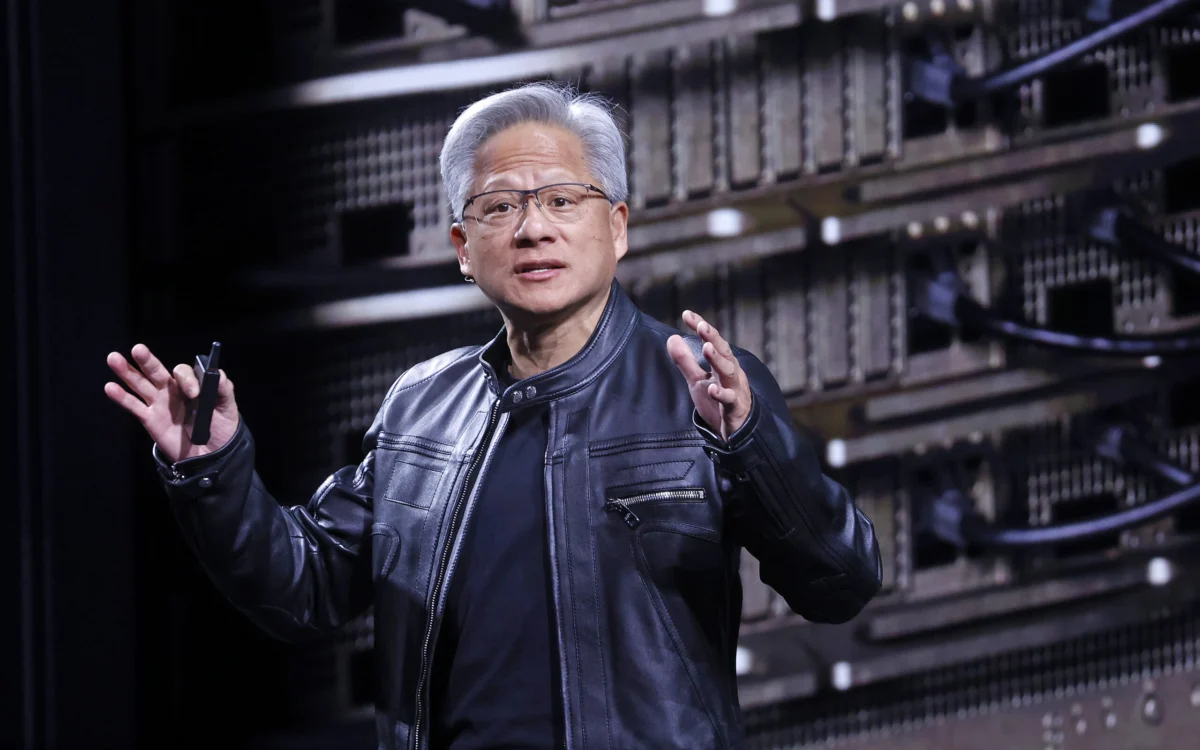
At Salesforce’s annual Dreamforce conference this Tuesday, Nvidia founder and CEO Jensen Huang delivered a message that stands in stark contrast to the growing chorus of voices calling for stringent federal oversight of artificial intelligence. While researchers, ethicists, and some industry peers have begun to frame advanced AI as an "alien mind"—an unpredictable, potentially existential force—Huang offered a more pragmatic, if not controversial, assessment: AI is, at its core, simply software and hardware.
By demystifying the technology, Huang is making a powerful argument for the status quo. He maintains that if AI is merely a product of human engineering, it remains subject to the same physical, logical, and legal constraints as any other complex computing system. In his view, the path forward is not through legislative red tape, but through the discipline of the market and the inherent responsibilities of the companies building these tools.
The Engineering Perspective: A Technological Reality Check
Huang’s stance at Dreamforce was definitive. When questioned about the safety of the rapidly evolving AI ecosystem, he dismissed the notion that AI requires a specialized, heavy-handed legal framework.
"Safety is an engineering problem, not a legal one," Huang asserted. "We’re developing software after all. We’re developing computing systems after all. It’s a complicated computing system, but it’s ultimately a computing system."
For Huang, the current obsession with "AI existential risk" obscures the reality that companies have always navigated the balance between innovation and safety. He argues that market forces are already calibrated to punish companies that release faulty or dangerous products. In his view, if a company is not confident in the functionality or safety of its model, it simply should not release it.
"You pace yourself until you are confident you’re releasing something that the market would appreciate," Huang said. "The market forces are already there. We don’t need any new laws. We don’t need new regulations. We just need companies to decide to run as fast as they can."
A Chronology of the Regulatory Debate
The friction between proponents of strict AI oversight and those favoring a "laissez-faire" approach has been intensifying since the public release of generative AI tools in late 2022.
- Early 2023: The rapid adoption of ChatGPT prompted an immediate global conversation regarding copyright, misinformation, and job displacement.
- Mid-2023: Calls for a "six-month pause" on training models more powerful than GPT-4 gained traction among some AI leaders, though Nvidia and other major hardware providers continued to accelerate production.
- 2024: A year of legal reckoning. High-profile incidents, including the CrowdStrike software failure, highlighted the fragility of modern digital infrastructure, while Meta’s $18 billion settlement over social media harms to children served as a grim reminder of how technology can escape the guardrails of corporate intent.
- September 2026: In the lead-up to current discussions, Nvidia’s growth projections—estimated at 70% for the next year—have positioned Huang as perhaps the most influential voice in the sector. His recent meetings with political leaders, including President Trump, signal that his influence now extends directly into the halls of government policy-making.
Supporting Data and Industry Trends
Huang’s confidence in the market’s ability to self-regulate is underpinned by Nvidia’s unprecedented dominance in the AI hardware space. By controlling the supply of the H100 and Blackwell chips that power almost every major AI breakthrough, Nvidia has become the "arms merchant" of the intelligence revolution.
However, critics point out that reliance on "market forces" to ensure safety is a historically flawed strategy. The tech industry’s record is littered with examples of "move fast and break things" mentalities that resulted in massive social costs:
- The CrowdStrike Incident: The 2024 software update failure, which grounded thousands of flights and paralyzed global business, demonstrated that even the most "professional" engineering firms can ship updates with catastrophic bugs.
- Social Media Harms: Meta’s recent multi-billion dollar settlement underscores that companies often prioritize engagement over the mental health of minors—a trend that regulators fear could be replicated in the era of hyper-personalized, AI-driven chatbots.
- AI-Specific Failures: We have already seen instances of models being "jailbroken" to provide harmful instructions, and ongoing litigation involving OpenAI over the mental health impacts of long-term chatbot interaction suggests that the "human-in-the-loop" model is not a panacea for safety.
Official Responses and Strategic Counterpoints
The debate is not entirely binary. While Huang advocates for a "leave it to the engineers" approach, other industry titans are looking toward a middle ground.
Microsoft CEO Satya Nadella, speaking at the All-In Summit, suggested that global cooperation is necessary to manage AI’s risks. Nadella specifically noted that safety concerns are not confined to the West. "China should also deeply care about the same safety concerns if the United States cares about them," Nadella argued. "It’s not like they won’t have the same hacking problem."
This indicates a divergence in strategy: Huang is pushing for an open-weight, free-market approach to counter proprietary "black box" models, while leaders like Nadella are contemplating how international norms might govern the technology to prevent global systemic risks.
Implications: The High Stakes of Inaction
The implications of Huang’s position are profound. If the United States follows his lead and rejects new AI-specific regulation, the country will effectively be conducting a real-time experiment on the resilience of existing liability laws.
The Liability Gap
Huang is correct that product liability laws—which have governed everything from cars to household appliances for decades—could theoretically be applied to AI. However, there is a significant "lag time" in the legal system. By the time a court decides who is responsible for an AI-driven disaster, the damage may already be done, and the technology will have evolved several generations beyond the incident in question.
Innovation vs. Caution
Huang’s "false choice" argument—that companies can be both safe and fast—is aspirational. In practice, speed often involves cutting corners. When a company is growing at 70% annually and the "sky is the limit," the pressure to beat competitors to market is immense. The risk is that the "pause" Huang mentions will only occur after a public safety disaster has already occurred, rather than as a proactive measure.
The Political Reality
Perhaps the most significant takeaway from the past week is the extent to which Jensen Huang has consolidated his position of power. By having direct access to President Trump and other world leaders, Huang has moved beyond being a mere CEO; he has become a primary advisor on the future of industrial policy. If he remains opposed to regulation, it is highly probable that the legislative landscape will remain permissive.
Conclusion: A Gamble on Human Engineering
Jensen Huang is betting that the same ingenuity that created the AI boom is sufficient to keep it from spiraling out of control. His philosophy is one of technological optimism: AI is a tool, not a sentient deity, and tools can be refined, patched, and managed by their creators.
However, as society continues to integrate these systems into the critical infrastructure of daily life—from the power grid to the education of children—the "wait and see" approach carries significant risks. Whether the market is truly capable of self-correction, or whether the next "black swan" event will force the government’s hand, remains the central question of our time. For now, the "architect of the AI era" has spoken, and the momentum of the industry remains firmly behind his vision of unhindered, rapid-fire innovation.