As the web development landscape undergoes one of its most radical transformations in decades, the intersection of artificial intelligence and human engineering is shifting from a novelty to core infrastructure. The dialogue surrounding how we build for the web has evolved past simple code generation; it is now deeply concerned with trust, reliability, governance, and the philosophical implications of delegating logic to non-deterministic systems.
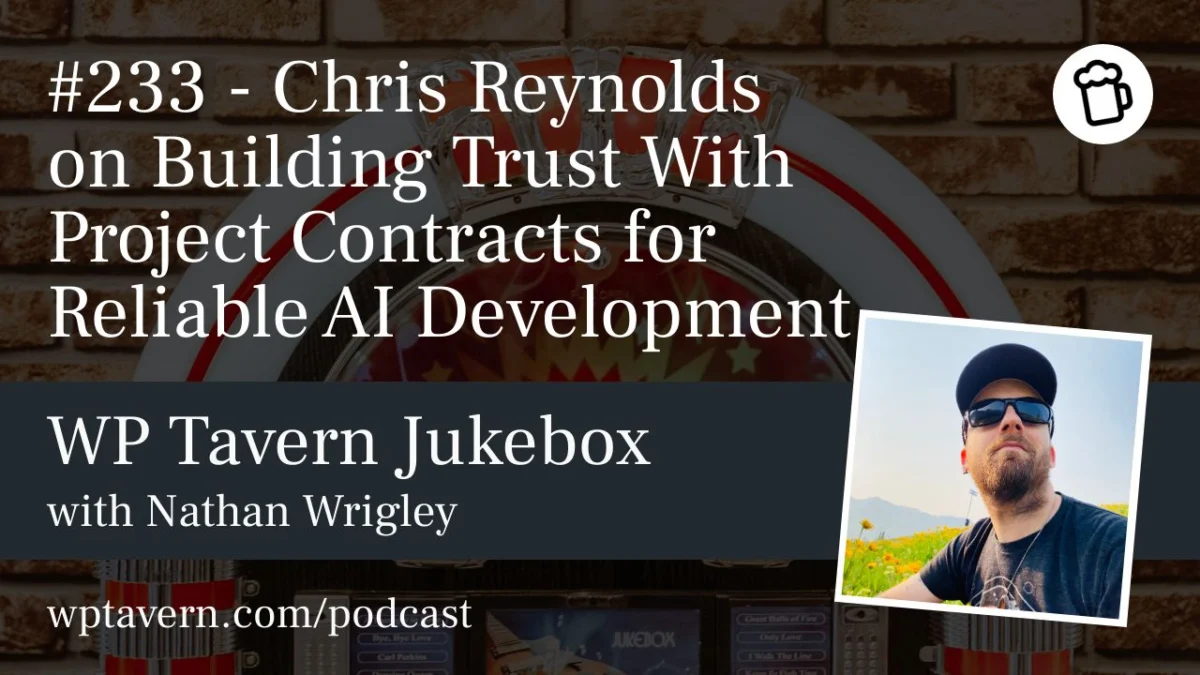
Recently, the Jukebox Podcast from WP Tavern hosted Chris Reynolds, Senior Manager of Developer Relations at Pantheon, to discuss these pressing issues. With a career spanning two decades in the WordPress ecosystem—including extensive work with leading agencies like WebDevStudios and Human Made—Reynolds brings a seasoned perspective to the table. His recent presentation at WordCamp US, titled "Parenting Claude: Guardrails for AI-Assisted Development," tackles the core challenge of modern development: how to harness the immense power of Large Language Models (LLMs) without losing control of project standards, security, and integrity.
Main Facts: The Reality of Non-Deterministic Coding
The fundamental tension in AI-assisted development lies in the nature of LLMs themselves. Unlike traditional, deterministic software processes where input A reliably yields output B one hundred percent of the time, LLMs are non-deterministic. They operate by finding the statistical path of least resistance to answer a prompt as quickly as possible.
While this speed is a boon for rapid prototyping, it introduces significant risks:
- The "Shortcuts" Problem: AI models, in their quest to fulfill a request efficiently, are prone to bypassing crucial data checks, introducing logical flaws, or inadvertently exposing sensitive security credentials (secrets) to the file system.
- The Black Box Phenomenon: Developers rarely have full visibility into the internal reasoning paths of LLMs. Even when an AI provides a "thought process," underlying calculations remain hidden.
- The Need for Automated Enforcement: Because human oversight cannot reasonably scale to review every single line of AI-generated output, developers must establish automated guardrails, pre-commit hooks, and multi-agent workflows to ensure compliance with web standards.
Chronology: From Novelty to Automated Workflows
The journey of AI integration in development has accelerated at a breathtaking pace over the past few years, moving from rudimentary text generation to sophisticated agentic workflows:
- The Early Era (2021–2022): Early machine learning models produced erratic, often humorous outputs (such as the infamous Horse eBooks Twitter bot or stilted phishing emails). At this stage, AI coding assistance was unreliable and largely viewed as a novelty.
- The Late 2023 Breakthrough: Major foundational models underwent massive architectural leaps. Tools like ChatGPT and, later, advanced coding interfaces suddenly demonstrated a profound aptitude for syntax, logic, and web architecture.
- The Rise of Autonomous Agents (2025–2026): Development workflows shifted from simple chat interfaces to deep terminal integrations, such as Claude Code. Developers began experimenting with building entire applications—such as migrating a personal site to Next.js hosted on Pantheon—using conversational prompts rather than manual coding.
- The Institutionalization of Guardrails (Present): As reliance on AI grew, the industry encountered the chaotic side effects of unchecked generation. This prompted developers like Reynolds to formalize concepts like "project contracts" and "reviewer agents" to police AI behavior automatically.
Supporting Data and Technical Architecture: The "Project Contract"
To mitigate the inherent unpredictability of AI coding assistants, Reynolds introduced the concept of a Project Contract. Implemented via structured markdown files (such as Claude.md and agents.md) within a project repository, this contract acts as an immutable set of laws that the AI must read and obey at the start of every session.
Key Components of an AI-Driven Workflow:
- Test-Driven Development (TDD) Mandate: By forcing the AI to write unit tests before writing the implementation code, developers ensure that the model creates a strict boundary against regressions. Because the AI wrote the test to make the function fail, it inherently understands how to satisfy it.
- The Reviewer Agent: Rather than relying solely on human code review, Reynolds implements a multi-agent structure where a secondary "reviewer agent" is automatically spawned after the primary agent builds a component.
- The 45-Point Checklist: Every proposed commit must pass a rigorous automated checklist that verifies:
- Build success and linting rules.
- Comprehensive unit and accessibility test passing.
- Absolute prevention of secret/API key leaks to the file system.
- Design adherence—such as requiring new components to be built within Storybook for visual review before full implementation.
- Hard-Gate Pre-Commit Hooks: If the reviewer agent does not generate an approved timestamped verification file, pre-commit hooks physically block the code from being committed to the repository. The AI cannot "talk its way out" of this gate.
Official Responses and Industry Perspectives
The rapid adoption of AI-generated code has sparked robust debates across the software engineering community, particularly regarding the philosophy of "vibe coding" and the changing role of the developer.
The Playfulness vs. Rigor Debate
Traditionally, web development demanded a highly methodical, regimented mindset. Today, AI has democratized creation, allowing non-developers or burnt-out engineers to focus on high-level building rather than tedious syntax writing. As Reynolds notes:
"The practice of writing the code was never the part that was fun. The part for me that was fun was building stuff. And I feel like I can let the robot do the coding and I can build the things and be satisfied with the output."
However, this playfulness comes with institutional concerns. Enterprise-level applications cannot rely on casual side-project standards, necessitating the strict guardrails discussed in Reynolds’ WordCamp US talk. Furthermore, many senior engineers acknowledge a sobering reality: despite protocols, developers rarely read every single line of AI-generated code. Consequently, trusting the system of verification has become more critical than trusting the individual output.
Implications: The Future of the Profession and the Skill Pipeline
As the industry looks toward the late 2020s, several profound long-term implications emerge for the software development profession:
1. The Disappearance of the Bottom Rung
One of the most profound anxieties voiced by veteran developers is the transformation of the career ladder. If AI models are effectively handling junior-level tasks—writing boilerplate code, simple components, and basic debugging—where do future senior engineers gain their foundational experience? If the entry-level tier of coding is entirely automated, the industry faces a challenge in cultivating engineers who possess the deep contextual understanding required to effectively "parent" and guide these AI systems.
2. The Shift to Agent Orchestration
The future of software architecture is moving away from human-to-AI prompt engineering and toward agent orchestration. Instead of interacting with a single monolithic model, developers will act as managers overseeing ecosystems of specialized agents—planners, coders, testers, and reviewers—working concurrently within strict automated parameters.
3. Philosophical and Environmental Tolls
Beyond code quality, the industry continues to grapple with the macroeconomic and philosophical realities of the AI boom. The staggering energy demands of expanding data centers across the globe raise serious environmental questions. At the same time, the human psyche adapts to a reality where distinguishing between human and machine communication becomes increasingly irrelevant.
Conclusion
The transition into AI-assisted development is neither a frictionless utopia nor a dystopian dead-end; it is a frontier defined by how well humans can establish boundaries. By treating Large Language Models less like all-knowing oracles and more like unruly, hyper-efficient assistants—constrained by strict project contracts, automated test frameworks, and unyielding pre-commit gates—developers can maintain control over their codebases while embracing a newly revitalized sense of creative play.