The landscape of web development has undergone a seismic shift. For nearly 13 years, the WordPress ecosystem has been defined by the rise of "page builders"—tools that democratized web design, allowing non-coders to construct complex, visually rich sites without mastering the intricacies of PHP, HTML, or CSS. Today, however, the industry faces a new, potentially more disruptive force: Artificial Intelligence.
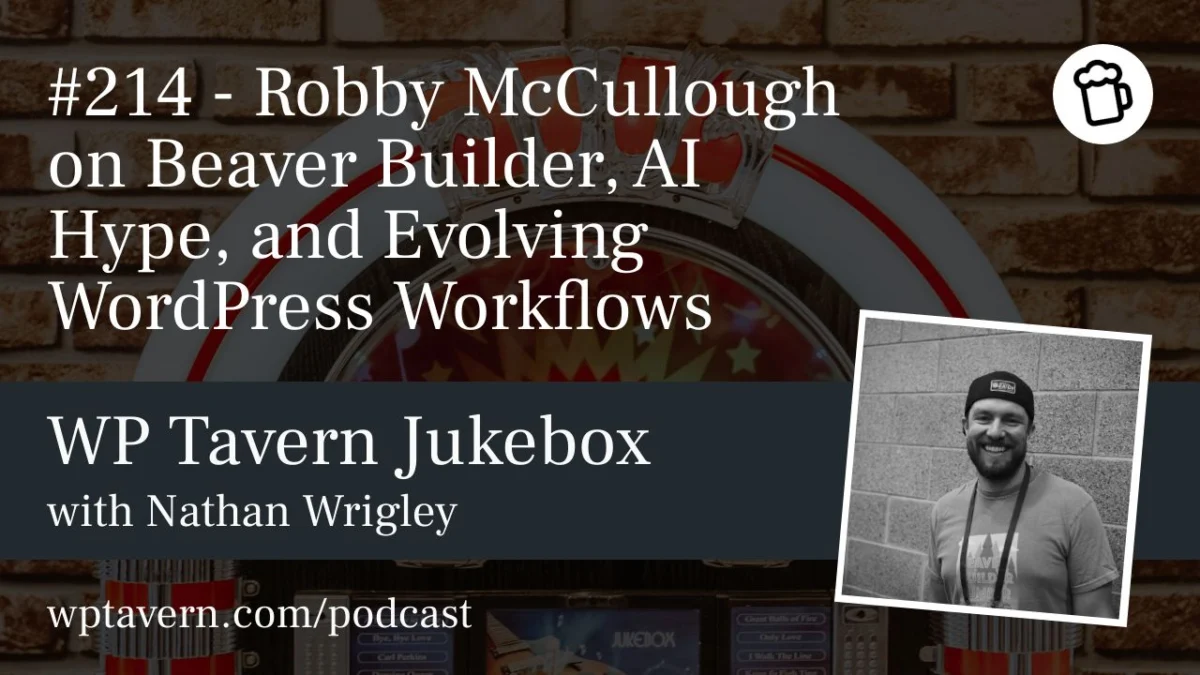
In a recent episode of the Jukebox podcast, WP Tavern’s Nathan Wrigley sat down with Robby McCullough, co-founder of Beaver Builder, to discuss the survival of page builders in an era where AI can generate entire websites from simple prompts. Their conversation spans the nostalgia of the early WordPress days, the technical anxieties surrounding AI, and the enduring human need for connection in an increasingly automated digital world.
The Journey of an "OG" Product Founder
Robby McCullough’s tenure in the WordPress space is a testament to the longevity of the platform. Since co-founding Beaver Builder 12 years ago, McCullough has navigated the transition from the era of manual coding to the dominance of drag-and-drop interfaces.
Reflecting on the early days, McCullough recalls the skepticism surrounding page builders. "When we started, there was a stigma around visual design tools," he notes. "Developers argued that the ‘proper’ way to build was through hand-coding themes and manipulating the WordPress template hierarchy. We faced the ‘Why would you do that?’ question constantly."
Despite the pushback, Beaver Builder became a cornerstone of the ecosystem. By simplifying the creation process, it helped propel WordPress from a blogging platform to a tool powering over 40% of the web. Today, as McCullough navigates a "whirlwind" personal life—marked by a new baby and a recent house move—he remains firmly at the helm of a product that continues to serve millions of users.
The AI Inflexion Point: From Hype to Utility
For a significant period, the tech world was swept up in an "AI gold rush," with software companies rushing to integrate basic Large Language Model (LLM) wrappers into their products. McCullough admits that Beaver Builder consciously avoided this trend.
"We didn’t jump on the AI bandwagon early, and I’m glad we waited," he explains. "A year ago, everyone was slapping a GPT wrapper on their product just to appease shareholders. It felt like a buzzword-driven exercise."
However, the industry has now reached an "inflexion point." The emergence of agentic AI—tools capable of writing code and performing complex tasks autonomously—has shifted the narrative from marketing hype to genuine utility. McCullough reveals that his team is currently deep in development, building features that allow AI to assist in the construction and maintenance of Beaver Builder sites.
Chronology: The Shifting Sands of Development
The history of web creation is marked by these distinct waves of innovation:
- The Hand-Coding Era (Pre-2010s): Developers built sites using raw HTML, CSS, and PHP. It required significant technical expertise but provided total control over the architecture.
- The Page Builder Revolution (2012–2020): Tools like Beaver Builder, Elementor, and Divi introduced visual interfaces. This lowered the barrier to entry, enabling a new generation of designers and business owners to build websites without deep technical knowledge.
- The Gutenberg Era (2018–Present): WordPress introduced a block-based editor, shifting the focus toward a more integrated, core-native way of building.
- The AI/Agentic Era (2023–Present): We are currently entering a phase where "vibe coding"—using natural language prompts to generate entire functional applications—is becoming standard.
McCullough acknowledges that this current wave is different. While previous shifts (like the introduction of Gutenberg) threatened the relevance of page builders, the AI revolution threatens the very necessity of the traditional "editing" process.
Supporting Data: The Utility of the "Human-in-the-Loop"
Despite the allure of AI-generated websites, a significant concern remains regarding the long-term maintenance of these digital assets. McCullough points to the "plumbing" of the web—elements like SEO metadata, database management, and complex site architectures—that AI currently struggles to manage in a professional, business-critical context.
"If you use an AI to whip up a site in four seconds, you often lose the ability to go back and deconstruct it," McCullough observes. "You don’t know how it was built, which makes it incredibly difficult to maintain over the long term."
This is where Beaver Builder intends to stay relevant. The goal, according to McCullough, is not to replace the developer, but to provide a robust "scaffolding" that AI can interact with. By allowing users to use AI to generate layouts or components, and then using the Beaver Builder UI to tweak, polish, and maintain those elements, the team hopes to provide the best of both worlds: the speed of AI and the reliability of a professional-grade editor.
The "Artisan" Concern: What Do We Lose?
One of the most poignant themes of the discussion was the potential loss of craftsmanship. McCullough and Wrigley both expressed a "healthy dose of nostalgia" for the days when a developer could explain the inner workings of a site’s CSS grid or the logic behind a PHP function.
"There’s a bit of a concern that we are getting into an interface where we just have a chat, and we don’t really know how anything got on the page," Wrigley noted.
McCullough’s response was a mix of pragmatism and acceptance. He draws a comparison to his hobby of restoring vintage ham radios. He appreciates the "classic car" nature of old technology, but he acknowledges that he now uses AI to generate frequency lists because the manual process was, quite simply, "tedious."
"There are some things I can’t see doing by hand ever again," McCullough admits. "But there’s also value in understanding the code. We want to expose more of the front-end code in Beaver Builder, not just to hide it, but to empower users to learn from what the AI is producing."
Official Responses and Strategic Implications
What does this mean for the future of WordPress products? McCullough’s strategy involves:
- Avoiding the "Black Box": Refusing to turn Beaver Builder into a service where users pay tokens for "black box" output. Instead, they aim to facilitate a "bring your own agent" model.
- Embracing Dictation and Workflow: McCullough shares that his own productivity has soared by using voice-to-text AI, allowing him to work effectively even while caring for his child.
- Prioritizing Human Connection: A recurring concern in the conversation was the risk of isolation. As we delegate more tasks to AI, the risk of losing meaningful human collaboration grows.
McCullough emphasizes that the future of the web isn’t just about code—it’s about the community. He expresses a strong desire to see a revitalization of in-person WordPress events. "I’d love to see WordCamps come back with a vengeance," he says. "Traveling to a new city, meeting people you only knew online, and having a meal together—that is something that no AI simulation can replicate."
The Road Ahead: A Hybrid Future
The consensus between the podcast host and the software founder is clear: while AI will inevitably become the primary interface for building the "bones" of a website, the need for professional, visual editing tools remains.
As web development becomes more abstracted, the "human" element—the taste, the strategic vision, and the community—will become the primary differentiator. For Robby McCullough and the team at Beaver Builder, the mission is to ensure that while the process of building becomes faster and more efficient, the quality and manageability of the final product remain firmly in the hands of the human creator.
The "tsunami" of AI is coming, but for those willing to adapt, it may provide the tools to build better, faster, and more creatively than ever before. The key, it seems, is not to fear the machine, but to ensure that the machine is working for us, rather than the other way around.