By the Editorial Team
Published in B2B Strategy & Marketing
Main Facts
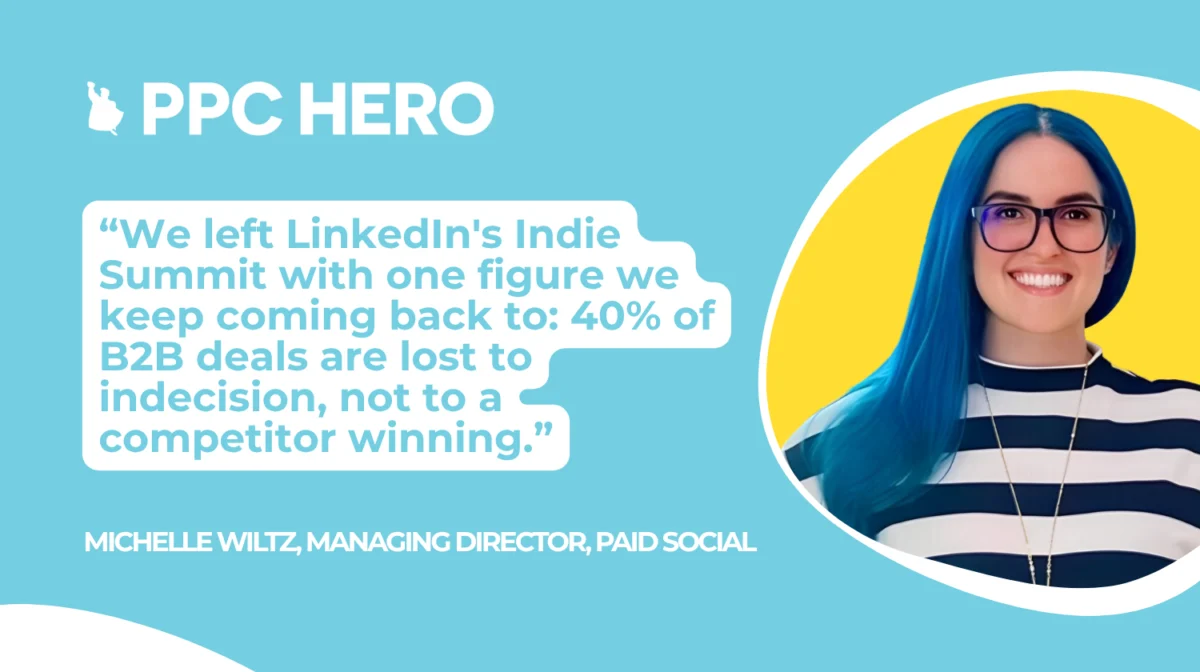
In modern B2B commerce, the traditional adversary is rarely a competing vendor; it is paralysis. Fresh insights emerging from LinkedIn’s Indie Summit highlight a stark reality: an astonishing 40% of B2B deals are lost entirely to indecision, rather than a rival winning the business.
The root cause of this widespread stagnation lies in a fundamental misalignment between modern buying behavior and legacy marketing frameworks. While traditional B2B campaigns are laser-focused on winning over a single decision-maker—optimizing for a direct path to conversion—the reality of enterprise purchasing has shifted dramatically. Today, the average B2B buying group comprises approximately ten distinct stakeholders, including Chief Marketing Officers, Chief Financial Officers, security leads, technical evaluators, and department heads.
Each stakeholder enters the evaluation process with unique priorities, risk tolerances, and mandatory questions that must be addressed before they are willing to sign off. When none of these stakeholders are actively opposed to a solution, but none are fully convinced, the deal does not pivot to a competitor—it simply stalls indefinitely. Compounding this challenge, 94% of B2B buyers now utilize Large Language Models (LLMs) during their purchasing journey, meaning they arrive at vendor evaluations heavily researched, highly skeptical, and often pre-armed with algorithmic comparisons.
To break through this stalemate, marketers must pivot their strategies. The objective is no longer simply beating the competition, but rather architecting campaigns that build collective confidence across an entire, risk-averse committee.
Chronology: The Evolution of B2B Decision-Making
Understanding how we arrived at the current era of stalled pipelines requires tracing the evolution of B2B sales and marketing over the past two decades:
- The Era of the Gatekeeper (Early 2000s): B2B marketing was largely linear and hierarchical. Campaigns targeted a single executive champion or a designated department head. Once that individual was convinced, sales teams could easily guide them through a straightforward procurement process.
- The Rise of Digital Self-Education (2010s): With the proliferation of SaaS review sites, independent blogs, and downloadable whitepapers, buyers began conducting independent research before ever engaging with a sales representative. However, marketing teams still largely catered to the "hero buyer"—the primary champion tasked with making an internal case.
- The Distributed Committee Era (Post-2020): Driven by remote work, increased software scrutiny, and heightened cyber-security requirements, buying groups expanded rapidly. Decisions became decentralized. Consensus-driven buying replaced top-down mandates, causing traditional lead-generation funnels to experience massive drop-offs.
- The Generative AI Disruption (Present Day): The widespread adoption of LLMs has accelerated the research phase. Buyers now bypass traditional top-of-funnel vendor content altogether, utilizing AI to synthesize category options, weigh technical trade-offs, and pre-qualify vendors before marketing teams even identify them as leads. Consequently, traditional feature-comparison marketing has lost its efficacy, forcing a rapid evolution toward trust-building, risk-mitigation content formats.
Supporting Data & Market Metrics
The shift toward consensus-based, AI-influenced buying has generated a substantial body of empirical data regarding what works—and what fails—in modern B2B advertising:
- 40%: The proportion of B2B deals lost to customer indecision rather than competitor victories (LinkedIn Indie Summit).
- 10: The average number of stakeholders involved in a modern enterprise B2B buying group, each requiring alignment before contract execution.
- 94%: The percentage of B2B buyers who incorporate LLMs and AI tools into their research process prior to vendor outreach.
- 1.6x: The increase in likelihood that a LinkedIn member will complete a lead generation form from a brand after viewing video ads from that same brand.
- 95%: The retention rate associated with video content, which is currently growing 60% faster than any other content format on professional networking platforms.
- 20%: The year-over-year growth rate experienced by agencies strategically leaning into video-first B2B campaigns, while static-focused agencies remain flat.
- 36%: The click-through rate (CTR) lift observed when video ads open with a specific statistical hook or hard data point rather than generic brand statements.
- 130%: The video completion rate advantage of specialized formats like BrandLink compared to standard in-feed video placements.
- 94% & 2.6x: LinkedIn Connected TV (CTV) reach and awareness lift compared to traditional linear television advertising.
Official Perspectives and Industry Insights
Industry leaders and platform data analysts emphasize that shifting enterprise buying dynamics require an immediate overhaul of creative briefs and media distribution strategies.
"When ten people have to arrive at a shared level of confidence—often without ever speaking to your sales team—the rules of engagement change completely," notes marketing strategist alignment analysis. "Marketers are spending millions trying to prove they are better than competitor X, when the real battle is convincing the CFO and the security lead that adopting this technology won’t disrupt operations."
According to platform insights, the traditional brief of "here is why we beat our alternatives" is rapidly losing its utility. Because modern buyers have already utilized AI tools to vet features, pricing, and category competitors independently, continuing to hammer home basic product superiority yields diminishing returns.

Instead, industry experts advocate for a shift toward friction-reducing messaging. The new creative mandate focuses on identifying the specific operational or financial risks keeping committee members awake at night and dismantling those fears transparently.
Furthermore, the mechanics of content consumption within a committee demand formats that are inherently shareable. Unlike a whitepaper or a static case study—which typically lives as a single touchpoint on one person’s desktop—video assets naturally transcend organizational silos. When a team lead drops a compelling video clip into an internal Slack channel, or plays a targeted brand asset during an internal alignment meeting, multiple stakeholders absorb the exact same context simultaneously. This shared exposure is what ultimately unblocks stalled decision-making.
Implications for B2B Marketers and Pipeline Strategy
The structural shift from single-buyer targeting to multi-stakeholder consensus has profound implications for how marketing teams must structure their campaigns, allocate budgets, and measure success.
1. Rewriting the Creative Brief
Creative teams must abandon generic value propositions that could apply to any software or service in their sector. Because research-heavy buyers scroll past vague messaging, hooks must feature hard data, contrarian industry viewpoints, or direct addressals of enterprise pain points. Furthermore, embracing lo-fi, authentic, and behind-the-scenes content often outperforms hyper-polished commercial production. Cautious buying committees are actively assessing trustworthiness and corporate stability; authenticity signals reliability far faster than a hefty production budget.
2. Moving Beyond the Single-Touch Attribution Trap
Relying on last-click attribution models in a multi-stakeholder environment is a recipe for pipeline starvation. When ten people are quietly reviewing materials across different channels, measuring success requires looking at aggregate brand lift, video completion rates, and cross-channel engagement among target accounts. Agencies and internal marketing teams must align with finance departments to establish metrics that account for long-term pipeline velocity rather than immediate, single-user conversions.
3. Optimizing for the "Dark Funnel" and Committee Loops
Because the vast majority of B2B evaluation occurs away from direct sales touchpoints—across LLMs, internal messaging apps, and committee meetings—marketers must ensure their brand footprint is robust enough to persist in these closed ecosystems. Distribution channels that facilitate sharing (such as high-retention video placements, Connected TV, and targeted social feeds) ensure that the brand remains part of the internal conversation even when sales representatives are not in the room.
The Ultimate Question
As B2B marketing teams head into their next planning cycles and draft upcoming campaign briefs, the core strategic question must shift from tactical execution to collective psychology:
Are you building campaigns designed merely to convince one individual, or are you creating the comprehensive, trust-building content necessary to get ten cautious stakeholders comfortable enough to move forward together?
Answering that question correctly may well be the difference between a thriving, predictable pipeline and one that remains permanently stalled.