In the modern media landscape, sports stand as the final frontier of appointment viewing. While the fragmentation of streaming and on-demand content has eroded the traditional television audience, sports remain the "last bastion" of live, communal viewing. Last year, nearly every one of the top 50 most-watched telecasts in the United States was tied directly to athletic competition. From the visceral tension of an NFL weather delay—which, ironically, drew millions of viewers—to the spectacle of championship games, audiences are clearly demonstrating that if it has "sports" in the title, they will watch.
This massive aggregation of human attention has not gone unnoticed. Streaming giants, cable networks, and global brands are pouring billions into broadcast rights and sponsorships. However, as marketing budgets face increasing scrutiny, senior executives are finally asking the uncomfortable, multi-million dollar question: “I’ve enjoyed the hospitality suites and the photos with star athletes, but is this $38 million investment actually doing anything for the bottom line?”
The Reality Check: Marketing Laws Still Apply
There is a dangerous misconception that sports marketing operates outside the traditional laws of physics—or rather, the laws of marketing. Too often, brands treat sports sponsorships as a "set it and forget it" strategy, hoping that mere association with a winning team or a legendary athlete will automatically translate into sales.
Avinash Kaushik, a veteran in the field of marketing analytics, argues that if a brand’s creative and storytelling are weak, they will fail just as spectacularly on a stadium’s digital back panel as they do in a 1.2-second TikTok ad. In fact, because the audience is hyper-focused on the game itself, the threshold for capturing attention is even higher.
Take the Seattle Seahawks as a case study in discipline. Despite their massive reach, they have maintained the same singular corporate logo on their uniform for decades. It is a masterclass in brand consistency, yet many marketers fail to emulate this, opting instead for a clutter of logos that dilute the brand identity. If your marketing suffers from "spike and silence"—where you generate brief interest followed by long periods of irrelevance—sports marketing will only exacerbate the problem. To succeed, brands must achieve a "spike and sustain" cadence, which often requires a frequency of three impressions per user, per week.
A Chronology of the "Sports Marketing Trap"
The lifecycle of a typical sports marketing engagement often follows a predictable, yet flawed, trajectory:
- The Procurement Phase: A company enters into a high-profile sponsorship deal, often driven by the C-suite’s personal interest in a specific sport or team.
- The "Hospitality" Honeymoon: Executives enjoy the perks—the luxury suites, the field-side access, and the prestige of association. During this phase, internal scrutiny is low.
- The Measurement Gap: As the novelty fades, the CFO begins asking for ROI. Marketing teams, often unprepared for the complexity of measuring brand-level impact, revert to "vanity metrics" like impressions or Advertising Value Equivalency (AVE).
- The Strategic Pivot: When the vanity metrics fail to correlate with revenue growth, the company either abandons the sponsorship in frustration or, if they are sophisticated, pivots toward rigorous, multi-level analytics to understand true business impact.
Supporting Data: Why "Vanity Metrics" Are Failing
The industry is currently plagued by the misuse of metrics. The most prevalent offender is Earned Media Value (EMV), or Ad Value Equivalency (AVE). This methodology relies on software that tracks every instance a brand’s logo appears on a screen, multiplies that duration by the cost of a traditional 30-second spot, and claims the resulting figure as "value."
This approach is widely discredited by major marketing associations. It assumes that all exposure is good exposure, ignores the quality of the audience, and completely overlooks the fact that the viewer’s focus is on the ball, not the brand. It is, as experts suggest, measuring the "noise" rather than the signal.
The Impact Intelligence Score (IIS)
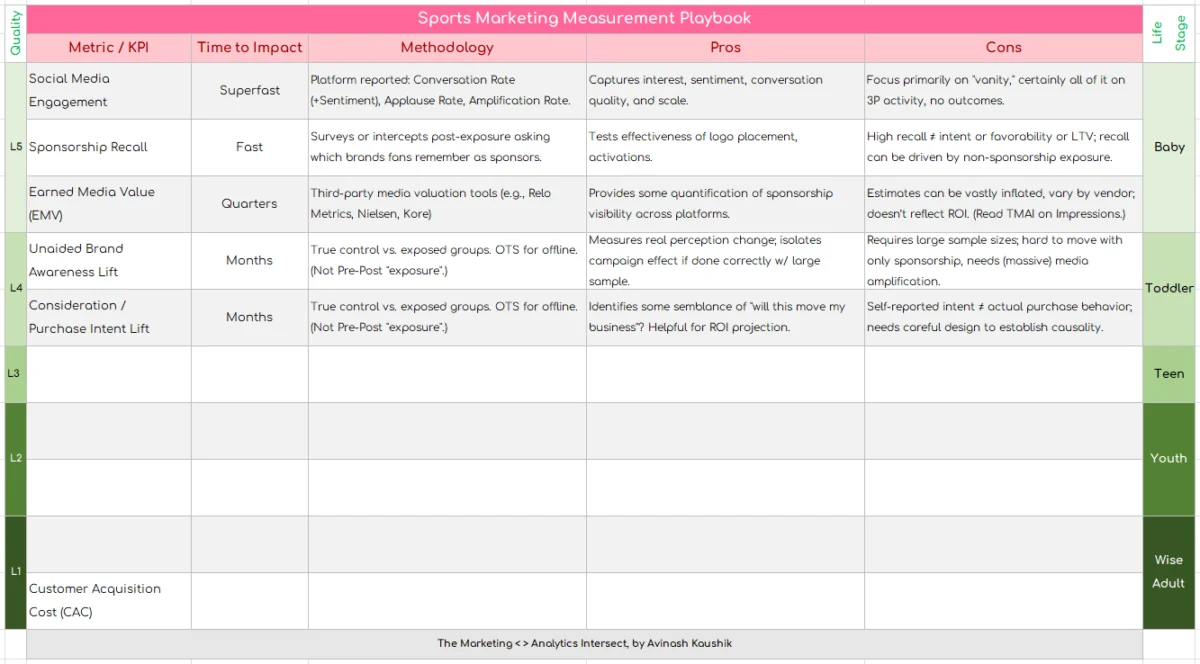
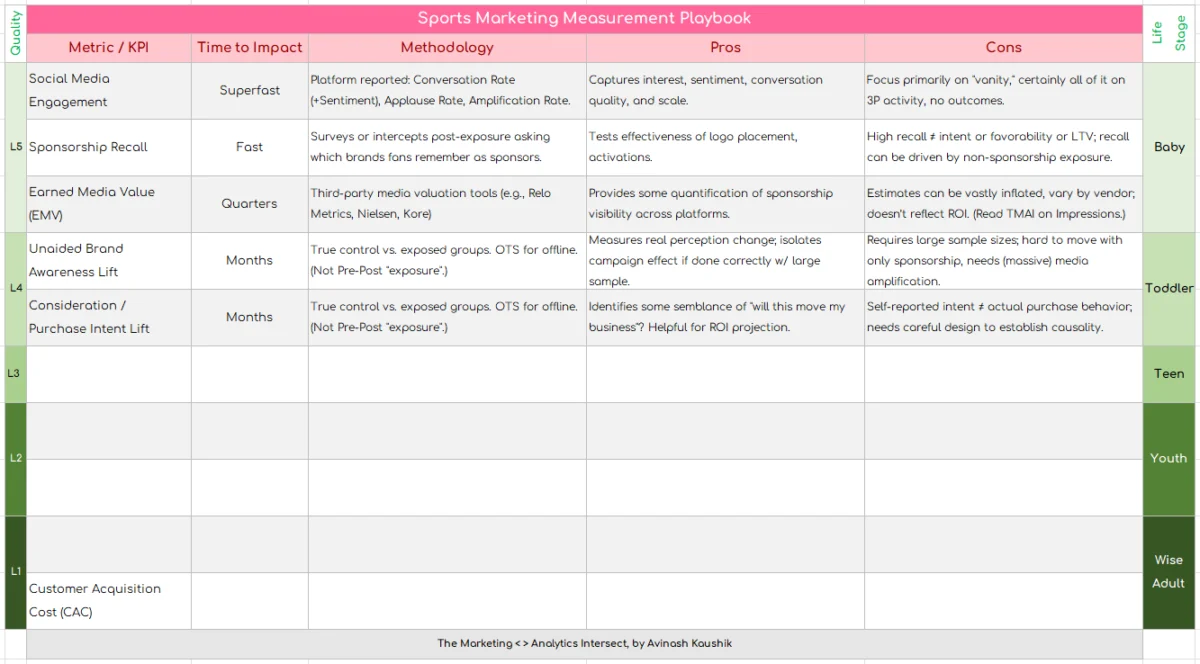
To move beyond these flawed metrics, analysts have developed a scale of sophistication to measure sports marketing, known as the Impact Intelligence Score (IIS).
- Level 5 (The Vanity Level): This is where most brands reside. It focuses on social media engagement, ad recall, and EMV. It is easy to track and provides impressive-looking charts, but it offers zero insight into causality or financial outcomes. It is a 1/10 on the Impact Intelligence scale.
- Level 4 (The Quest for Brand Impact): This level introduces test-versus-control measurement. Brands ask, "Did this sponsorship shift what people think and feel about us?" This involves tracking Unaided Brand Awareness (UBA) and Purchase Intent. While it takes months to see results, it provides a significantly more accurate picture of how sports marketing influences long-term revenue.
Official Industry Perspectives
Leading analysts and data scientists emphasize that the most profitable path is to treat sports as a partner in storytelling. Creative is responsible for 60% to 70% of brand marketing success. Therefore, if a company struggles with its own creative narrative, it can be a highly effective strategy to leverage the existing, high-intensity storytelling of a sport or an athlete.
However, this must be a conscious decision. Brands must be willing to commit the necessary "paid media" budget to amplify that story. Simply placing a logo on a jersey is not enough; the sponsorship must be supported by a deliberate, data-backed media strategy that keeps the brand in the consumer’s consideration set over the long term.
The Strategic Implications
For the modern enterprise, the implications of these findings are profound:
- Long-Term Commitment is Mandatory: Sports marketing is not a "quick win." Because brand perception shifts take time, short-term deals are essentially a waste of capital. Companies should view these investments through a five-year lens.
- Move Beyond Exposure: If your metrics are limited to impressions and logo-slaps, you are operating in the dark. Brands must transition to measuring lift in consideration and purchase intent.
- Focus on Incrementality: The "gold standard" of sports marketing measurement is proving incrementality—confirming that the revenue gain would not have occurred without the sponsorship. This requires sophisticated Marketing Mix Modeling (MMM) and a willingness to integrate sports data with sales data.
Ultimately, sports marketing is not an act of charity or an executive perk; it is a significant capital allocation. By turning the lights on and applying rigorous analytical frameworks, companies can ensure that their multi-million dollar investments are not just buying them a seat in a luxury box, but driving real, measurable, and profitable growth. As the market continues to favor live, authentic content, those who master the science of measurement will be the ones who truly win the game.