The global media landscape is undergoing a profound and rapid transformation, marked by intense legal and political confrontations, major executive re-shuffling at legacy networks, and structural downsizings of international news operations. From the steps of the White House to the financial hubs of Hong Kong, media organizations are grappling with unprecedented challenges to press freedoms, economic realities, and editorial independence.
This comprehensive report examines the mounting tensions between the executive branch and major news outlets, leadership shifts at NBC News and 60 Minutes, structural changes at Good Morning America and CNBC, and the operational adjustments defining contemporary journalism.
Main Facts
The current turbulence in the media industry is defined by several major developments occurring simultaneously across the journalistic ecosystem:
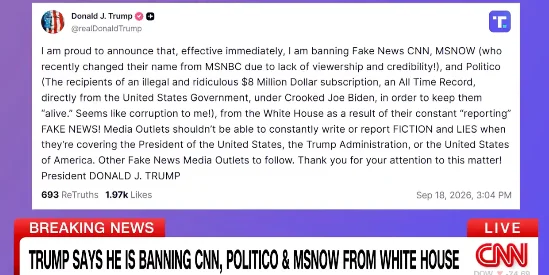
- White House Press Access Crisis: President Donald Trump announced a ban barring CNN, MS NOW, and Politico from reporting within White House grounds "effective immediately." Despite the social media proclamation, reporters from CNN and MS NOW continued to report from the White House complex, defying the administration’s directives.
- Executive Departures and Restructuring: Janelle Rodriguez, Executive Vice President of NBC News Programming, stepped down after a 12-year tenure. Her departure prompted an extensive internal reorganization led by Rebecca Blumenstein, President of Editorial.
- International Bureau Shuttering: CNBC officially closed its Hong Kong bureau, canceling several high-profile business programs and shifting regional assets toward Singapore and Beijing.
- New Leadership and Controversies at 60 Minutes: CBS News’ flagship magazine program returned for a new season under the guidance of Bari Weiss and Nick Bilton, amid ongoing fallout from editorial independence debates and the departure of former managing editor Guy Campanile.
- Broadcast Realignments: ABC News introduced new anchor teams for the weekend editions of Good Morning America, and CNN scheduled a high-stakes California gubernatorial debate between Xavier Becerra and Steve Hilton.
Chronology of Events
The trajectory of these media developments unfolded over a consequential multi-week period, highlighting the rapid pace of change within the industry:
- Early September 2026: CNBC announces the closure of its Hong Kong operations following a months-long strategic review of its international programming, commercial viability, and resource deployment.
- September 8, 2026: Details emerge regarding a private Facebook post by former 60 Minutes managing editor Guy Campanile, alleging editorial interference and raising industry-wide concerns about the direction of the historic news program.
- Wednesday, September 9, 2026: MS NOW officially launches its direct-to-consumer subscription model, MS NOW Membership, featuring a seven-day interactive schedule of live Q&As with network reporters and hosts.
- Friday, September 12, 2026: President Donald Trump uses social media to announce a ban prohibiting CNN, MS NOW, and Politico from reporting within White House grounds. During an Oval Office Q&A that afternoon, the president states he has "no reason" for the ban other than cumulative coverage over the prior two years. CNN and MS NOW reporters continue broadcasting from the White House, while legal and institutional pushback begins immediately. Former White House Correspondents’ Association (WHCA) President Weijia Jiang publicly highlights the First Amendment on social media.
- Weekend of September 13–14, 2026: ABC News debuts its newly structured Good Morning America weekend anchor lineups. Meanwhile, CBS News launches the new season of 60 Minutes under Bari Weiss and Nick Bilton.
- Mid-September 2026: Janelle Rodriguez announces her departure from NBC News, leading to an immediate restructuring of the network’s editorial and content divisions under Rebecca Blumenstein.
Supporting Data and Operational Metrics
The operational shifts across these networks reflect deeper financial calculations, changing audience consumption habits, and organizational pivots:
- ABC News Weekend Integration: The newly minted Saturday GMA team pairs senior political correspondent Rachel Scott with Whit Johnson, while Rhiannon Ally joins Gio Benitez for Sunday editions. Meteorologist Leslie Lopez steps in as weekend meteorologist, replacing Somara Theodore, who transitions to a full-time role on ABC News Live. Additionally, the weekend anchors will rotate hosting duties for ABC News Live Weekend at 10 a.m. ET.
- CNBC Program Cancellations: The winding down of CNBC’s Hong Kong hub resulted in the termination of day-side international programs including Inside India, The China Connection, and Europe Early Edition. Long-form feature series like CNBC Meets and Built for Billions are scheduled to conclude at the end of their current broadcast runs. Affected employees represent a "small number" of the network’s total global workforce, with key operational facilities remaining in Singapore, Beijing, London, and Abu Dhabi.
- NBC News Leadership Expansion: Under the new structure implemented by Rebecca Blumenstein:
- Catherine Kim assumes the role of Executive Vice President of Editorial and Content, taking over oversight of NBC News Now and special programming.
- Matt Carluccio expands his portfolio to manage core editorial units, including business, health, investigations, and climate coverage.
- Matt Frucci, Executive Producer of NBC Nightly News, reports directly to Blumenstein.
- MS NOW Membership Model: The newly launched digital tier relies on twice-daily live interactive Q&As hosted via ms.now and the mobile app, providing subscribers direct video access to network personalities.
- Upcoming Political Debates: CNN confirmed that anchors Jake Tapper and Dana Bash will moderate a one-hour California Governor Debate on Wednesday, September 30, at 9 p.m. ET, broadcasting live from Los Angeles across CNN, CNN International, and CNN en Español, with digital streaming for subscribers.
Official Responses and Stakeholder Statements
The escalating conflict between the White House and the press corps has drawn sharp, formalized responses from media organizations and constitutional advocates.
CNN’s Official Statement
Following President Trump’s threat to bar the network from White House grounds, CNN released a firm institutional response:
"CNN stands fully behind our White House reporters. We have a right under the U.S. Constitution to report without hindrance from the government. Should the ban which President Trump threatened go ahead, it would be an illegal assault on that fundamental and constitutionally-protected right."
Institutional Defense of the First Amendment
Weijia Jiang, former president of the White House Correspondents’ Association, utilized social media to underscore the foundational legal protections governing American journalism, posting the text of the First Amendment:
"Congress shall make no law respecting an establishment of religion, or prohibiting the free exercise thereof; or abridging the freedom of speech, or of the press; or the right of the people peaceably to assemble, and to petition the Government for a redress…"
Executive and Editorial Perspectives
- Janelle Rodriguez (NBC News): In her farewell message to colleagues after 12 years with the network, Rodriguez characterized her departure as "the right moment" to step back and transition to the next chapter of her professional life.
- Internal 60 Minutes Leadership: In a joint welcome note shared with media analyst Brian Stelter, new 60 Minutes guiding figures Bari Weiss, Nick Bilton, and CBS News President Tom Cibrowski praised the season premiere as "a powerful start with three original, revelatory stories that showcase 60 at its best."
- Dissenting Views: Countering the institutional narrative at CBS, former managing editor Guy Campanile voiced sharp criticism regarding alleged editorial pressure. In a public-facing discussion captured by The Guardian, Campanile stated that he and his departing colleagues refused to "be accomplices in the destruction of the most prestigious news program on American television" by accommodating "unverifiable notions or White House talking points."
Implications for the Future of Journalism
The convergence of these events signals a critical juncture for the Fourth Estate, carrying profound implications for how news is gathered, distributed, and protected:
1. Constitutional Standoffs Over Press Access
The Trump administration’s attempt to bar CNN, MS NOW, and Politico threatens to set a volatile precedent for executive branch transparency. By explicitly stating he had "no reason" other than cumulative dissatisfaction with past reporting, the president frames press credentials not as an institutional necessity for a free press, but as a revocable privilege tied to favorability. If challenged in federal courts, this ban could result in a landmark constitutional ruling defining the limits of executive authority over physical press access on federal property.
2. Economic Pressures and Global Footprint Reductions
CNBC’s closure of its Hong Kong bureau highlights a broader trend of legacy networks rationalizing their international real estate and reporting infrastructure. As television audiences migrate toward digital streaming, subscription tiers (such as MS NOW Membership), and regional consolidated hubs (such as Singapore and Beijing), traditional overseas bureaus are increasingly viewed through a strict cost-benefit analysis. This contraction risks diminishing on-the-ground reporting capabilities in critical geopolitical and financial markets.
3. Shifts in Editorial Independence and Public Trust
Internal friction at legacy institutions like 60 Minutes—underscored by high-profile departures and allegations of ideological pressure—reflects deep cultural divisions within newsrooms. As new leadership models are implemented across networks like NBC News and CBS, public trust in media institutions hangs in the balance. Audiences are increasingly sensitive to perceptions of editorial interference, pushing media organizations to either double down on traditional journalistic standards or risk alienating core viewers in an intensely polarized political environment.