By Editorial Staff
Updated July 21, 2026
In the modern small-to-medium business (SMB) landscape, misalignment between sales and marketing rarely presents itself as an overt declaration of war. Instead, it manifests as a quiet, corrosive friction: marketing generates "qualified" leads that sales refuses to call, campaign messaging that rings hollow to the reps on the front lines, and a revenue pipeline that appears robust on a dashboard but leaks cash in practice.
A comprehensive new study by Unbounce, surveying over 500 go-to-market (GTM) professionals, exposes a stark reality: while 87% of teams identify better alignment as the single greatest lever for performance, only 56% of those same teams classify themselves as "highly aligned." This discrepancy represents not just a communication hurdle, but a systemic threat to sustainable growth.
The Mirage of Alignment: Where Organizations Fail
The data reveals a dangerous comfort zone. Many organizations believe they have achieved alignment simply by establishing a recurring calendar sync or agreeing on a loose definition of a "lead." However, the study suggests this is merely the "meeting-cadence layer" of alignment, which often masks a deeper, broken operating model.
True alignment requires more than regular check-ins; it necessitates a unified architecture of lead data, synchronized handoff protocols, and shared key performance indicators (KPIs). When teams stop at the meeting level, they continue to operate in silos: marketing celebrates lead volume, sales celebrates closed deals, and the numbers never reconcile. In this environment, the organization is doing the "work" of alignment without ever reaping the results.

The Perception Gap: Executives vs. The Trenches
Perhaps the most alarming finding in the 2026 report is the vast perception gap between leadership and frontline employees. Approximately 69% of executives report that their sales and marketing functions are strongly aligned. In contrast, only 47% of non-executive employees agree.
This disparity suggests a "structural information lag." Executives frequently view alignment through the lens of strategy decks and organizational charts, whereas frontline staff experience the daily reality of data inconsistencies, siloed communication, and conflicting priorities. When leadership assumes a level of harmony that does not exist on the ground, they fail to address the root causes of friction, allowing them to compound as the organization scales.
The High Cost of Disconnected Teams
Misalignment is rarely just a cultural issue; it is a measurable drain on operational efficiency. The primary consequence reported by GTM teams is employee frustration (29%), followed closely by lost revenue opportunities.
The ripple effect is predictable:
- Marketing generates leads based on one set of criteria.
- Sales views those leads as substandard and delays follow-up.
- The Pipeline slows, leading to a decline in win rates.
- The Post-Mortem yields two different stories—marketing blames sales for not calling, and sales blames marketing for poor quality.
This cycle is not just inefficient; it is expensive. When marketing and sales do not agree on what constitutes a "qualified" lead, resources are squandered on dead-end prospects. The lack of a unified handoff process means that valuable lead context is lost, forcing sales reps to restart the qualification process from scratch—a waste of time that directly impacts conversion rates.

Why "More Meetings" Won’t Fix the Problem
Many organizations attempt to bridge the gap by mandating more frequent communication. However, the data indicates that communication frequency is a secondary lever. Over 54% of GTM teams currently prioritize meetings over structural changes, yet the data shows that the most successful teams focus on the "operating model" first.
Highly aligned organizations—those that outperform their peers—are 3.5 times more likely to have strong cross-functional data sharing. Their success is rooted in:
- Integrated Workflows: Systems where data flows seamlessly from a marketing automation platform to a CRM without manual intervention.
- Shared KPIs: Measuring both departments on the same outcome, such as Revenue Contribution or Customer Acquisition Cost (CAC), rather than vanity metrics like MQL counts.
- Coordinated Targeting: Using the same buyer personas and firmographic data to ensure that the message delivered in an ad is the same one discussed in a discovery call.
The Root Causes: Data, Tools, and Incentives
The report categorizes the root causes of misalignment into four distinct areas: operational (53%), goal and incentive (43%), cultural (40%), and structural (34%).
The Data Paradox
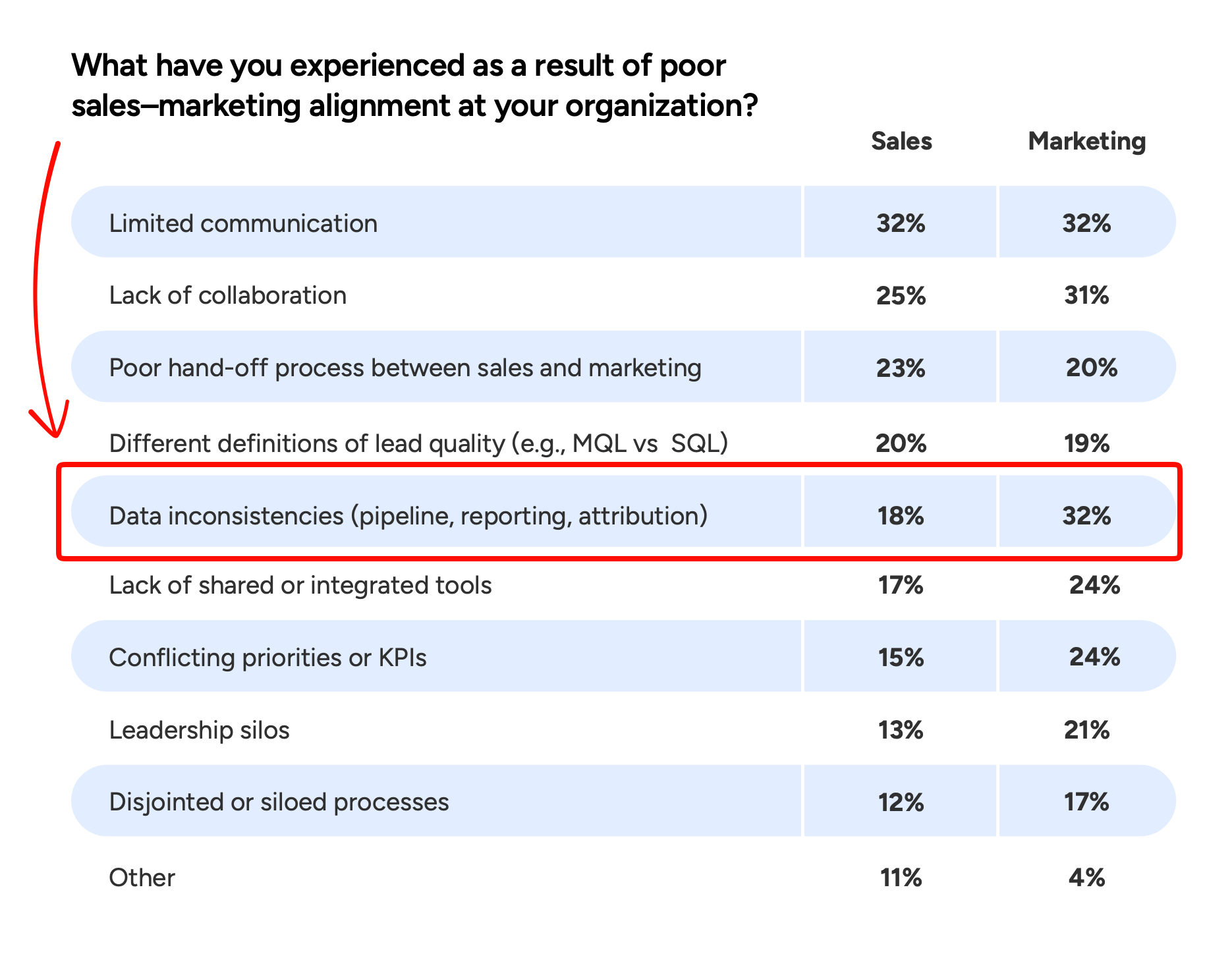
While 40% of teams claim to have excellent data sharing, 68% report regular inconsistencies. This indicates a "confidence vs. reality" gap. Marketing often relies on platform-level attribution, while sales relies on rep-entered data in a CRM. Without a single source of truth, the teams are effectively looking at different maps while trying to navigate the same territory.
Tool Bloat and the "Buying" Trap
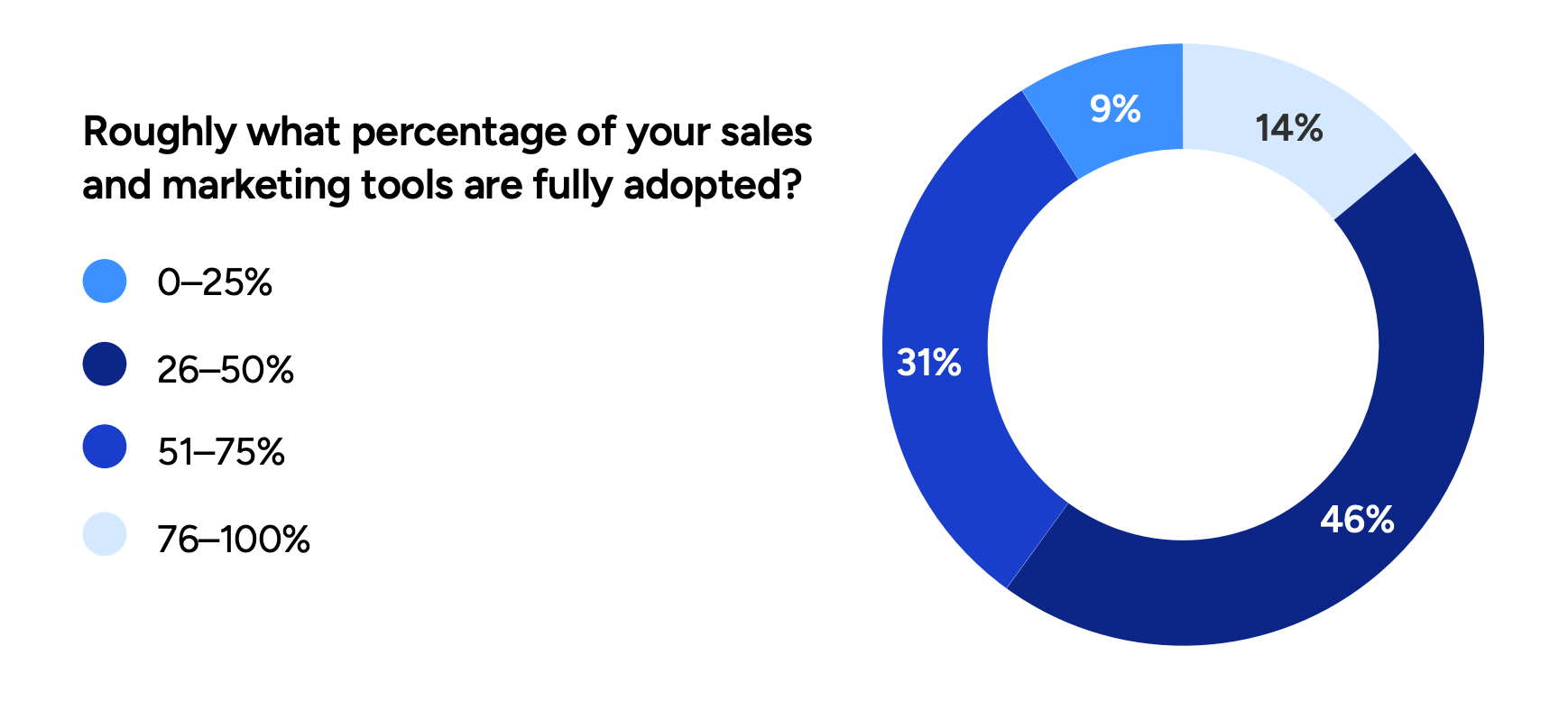
When alignment breaks down, the immediate instinct for many managers is to purchase another tool. The report finds that 56% of GTM professionals struggle with tool bloat, and 60% of teams utilize less than half of their current tech stack. This "buying" mentality actually exacerbates the problem; it creates more silos and increases maintenance overhead. Conversely, teams that consolidated their tech stacks reported significantly higher lead quality and operational speed.
The Incentive Mismatch
Perhaps the most stubborn obstacle is the compensation model. If marketing is incentivized by lead volume and sales by closed-won revenue, they are structurally predisposed to conflict. As investor Charlie Munger famously noted, "Show me the incentive and I will show you the outcome." Until the compensation architecture is aligned with shared business goals, philosophical agreements on alignment will rarely translate into behavioral changes.
Moving the Needle: A Roadmap for Alignment
To escape the cycle of misalignment, SMBs must move beyond surface-level fixes and implement three core operational changes:
1. Jointly Define the Buyer and the Lead
Buyer personas should not be a "marketing deliverable" presented to sales; they must be a co-authored document. By incorporating sales’ firsthand knowledge of buyer objections into the initial marketing strategy, teams can ensure that marketing content is actually relevant to the prospects sales is trying to close.
2. Standardize the Handoff Process
A formal Service Level Agreement (SLA) is required. This should define exactly what information must be included in a lead handoff, the timeline for follow-up, and the feedback loop for rejected leads. When sales provides clear, timely feedback on why a lead was disqualified, marketing can iterate on their targeting in real-time.
3. Unify the Tech Stack
Leaner is almost always better. High-performing teams focus on consolidating their stack into a set of tools that both teams actually use and trust. By reducing the number of platforms, organizations can minimize data fragmentation and ensure that every member of the GTM team is operating from the same data set.
Implications for the Future
The path to higher revenue efficiency for SMBs in 2026 and beyond is not through bigger budgets or more complex tools. It is through the rigorous, often difficult, work of aligning the operating model.
As the report concludes, the strongest alignment moves are the ones that are hardest to implement: reconciling incentives, forcing agreement on lead quality, and cutting the "bloat" from the tech stack. The organizations that succeed in this transformation will find themselves with a distinct competitive advantage—a lean, agile, and unified revenue engine that turns every marketing dollar into a clearer path to a closed deal.
For businesses looking to benchmark their own progress, the full Unbounce report offers over 50 data points and specific frameworks for diagnosing the exact "alignment leak" currently hindering their growth. In an era of increasing customer acquisition costs, bridging the gap between sales and marketing is no longer just a "nice-to-have"—it is an existential imperative.