In the contemporary digital landscape, a product’s success is rarely determined solely by individual talent. While brilliant designers and skilled researchers are foundational, the true catalyst for impactful digital experiences lies deeper within an organization’s structural DNA. This systemic integration—known as UX maturity—dictates how a company prioritizes, funds, and executes user experience across its entire portfolio.
According to UX expert Victor Yocco, simply being proficient at individual design tasks is no longer enough. To truly elevate the craft and deliver exceptional value to end-users, practitioners must act as organizational advocates, actively scaling UX maturity across their broader enterprises.
Main Facts: Decoding Organizational UX Maturity
UX maturity goes far beyond the subjective design aesthetics of a website or app. It measures the presence, sophistication, and operational integration of user experience philosophies, processes, and tools within an organization’s core business practices.

As noted by industry researchers Chapman and Plewes (2014), "Achieving great UX design is not just a function or talent of individuals, it is an organizational characteristic."
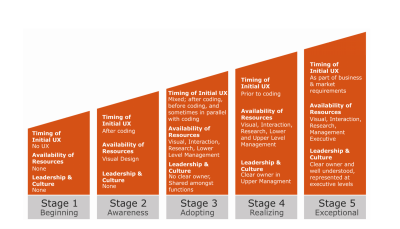
UX maturity typically spans five distinct stages, moving from a "Beginning" phase—characterized by zero UX presence, scarce resources, and a lack of leadership buy-in—to an "Exceptional" phase. In an exceptional organization, UX is fully embedded into corporate workflows, backed by ample funding, championed by executive leadership, and supported by a culture deeply attuned to user needs.
However, many product teams find themselves stranded in the earlier, less mature stages of this continuum. Operating in environments with low UX maturity often breeds frustration, as practitioners struggle to secure resources, prove their worth, and influence high-level product decisions. Overcoming this hurdle requires moving beyond mere design theory and implementing deliberate, scalable strategies.
Chronology: The Journey from Isolation to Enterprise Integration
The path toward elevated UX maturity rarely happens overnight. It requires a deliberate, chronological approach that shifts an organization from fragmented, one-off design efforts to a cohesive, enterprise-wide strategy.
- Phase 1: The Awareness Gap. In early-stage organizations, UX is treated as an afterthought—if it is considered at all. Design tasks are often delegated to developers or product managers operating strictly from technical requirements, resulting in disjointed user experiences.
- Phase 2: Finding a Foothold (Months 1–3). When specialized UX practitioners or consultants enter the fold, their immediate priority must be listening, mapping relationships, and identifying key internal stakeholders. By targeting critical product initiatives, practitioners can secure early opportunities to conduct foundational research and usability testing.
- Phase 3: Cultivating Alliances. Practitioners identify and empower informal "UX champions"—influential colleagues who are well-connected and motivated to solve user pain points. These champions begin opening doors to executive leadership, bridging the communication gap between design teams and business decision-makers.
- Phase 4: Demonstrating Tangible Value (Months 6–12). Armed with baseline metrics, user surveys, and analytics dashboards, teams begin tying UX outputs directly to key performance indicators (KPIs) and return on investment (ROI).
- Phase 5: Cultural and Process Transformation (Years 1+). Over time, successful validation leads to permanent headcount allocations, dedicated testing budgets, and institutionalized UX workflows. User-centric thinking shifts from a buzzword to a mandatory corporate practice.
Supporting Data: Proving the Value and Overcoming Myths
One of the most persistent roadblocks to growing UX maturity is the challenge of proving its financial and operational return on investment. Stakeholders accustomed to traditional profit-and-loss metrics often view design as an abstract cost center rather than a revenue driver.
According to the Nielsen Norman Group (NNG), calculating UX ROI is frequently hindered by common myths that convince teams not to bother measuring design impact. Overcoming these misconceptions is vital for earning executive buy-in.

Furthermore, ROI does not strictly equal monetary profit. Depending on the industry and product type, organizations can leverage a diverse array of metrics to build a compelling business case for UX:
- Efficiency Metrics: Speed to complete routine tasks, reduction in user error rates, and shortened onboarding curves.
- Support Metrics: Decreased call-center volume, lower ticket counts for customer service, and reduced requests for walk-through assistance.
- Engagement and Retention Metrics: Conversion rates, cart abandonment drops, app store review ratings, and customer satisfaction (CSAT) scores.
By establishing baseline measurements early—even if current performance metrics are less than desirable—practitioners create a benchmark against which all future design iterations can be measured, clearly demonstrating how UX enhancements directly improve operational health.
Official Case Studies: Real-World Applications
To understand how these strategies play out in practice, examining real-world deployments provides invaluable insight into scaling UX maturity from the ground up.

Case Study 1: Transforming Logistics Through UX Champions
A major international logistics enterprise was undergoing a massive backend technology transformation to unify disparate entities onto a single platform. Despite claiming to be "customer-first," the company lacked uniform UX processes, and design work was largely restricted to reactive, one-off fixes for major clients.
Brought in as a consultant to infuse UX into the transformation pipeline, Yocco began by mapping workflows and interviewing stakeholders. Rather than pushing for top-down executive mandates, the team identified a pivotal product owner who acted as an ideal UX champion. Though not an executive, this champion was highly motivated, well-connected, and deeply invested in the success of a core product stream.
Empowered with UX education, examples, and resources, the champion opened doors across departments. Within three months, the initiative established a formal repository of research reports, embedded usability testing into development sprints, secured permanent UX headcount for the product, and built a thriving internal network of design advocates.

Case Study 2: Demonstrating ROI at a Medical Insurance Provider
A large medical insurance provider acquired multiple smaller companies, forcing independent and exclusive agents onto an unfamiliar, unified platform. Rolled out in geographic phases without any initial UX budget or oversight, the system immediately backfired: agents abandoned the platform entirely, and the call center was overwhelmed with frantic requests for basic tasks like running quotes.
Brought in to establish a usability workstream, the UX team immediately conducted user interviews and usability testing to triage critical flaws. To secure continued funding from the executive committee for subsequent rollout phases, the project leaders collaborated to build an analytics dashboard tracking user satisfaction, call-center volume, and quote completion rates.
By establishing a clear benchmark during the troubled first phase, the team successfully demonstrated that subsequent UX-optimized releases drove higher initial satisfaction and significantly reduced support burdens. The executive committee approved ongoing funding, cementing UX as a mandatory component of all future digital product development.

Strategic Implications for the Future of Work
The push to elevate UX maturity carries profound implications for organizations navigating digital transformation. When companies treat UX merely as a cosmetic layer applied at the end of a development cycle, they risk alienating users, wasting engineering hours, and eroding customer trust.
Conversely, organizations that intentionally cultivate UX maturity—by actively identifying and nurturing internal champions and relentlessly demonstrating the multifaceted value of design—build resilient, customer-centric cultures.
As Yocco outlines, the responsibility for this evolution rests heavily on UX practitioners themselves. By looking beyond daily design tasks and stepping into roles as educators, strategists, and data-driven advocates, professionals can transform their organizations from the inside out, ensuring that user experience drives not only better products, but healthier, more profitable businesses.