
As the field of User Experience (UX) continues its meteoric rise, organizations are finding that their traditional research methods are struggling to keep pace with the hyper-accelerated nature of modern product development. As the discipline matures, scalability has moved from a "nice-to-have" to a survival imperative. To remain relevant in an era of agile sprints and rapid iterations, research teams must evolve. One of the most effective strategies for this evolution is the implementation of a Rapid Research Program.
A Rapid Research program is not merely "rushed" research; it is a standardized, templatized, and highly disciplined framework designed to deliver actionable user insights at a velocity that matches the heartbeat of engineering and product teams.
The Core Concept: What is Rapid Research?
At its simplest, Rapid Research is an operational model where research processes are streamlined to ensure a consistent, repeatable cadence of insights. By utilizing guardrails, standardized templates, and a predefined scope, teams can move from problem identification to actionable data in a fraction of the time required by traditional, bespoke studies.
The primary objective is twofold:

- Operational Velocity: Delivering insights within the window of a standard product sprint (typically 1–2 weeks).
- Bandwidth Optimization: Freeing up senior researchers from repetitive evaluative tasks, allowing them to focus on complex, high-impact generative discovery work.
The Four Pillars of the Program
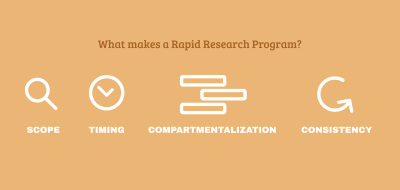
To build a successful framework, organizations must balance four critical components:
- Scope: Defining what can and cannot be researched within a compressed timeframe.
- Timing: Establishing a strict, end-to-end cadence that provides predictability for stakeholders.
- Compartmentalization: Breaking down the research process into independent, modular units to eliminate bottlenecks.
- Consistency: Ensuring that the output quality remains high, regardless of the speed at which it is delivered.
A Strategic Chronology: Building from Scratch
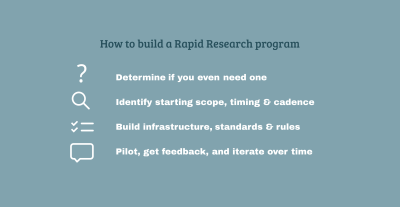
Establishing a Rapid Research program is a significant undertaking that requires architectural foresight. Based on industry standards, the following chronology serves as a roadmap for implementation.
Phase 1: The Diagnostic Audit (Months 1–2)
Before launching, you must determine if your organization actually requires a Rapid Research program. This involves an internal audit of existing research requests. Are your researchers constantly bogged down in tactical validation? Are product managers bypassing research because the timelines are "too slow"? Use this phase to document current bottlenecks, average study durations, and the most frequent methodologies requested by product teams.
Phase 2: Defining the Operational Infrastructure (Months 3–5)
Once the need is validated, you must build the "pipes" of the program. This includes:
- Templatization: Creating standardized intake forms, discussion guides, and reporting formats.
- Staffing Models: Deciding whether to utilize internal junior researchers, hire dedicated specialists, or partner with an external research vendor.
- Buy-in Acquisition: Securing stakeholder agreement on the "rules of engagement," including SLAs for feedback loops and the limits of the program’s scope.
Phase 3: The Pilot Program (Months 6–9)
Never launch a full-scale program in a vacuum. Start with a pilot phase involving a select group of "friendly" product teams. Treat these initial projects as live experiments. Collect feedback at every milestone: Where did the process stall? Was the recruitment too slow? Did the insights reach the team in time to influence the sprint?
Phase 4: Full Integration and Iteration (Month 10+)
With the pilot learnings in hand, refine the program’s policies. Standardize the "must-haves" for every study and begin rolling the program out to the broader organization. Continue to track impact metrics—such as the number of usability issues caught upstream—to justify the program’s ROI to leadership.
Supporting Data: Why Speed Matters
The transition to a Rapid Research model is supported by compelling operational data. Research indicates that when teams successfully integrate rapid, evaluative research into their workflows, they can realize significant cost and efficiency gains.
Efficiency Gains
- Throughput: Organizations that implement dedicated Rapid Research teams often see a 2x increase in project throughput compared to ad-hoc, siloed research models.
- The 100x Rule: Research suggests that addressing usability issues during the design or prototyping phase—facilitated by rapid, iterative testing—is significantly cheaper than fixing those same issues post-launch. Industry benchmarks often cite this as a 100x reduction in overhead costs associated with rework and technical debt.
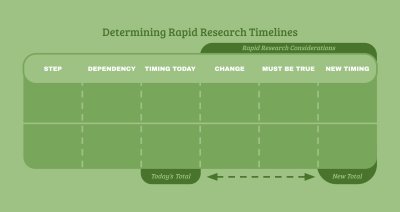
- Predictability: By compartmentalizing the workflow, teams move from "unknown" research timelines to a "predictable cadence," which allows product managers to plan their development cycles with higher confidence.
Official Perspectives: Balancing Rigor and Velocity
Leading industry experts, including those from organizations like Google and various top-tier tech firms, emphasize that Rapid Research is not about cutting corners—it is about selective rigor.
According to internal documentation from firms that have matured these programs, the goal is to "right-size" the methodology. For instance, while a longitudinal diary study might be inappropriate for a 2-week sprint, a focused, remote, moderated usability session with five participants is perfect.
The Expert Consensus
- On Recruitment: The biggest bottleneck in any study is participant acquisition. To stay "rapid," organizations must maintain a pre-vetted panel or a steady stream of participants who match the primary user personas.
- On Transparency: Leaders emphasize that the "Rapid" label should come with a disclaimer: these programs are for tactical, evaluative questions. For long-term strategic discovery, the organization should still rely on deep-dive, traditional research methods.
Implications: The Long-Term Strategic Impact
The implementation of a Rapid Research program fundamentally alters the culture of an organization. It changes how product managers, designers, and engineers interact with data.
1. Shift Toward Generative Research
Perhaps the most profound implication is the shift in the research team’s portfolio. By offloading the "grind" of iterative testing to a dedicated rapid process, high-level researchers are liberated to tackle generative discovery. This allows the organization to move from purely reactive UX (fixing bugs) to proactive, strategy-driven innovation.
2. Democratization vs. Professionalization
Rapid Research acts as a bridge. It allows for a level of "research democratization" where product teams feel empowered to get answers quickly, while maintaining the professional standards of the research operations team. It creates a "middle way" where quality is maintained by the infrastructure, even if the person conducting the session is not a PhD-level anthropologist.
3. Risk Mitigation
The "Pilot" approach is not just a project management tool; it is a cultural safety net. By treating the first several months as an iterative process, the research team manages expectations. It ensures that if the program hits a snag—such as a legal compliance bottleneck or a recruitment failure—it is treated as a process improvement opportunity rather than a failure of the program itself.
The Bottom Line: When to Say "No"
A critical implication of a successful program is the ability to say "no." Not every question requires a formal research study, and not every study fits the "rapid" mold. A mature research department must provide clear guidance on when the Rapid Research program should be bypassed in favor of either desk research, data analytics, or a deep-dive, multi-week discovery project.
Final Considerations
Standing up a Rapid Research program is a significant, yet highly rewarding, investment. Depending on the organizational complexity, the ramp-up time can take between three months and a full year. However, for organizations aiming to achieve true research maturity, the benefits—greater throughput, deeper strategic insight, and a tighter integration with agile product development—make it an essential component of the modern design organization.
By building with intention, setting clear guardrails, and iterating based on real-time feedback, you can transform your research practice from a bottleneck into a primary engine for organizational growth.