SAN FRANCISCO — In the modern landscape of B2B sales, speed and personalization are no longer just competitive advantages—they are existential requirements. For years, high-ticket event sponsors and enterprise software buyers have tolerated agonizing wait times, generic round-robin routing, and soul-crushing PDF prospectuses delivered days after expressing initial interest.
Now, a quiet revolution is taking place at SaaStr. By completely overhauling their inbound pipeline with a suite of custom-built AI agents, the team has managed to scale operations to an extraordinary degree. Over the past 12 months, their inbound AI agent has handled 17,000 distinct prospect conversations and successfully booked approximately 600 high-intent meetings for the upcoming SaaStr AI Annual 2026 conference. Looking ahead to 2027, the volume has doubled.
Most remarkably, this entire infrastructure—driving a 60% increase in new business—is operated and maintained by a team of just three humans.
On a recent episode of The Agents, leadership walked through the complete blueprint of how they replaced traditional, bloated sales funnels with an automated, real-time engagement engine.
Main Facts: The Anatomy of an AI-First Sales Operation
The transformation at SaaStr did not happen overnight, nor was it built on the back of a massive engineering team. Instead, it was constructed methodically, replacing outdated human bottlenecks with intelligent, contextual automation.
- The Scale: Over 17,000 inbound AI conversations in 12 months, resulting in roughly 600 booked meetings for SaaStr AI Annual.
- The Growth: Pipeline generation for the 2027 event is running at nearly double the pace of the previous year.
- The Impact: A 60% overall increase in new business generation.
- The Team: Just three human operators oversee the entire system, leveraging AI to handle discovery, data enrichment, lead routing, and custom pitch generation.
- The Tech Stack: Built using tools like Qualified (for on-site chat avatars), Replit (for tokenized dynamic web pages), Microsoft Clarity (for behavioral heat mapping), and custom AI agents coordinated by advanced models like Fable 5.1.
Chronology: From Static Forms to Dynamic, Agentic Sales
To understand the magnitude of the shift, one must look at how the sales process operated just over a year ago.
The Old World: The "Worst Email on Planet Earth"
Thirteen months ago, the inbound funnel for high-ticket sponsorships (averaging around $90,000) relied on friction. A prospect would navigate to the sponsor page and encounter a long-form contact form. Upon submission, the lead landed on Amelia’s desk. She would manually round-robin the lead to herself or David.
Inevitably, a human would respond roughly 24 hours later with what Amelia describes as the worst email on planet Earth: a generic template stating, "Hey [Company], you look like a great fit for SaaStr AI, let’s book a time," accompanied by a Calendly link.
The customer had raised their hand, only to be met with a delayed, soul-crushing form letter. Valuable leads slipped through the cracks in the gap between "submitting a form" and receiving a coherent human response.
Phase 1: Deploying the On-Site Inbound Agent
Realizing the bar was exceptionally low, SaaStr introduced their first major upgrade: an on-site AI agent deployed via Qualified, acting as an avatar named "Amelia AI."

Instead of placing the agent on the homepage, they strategically targeted their highest-intent real estate—the SaaStr AI Annual sponsor page. Here, prospective buyers evaluating massive financial commitments could instantly get answers to complex questions.
Crucially, the agent’s primary job was not merely to chat, but to qualify. It worked through real-time discovery questions, mapping out buyer intent instantly. Once qualified, the agent bypassed the traditional handoff and booked the meeting on the spot. When the human sales reps hopped on the call, they didn’t waste the first ten minutes on repetitive discovery; they picked up precisely where the AI left off.
Phase 2: Solving the Self-Serve Gap
Despite the success of the chat agent, a significant portion of buyers preferred not to chat with an AI avatar. Many simply wanted to review packages and pricing privately. For a year, SaaStr relied on a static Google Slides prospectus download link for these self-serve users. It converted poorly.
Taking a cue from their own internal renewal agents, the team built a second layer of inbound automation designed to capture intelligence from self-serve visitors without requiring them to type a single message in a chat box.
Supporting Data and the Mechanics of the New Funnel
The second phase of the build introduced a sophisticated, multi-layered data ingestion and personalization loop. Here is how a self-serve lead is processed today:
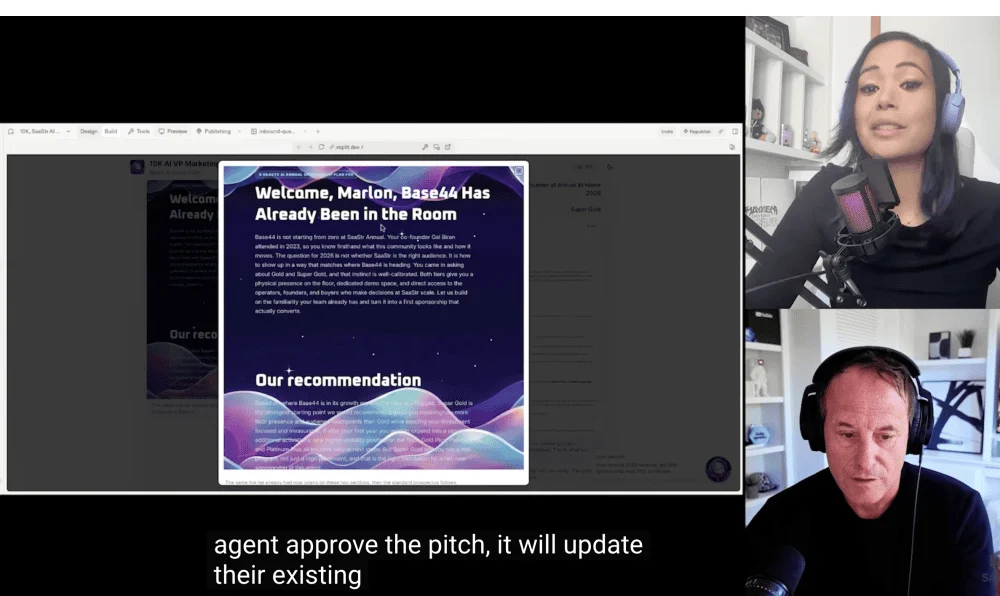
- Tokenized Web Pages (Replacing the PDF): When a prospect fills out a short form, they receive a unique, company-specific URL hosted on their own site (built via Replit) rather than a static PDF. This allows SaaStr to track engagement continuously rather than losing visibility the moment a file is downloaded.
- Behavioral Heat Mapping: Utilizing Microsoft Clarity (recommended autonomously by their AI VP of Revenue, "10K"), the system tracks exactly where the prospect spends time—whether lingering on the Gold package, reviewing Super Gold, or hesitating on specific terms.
- The 10-Minute Rule: To ensure the session data is complete, the system waits 10 minutes after a visitor leaves before triggering the agentic workflow.
- First-Party Signal Prioritization: Before looking at third-party data vendors, the agent analyzes internal historical data: has this company sponsored before? Did their CEO attend a previous event? Who are their primary competitors?
- Multi-Channel Routing: Once the data is compiled, the lead is pushed simultaneously to Slack, Salesforce, internal dashboards, and email channels.
- Automated Pitch Generation: The agent drafts a hyper-personalized pitch in 30 to 60 seconds, highlighting public competitor participation and recommending specific packages. A human operator (Amelia) reviews and approves the email before it is sent from a personal account.
- Living Documents: The prospect’s unique URL dynamically updates. If they return to the link later, it greets them by name and adapts to the ongoing sales cycle.
- Custom-Built Booking Engines: Rather than relying on disconnected calendar tools, the AI built a custom booking link in 20 minutes that ties directly back to the prospect’s personalized prospectus and tracks viewing behavior.
- Intelligent Routing: Leads are routed not just randomly, but to the sales rep who owns the most similar accounts in their portfolio (e.g., matching a company with the rep who successfully closed competitors like Replit or Lovable).
Official Insights and System Architecture
Building an autonomous sales engine of this caliber does not require a massive software engineering department. SaaStr’s infrastructure relies on a lean, modern stack:
- Chat Interface: Qualified
- Dynamic Hosting: Replit
- Analytics & Heat Mapping: Microsoft Clarity
- Orchestration & Reasoning: Advanced large language models, including Fable 5.1.
However, scaling such a system requires discipline. The team noted several critical guardrails based on early missteps:
- Avoid Monolithic Bloat: At one point, the backend app ("10K") began degrading in quality because it was overloaded with too many APIs and excessive data. Modularizing the system restored its efficiency.
- Stair-Step Implementation: Trying to build an entire automated ecosystem at once is a recipe for failure. SaaStr ran their basic on-site chat agent successfully for nearly a full year before layering on the self-serve web prospectus and automated follow-up systems.
- Democratize Access: While Amelia interacts seamlessly with the backend AI agents, other team members still rely heavily on traditional interfaces like Salesforce. Bridging this internal gap is the next frontier for their development roadmap.
Implications for the Broader B2B Market
The success of SaaStr’s AI-driven sales funnel signals a profound shift in how tech-centric and AI-native buyers expect to evaluate products. When selling to modern software companies, artificial intelligence in the sales cycle is no longer viewed as a gimmick—it is expected. If an organization positions itself as a cutting-edge tech entity but forces buyers to wait two days for a generic PDF and a delayed follow-up, sophisticated prospects immediately notice the friction.
At the same time, this model underscores a vital nuance: buyer segmentation matters. While tech-centric buyers readily embrace instant AI qualification and self-serve tokenized prospectuses, traditional buyers may still require conventional high-touch pathways. SaaStr’s ongoing strategy of running multiple parallel doors ensures that no buyer is alienated while aggressive efficiency gains are captured.
Ultimately, the experiment proves that the future of B2B revenue operations is not about replacing humans entirely, but about empowering a tiny, elite team with agentic systems that handle the heavy lifting of data gathering, personalization, and scheduling—leaving humans free to do what they do best: build relationships and close deals.