The marketing landscape is undergoing its most significant structural shift since the dawn of the internet. As "Agentic AI"—systems capable of independent execution, complex reasoning, and continuous optimization—becomes the industry standard, the traditional marketing agency contract has effectively become an artifact of a bygone era.
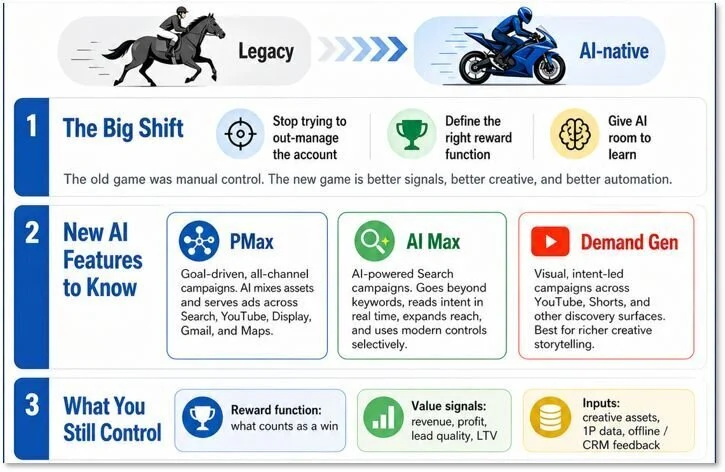
For decades, the agency business model has been built on the "execution army": armies of junior employees performing manual tasks, such as bid adjustments, keyword sculpting, and exhaustive weekly reporting. However, in an age where platform-native AI (such as Google’s PMax or Meta’s Advantage+) handles these tasks with superior speed and accuracy, the old model is no longer just inefficient—it is actively counterproductive. To thrive, brands and agencies must transition from a model based on billable hours and media spend percentages to one rooted in strategic outcomes and high-level governance.
The Death of the Execution Army: Main Facts
The primary tension in modern marketing is the disconnect between automated capabilities and legacy contractual incentives. Current agency agreements often reward the very behaviors that modern AI is designed to automate: micro-optimization, frequent campaign adjustments, and high-volume media spending.
When an agency is paid a "percentage of media spend," their financial incentive is to encourage higher budgets, regardless of whether those dollars are driving incremental profit. Furthermore, when agencies perform manual, repetitive tasks—often termed "hygiene" or "optimization"—they frequently disrupt the learning cycles of algorithmic platforms. Modern AI models require stable, consistent data to optimize effectively. When human agencies "rescue" a campaign by making manual adjustments every few days, they reset the AI’s learning phase, creating a cycle of volatility that degrades performance.
A Chronology of Obsolescence
The transition toward Agentic AI has been a gradual, then sudden, process.
- The Early 2020s: Agencies focused on manual A/B testing, granular keyword management, and complex audience segmentation. These were considered high-value services.
- 2024-2025: Ad platforms rolled out massive updates to machine learning. "Smart" bidding and automated asset assembly moved from experimental to mandatory.
- The Present (2026): We have entered the era of the "Agentic Operating Model." The majority of performance marketing execution is now platform-led.
- July 2026 and Beyond: This is the critical juncture for contract renegotiations. Industry experts argue that by this date, any contract not aligned with outcome-based incentives is essentially a tax on the client’s efficiency.
Supporting Data: The Case for Contractual Reform
The potential for cost savings is substantial. By stripping away manual tasks that have been superseded by AI, companies can expect a significant reduction in traditional overhead while redirecting funds toward high-impact growth initiatives.
Based on current industry analysis, agency work can be broken down into clusters where massive efficiencies are available:
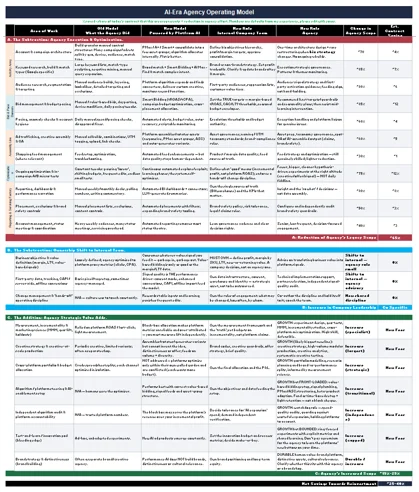
- Agency Activity Army (Architecture/Segmentation): This represents approximately 22% of contract costs. Modern AI has reduced the need for manual architecture design by 78%.
- The Bid & Pace Dancers: Manual bidding and day-parting account for 14% of costs. Automation handles this with greater precision, rendering 73% of this human effort redundant.
- The Assembly Line: Trafficking, QA, and creative variation builds account for 12% of costs. With Generative AI, 45% of this effort is now automated.
- The Optimization Theater: Daily rituals of "pausing losers" and minor tweaks represent 16% of costs. These are now largely destructive, as AI platforms run continuous explore-exploit cycles. 75% of this work should be eliminated.
- The Reporting & Servicing Factory: The most bloated area (30% of costs) involving weekly decks and check-ins. Through real-time data lakes and automated insights, 60% of this "reporting" overhead is unnecessary.
When these reductions are aggregated, a business could theoretically reduce their agency fee structure by 60% to 75% simply by eliminating tasks that no longer add value.
The New Operating Model: Implications for Agencies
While this transition may appear threatening to traditional agency leaders, it represents a profound opportunity for evolution. The "hamster wheel" of manual reporting and execution is being replaced by the "consultancy of outcomes."
Redefining Value
Agencies are not becoming obsolete; their value is simply migrating upstream. The new agency role focuses on:
- Governance and Guardrails: Defining the "reward functions" for AI, setting brand safety parameters, and establishing margin protection bands.
- Strategy and Creativity: Shifting from "creating variations" to "ideating core concepts" that inform the AI’s generative engine.
- Cross-Platform Synthesis: Managing the "outside-in" view of consumer behavior, which remains a human-led, strategic exercise.
The Financial Shift
To align incentives, the new contract structure should look fundamentally different:
- Lean Base Retainer (40-50%): Covers governance, steering, and data engineering.
- Project Fees (30-40%): Reserved for high-value strategic analytics, creative concepting, and portfolio-wide strategy.
- Outcome Incentives (15-25%): Tied directly to incremental profit or verified lift, rather than platform ROAS or media spend.
Official Perspectives and Expert Insight
Industry leaders are increasingly vocal about the need for this shift. The consensus among those who have managed both sides of the table—ad platforms and agency leadership—is that "over-touching" is the silent killer of modern campaign performance.
The most successful agencies of the next three years will be those that embrace "Agentic wrangling." These agencies will hire fewer, but higher-skilled individuals who act as architects of AI systems rather than operators of ad platforms. This allows for a more robust wage structure for employees, moving away from the "churn and burn" model of hiring juniors at low wages to perform manual tasks.
Strategic Action Plan for Clients
For CMOs and Procurement departments, the path forward involves three immediate actions:
- Audit the SOW: Identify every line item related to manual bidding, reporting, or trafficking. These are your "subtractions."
- Renegotiate, Don’t Just Cut: The goal is not merely to save money, but to reallocate fees toward areas the AI cannot solve: high-level strategy, creative conceptualization, and complex data governance.
- Demand Data Ownership: As agencies transition to a more advisory role, ensure full ownership of all pixels, ad accounts, and data streams. Never allow an agency to become a "black box" where data is held hostage.
Conclusion: A Bright Future for the Adaptable
The "Agentic AI Era" is not a funeral for the agency business; it is a long-overdue transition to a higher form of service. By shedding the "execution army" and embracing the role of a strategic partner, agencies can move from being seen as a cost center to being viewed as an indispensable growth engine.
The math is clear: those who continue to pay for the "illusion of work" will see their margins evaporate and their performance suffer as they fight against the very algorithms they are paying to manage. Conversely, those who pivot toward outcome-based, AI-integrated contracts will unlock a new era of efficiency and business impact. The future belongs to those who stop "doing" and start "deciding."
For the modern marketer, the instruction is simple: Stop paying for the past. Start investing in the future.