In an era defined by hyper-efficient, long-range digital infrastructure, clinging to manual legacy processes is not merely inefficient—it is a strategic liability. This paradigm shift is nowhere more evident than in the evolution of Google Ads. As the platform transitions from a manual, keyword-driven interface to an AI-native ecosystem, marketing professionals face a binary choice: evolve into AI-integrated strategists or remain tethered to the "horse-and-buggy" tactics of the early 2000s.
The prevailing industry debate—often centered on the tired dichotomy of "brand versus non-brand" search—misses the fundamental reality of the modern digital landscape. Search marketing is no longer about human-level micro-adjustments to match types, geo-targeting, or bid modifiers. It is about feeding the machine the right data and allowing it to optimize for business outcomes that actually matter.
The Chronology of Transformation: From Manual Control to AI Autonomy
The transformation of the Google Ads ecosystem has been a long, deliberate journey, yet many agencies and in-house teams continue to operate as if they are working within the constraints of the 2005 AdWords interface.
The Legacy Era (2000–2015)
For over a decade, professional success in search marketing was defined by "sculpting" accounts. Advertisers spent their days obsessed with exact-match keywords, granular device bidding, and manual hourly adjustments. The "expert" was the person who could make the most manual changes in a single day. This was a era of control, where the human brain was the primary decision-making engine in every auction.
The Hybrid Transition (2016–2022)
As machine learning began to permeate the Google stack, we entered a hybrid period. Smart Bidding was introduced, and while many teams adopted it, they simultaneously maintained legacy structures. This created a friction-heavy environment where automation competed with manual "guardrails," often leading to suboptimal performance as human intervention inadvertently stifled the machine’s ability to learn.
The AI-Native Present (2023–Present)
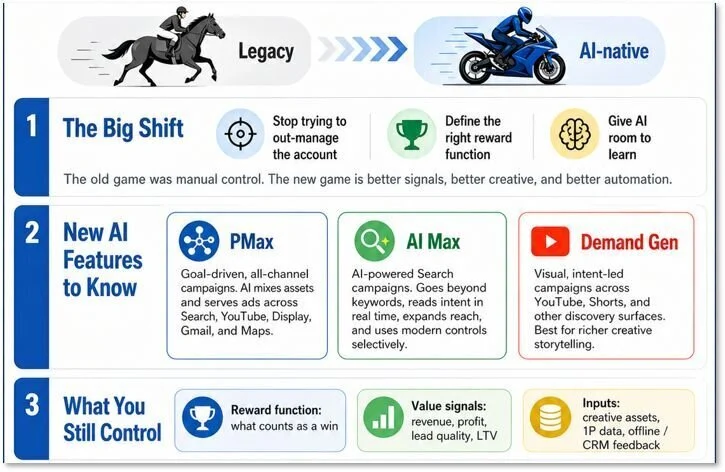
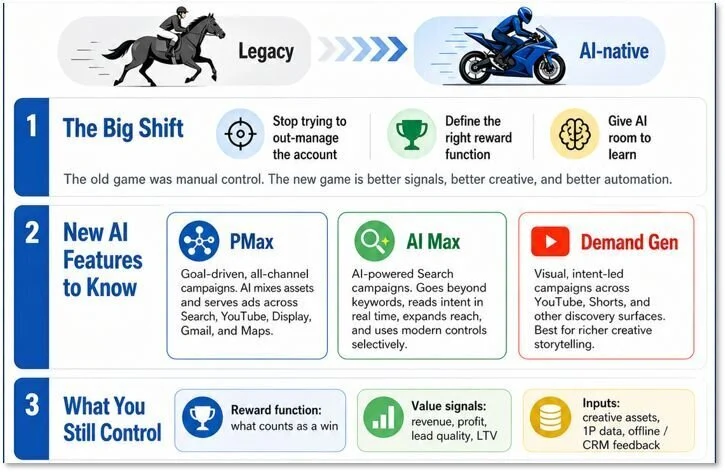
Today, we are in the era of "AI-first" performance. With the advent of Performance Max (PMax), AI Max, and Demand Gen, the platform has shifted from a keyword repository to an intent-matching engine. The system now evaluates signals that no human can process—user intent, browsing behavior, and real-time contextual data—to serve ads across Search, YouTube, Gmail, Maps, and Display. The role of the marketer has fundamentally changed: we are no longer pilots; we are air traffic controllers setting the parameters for the system to execute.
Supporting Data: Measuring Your AI Maturity
To help professionals assess their current standing, industry experts have developed a "Google Ads Maturity Model." This framework moves beyond vanity metrics and focuses on two critical vectors: Capability (how sophisticated your tactics are) and Depth (how widely those tactics are deployed across your budget).
The Scoring Framework
A company’s maturity is measured across six core dimensions, scored on a scale of 0 (Legacy) to 4 (AI-native). By multiplying the capability score by the depth of deployment, marketers can identify exactly where they are failing to leverage the system’s full potential.
- 0: Legacy: Heavy reliance on manual bidding and exact-match keywords.
- 1: Pilot Phase: Testing automation, but with limited budget exposure.
- 2: Hybrid: Adopting smart bidding but maintaining excessive segmentation.
- 3: Modern: Core non-brand spend is managed by AI with minimal human interference.
- 4: AI-Native: Fully automated execution with human oversight focused on business outcomes.
The goal for any serious organization is a maturity score of 85 or higher. Anything below 70 indicates a "Legacy Operator" who is likely pulverizing potential profit through over-management.
The Six Dimensions of AI Maturity
Understanding where your organization falls requires an audit of six specific pillars of operation.
1. Measurement and Value Architecture
This is the most critical pillar, carrying a weight of 30 points. Google’s AI is only as good as the "reward function" it is given. If you are optimizing for pageviews or basic leads, you are providing the AI with low-quality data. Modern advertisers pass back CRM data, profit margins, and predicted Lifetime Value (LTV). If your measurement is weak, your automation is essentially building on sand.
2. Search Operating Model
The "motorcycle rider" approach to search involves abandoning the obsession with match types. It means trusting Smart Bidding to find intent rather than relying on an exhaustive list of manual keywords. The modern operating model leverages AI Max to expand audience reach beyond what human intuition could ever predict.
3. First-Party Data & Audience Intelligence
The ability to feed high-quality, offline customer signals into Google’s intelligence is a major differentiator. The more proprietary data you provide the machine, the more effectively it can identify "lookalike" high-value customers.
4. Surface Breadth & Campaign Mix
Legacy marketers often stick to their comfort zones (e.g., Search only). Modern maturity requires utilizing the full breadth of Google surfaces—including video and visual discovery—to capture intent across the entire customer journey.
5. Creative & Landing Page Adaptability
AI-driven campaigns require a wealth of assets. If you do not provide the system with diverse, high-quality images, videos, and copy, the AI cannot test and iterate effectively. The bottleneck to performance is often the creative production pipeline, not the bidding algorithm.
6. Operating Cadence & Governance
Mature organizations have shifted from "constant manual intervention" to "intelligent guardrails." Instead of checking accounts hourly, teams now focus on quarterly or monthly reviews of business outcomes and AI performance, adjusting guardrails only when necessary to protect the brand.
Official Perspectives: The Case for "Embrace and Extend"
Industry leaders, particularly those with deep roots in Google’s own product and engineering teams, advocate for an "embrace and extend" philosophy. The core argument is simple: the AI is not perfect, but it is better than the alternative.
"The choice to stay in the past is not available," notes former Google insider and analytics expert Avinash Kaushik. "The vast majority of performance marketing will be powered by AI. While the system may make mistakes, it learns and improves every single day. The trade-off is clear: you might lose a few auctions, but you will win significantly more in the long run by giving the machine the room it needs to optimize."
The professional consensus is that those who resist this transition are essentially choosing to "lose employer cash every single hour." By holding onto the manual controls of the past, marketers are actively putting their own careers in reverse gear.
Implications: The New Definition of "Marketing Success"
What does this mean for the future of marketing roles? It implies a move away from the tactical execution of "tinkering" toward the strategic management of "truth."
Shifting the Human Focus
The human element in marketing is not disappearing; it is being upgraded. The new, high-value tasks include:
- Data Integrity: Ensuring that the signal being sent to the AI is accurate and reflects true business value.
- Strategic Creative: Conceptualizing campaigns that resonate on an emotional level—something the AI still struggles to define.
- Governance: Setting the boundaries of the AI’s behavior, ensuring it aligns with brand safety and long-term ethical goals.
The Cost of Inaction
The cultural pain of learning this new game is significant. It requires unlearning decades of "best practices" that are now obsolete. However, the financial implications are massive. Organizations that make the leap to high-maturity scores frequently report performance gains of 3x, 5x, or even 20x.
Avoiding Self-Deception
One of the greatest dangers in this transition is the tendency for teams to "fake" their maturity. It is easy to claim high-level sophistication while still running legacy campaigns under the hood. To avoid this, audit the top 80% of your spend. If that spend is not driven by modern, value-based automated signals, you are not as mature as you think you are.
Conclusion: Carpe Diem
The era of the "Search Marketer" as a manual auction-tinkerer is over. The new game is about feeding the machine better truth, better assets, and better value signals. It is about letting go of the soul-sucking, repetitive tasks of the AdWords era to focus on the business outcomes that actually scale revenue.
The tools are ready. The methodology is defined. The only variable remaining is the willingness of marketing professionals to stop riding horses and start embracing the speed and efficiency of the AI-powered digital present. Those who choose to pivot today will define the next decade of performance marketing; those who do not will simply be left behind.