In the high-stakes world of digital advertising, data is the currency of trust. When a Chief Marketing Officer (CMO) or a media director decides to allocate an additional $5 million to a YouTube campaign, they are doing so based on the promise of measurable efficacy. For years, the industry standard for measuring this efficacy has been the Brand Lift, Search Lift, and Conversion Lift study. However, a closer inspection of Google’s own guidance on these metrics suggests that the statistical foundation of these reports may be far less robust than the polished dashboards lead us to believe.
As the industry grapples with the nuance of "statistical significance," a troubling discrepancy has emerged between what platforms define as a "good result" and what a business requires to justify a significant capital expenditure. At the heart of this issue is a term that has become a red flag for seasoned analysts: "directional results."
The Mirage of "Directional Results"
In the lexicon of marketing analytics, "directional" is often used as a sophisticated euphemism for "statistically inconclusive." It is a term that suggests a result is nuanced and reasonable, but in practice, it is a blank check for interpretation.
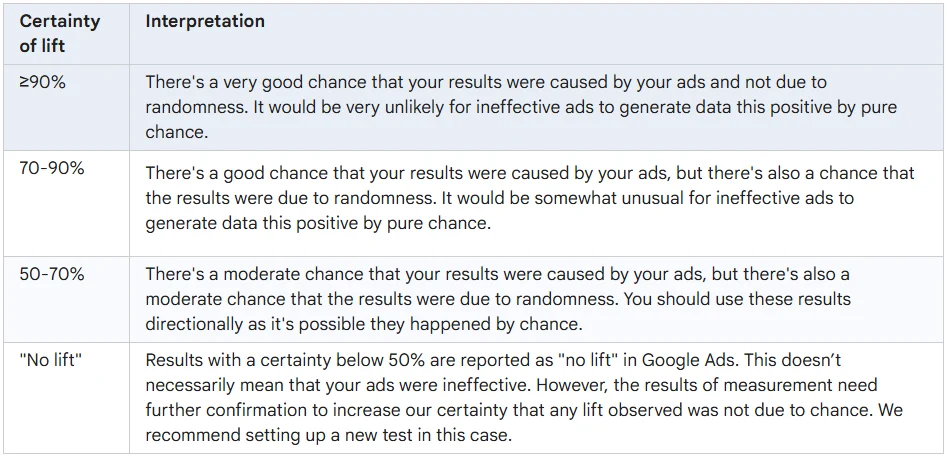
According to recent official guidance from Google, the platform categorizes the certainty of lift studies into various tiers. A 90% certainty is labeled a "very good chance," 70% to 90% is a "good chance," and 50% to 70% is a "moderate chance." Perhaps most concerning is the guidance that any study yielding a 50% or higher result can provide "valuable, directional insights."
For a media buyer, this sounds like a reassuring nudge to continue spending. However, when translated into plain English, these tiers essentially communicate: Your ads probably did something. And if the result falls into the lower tiers, the message shifts to: The ads might not have failed, so keep spending and let’s see what happens.
The Asymmetry of Incentives: Two Parties, Two Realities
To understand why these metrics are so contentious, one must look at the divergent incentives of the two parties involved.
Party One: The Platform (Google)
Google’s primary business model is the sale of advertising inventory. Their incentive structure is designed to encourage continued spending. If a study provides even a modicum of suggestive data that an ad campaign had a positive impact, the platform has every incentive to encourage the advertiser to interpret that data as a success. For the platform, the "cost" of a false positive is negligible; it simply leads to more ad spend.
Party Two: The Advertiser (You)
The advertiser operates under a completely different set of pressures. Their job is not to find "interesting" patterns in data, but to determine whether the evidence is strong enough to risk the company’s capital. When a CFO asks if a $5 million campaign worked, they are not asking for a "directional" sentiment; they are asking for evidence that the result is replicable.
This fundamental misalignment creates a scenario of "Heads Google wins, tails you lose." The platform provides the framework for the test, defines the success metrics, and provides the interpretation, all while shifting the entire risk of financial loss onto the advertiser.
The Mathematics of Replication Risk
The most damning critique of "directional" reporting is the failure to account for "Replication Risk." When a study reports a +3-point lift in brand consideration at 70% certainty, the intuitive response is to assume that if you spend the money again, you will see a similar result. However, statistical modeling suggests otherwise.
Using a Bayesian replication model—a methodology popularized by biostatisticians to ensure that clinical trial results aren’t just statistical flukes—we can calculate what happens if a campaign is repeated under identical conditions.
If we take a campaign that reports a 70% certainty (a "good chance" according to Google), the reality of replication is sobering:
- Probability of any positive lift: Even a miniscule, negligible increase has only about a 65% chance of occurring in a repeat trial.
- Probability of hitting a 90% certainty threshold: This drops to a mere 30%.
- Replication Risk: This is the probability that the repeat trial fails to provide evidence strong enough to justify a "spend again" decision.
In this scenario, there is a 70% chance that the advertiser will spend another $5 million and fail to get a result that justifies the investment. For a CFO, a 70% chance of failure is not a "good chance"; it is a massive financial risk.
The Case for a 90% Minimum Threshold
For experienced media professionals, the 90% confidence threshold is not a suggestion—it is the floor. It is the minimum level of evidence required to confidently tell a leadership team that an investment was effective.
However, even at 90% certainty, the replication risk remains surprisingly high (often around 50%). This is why high-level analysts frequently push for 95% confidence intervals. When dealing with substantial budgets, the goal is to increase the odds of a replicable success and lower the probability of "Type S" (sign) and "Type M" (magnitude) errors—errors where the direction or the size of the impact is incorrectly estimated due to weak evidence.
The "Directional" Trap and the Cost of Inaction
The danger of relying on "directional" data is twofold. First, it encourages the misallocation of resources toward underperforming campaigns that simply "look" promising. Second, it creates a culture of complacency where agencies and vendors are never held to a rigorous standard of evidence.
When a campaign is labeled as providing "valuable, directional insights," it gives stakeholders a false sense of security. It masks the reality that the evidence is too weak to support a strategic business decision. As the adage goes: "Weak evidence can hurt twice." It hurts when the initial investment fails to yield a return, and it hurts again when you double down on a strategy based on a flawed, "directional" interpretation.
Implications for Modern Media Strategy
If the goal is to protect the company’s budget and ensure that marketing spend is actually driving growth, the following shifts in strategy are necessary:
1. Reclaiming Risk Tolerance
Advertisers must stop outsourcing their risk tolerance to the very companies that profit from their spending. Just because a dashboard displays a "green" or "positive" indicator does not mean the data is statistically significant enough to warrant further investment. Define your own thresholds for success before the campaign begins.
2. Standardization of Reporting
Organizations should mandate a standardized format for statistical reporting. Whether a study comes from Google, Meta, TikTok, or an external agency, the reporting must be consistent. If the agency or vendor cannot provide the p-values, the standard deviations, and the replication risk, they are not providing enough information to make an informed decision.
3. The "CFO Math" vs. "Google Math"
Always perform a "CFO Math" audit on any platform-provided report. Ask the question: "If I spend this money again, what is the probability that I will be able to justify this spend to the board?" If the answer is anything less than a high-confidence threshold, treat the results as a learning hypothesis rather than a justification for budget scaling.
Conclusion: A Call for Accountability
Google’s guidance is, to its credit, carefully caveated. They do include lines suggesting that advertisers should interpret results based on their own business needs and risk tolerance. However, these disclaimers are often buried in the fine print, while the dashboard UI pushes the "good chance" narrative front and center.
The bottom line is that advertising platforms are not neutral arbiters of truth; they are participants in a market where they have a vested interest in the outcome of your spend. As such, the responsibility for statistical rigor rests solely with the advertiser.
In an era of tightening budgets and increased pressure to prove Return on Ad Spend (ROAS), the era of "directional" decision-making must come to an end. It is time for marketing professionals to move past the comforting, yet obfuscating, language of platform-provided metrics and embrace the harder, more transparent mathematics of actual business impact. Don’t let the advertising platform’s definition of "useful" become your company’s definition of "sufficient." Your budget, and your career, depend on it.