WASHINGTON — In a landmark coordinated strike against modern cybercrime infrastructure, Microsoft’s Digital Crimes Unit (DCU), operating under a federal court order, has successfully dismantled "EvilTokens"—a sophisticated, AI-driven phishing-as-a-service (PaaS) platform. The operation, executed in close partnership with the Health Information Sharing and Analysis Center (Health-ISAC) and a coalition of private-sector tech giants, has severed the operational backbone of a criminal enterprise linked to tens of thousands of corporate inbox compromises globally.
The takedown highlights an ominous evolution in the threat landscape: the weaponization of artificial intelligence not merely as a tool for initial social engineering, but as an autonomous, conversational co-pilot designed to navigate enterprise mailboxes, identify high-value financial targets, and orchestrate precision business email compromise (BEC) attacks at scale.
Main Facts: The Anatomy of the Takedown
The emergency enforcement action, authorized by the U.S. District Court for the Eastern District of Virginia, targeted the infrastructure underpinning EvilTokens. Microsoft and its coalition partners seized 50 distinct websites and disabled more than 150 domains used to host, distribute, and manage the phishing kits.
The operation was supported by a diverse alliance of cybersecurity stakeholders, including Cloudflare, Coinbase, OpenAI, SpyCloud, TRM Labs, and the Shadowserver Foundation. Together, these entities cut off EvilTokens’ access to content delivery networks, domain registrars, and cryptocurrency tracking channels, rendering the platform effectively inert.
According to telemetry released by Microsoft, EvilTokens has been systematically weaponized since February of this year. During its active window, the platform facilitated the compromise of more than 12,000 corporate inboxes across over 10,000 distinct organizations worldwide. Tracked by Microsoft threat intelligence teams under the designation Storm-2992, this marks the 40th successful court-authorized disruption executed by the DCU.
The financial fallout is already substantial. A Microsoft spokesperson confirmed that investigators have formally correlated at least 13 distinct FBI Internet Crime Complaint Center (IC3) reports directly to the EvilTokens operation, accounting for approximately $1.7 million in immediate, reported losses. Cybersecurity analysts emphasize that this figure is a highly conservative baseline, as many enterprise victims have yet to quantify secondary damages, intellectual property exfiltration, or operational downtime.
Chronology of the Operation: From Surveillance to Seizure
The dismantling of EvilTokens is the culmination of a months-long international intelligence-sharing and operational readiness campaign that bridged private-sector threat telemetry, judicial intervention, and physical law enforcement actions.
- February 2026: Microsoft’s Threat Intelligence center first observes anomalous device-code authentication spikes, eventually clustering the activity under the moniker Storm-2992. Early indicators suggest a novel, highly scalable phishing framework is being leased out via Telegram and dark web forums.
- Spring to Summer 2026: As the platform gains traction among lower-tier cybercrime syndicates, the DCU maps out its infrastructure, identifying key hosting providers, cryptocurrency payment gateways, and registrar touchpoints. Collaborative intelligence is pooled with infrastructure partners including Cloudflare and the Shadowserver Foundation.
- Early September 2026: Cross-jurisdictional intelligence pins down physical operators of the infrastructure. In coordination with international authorities, the U.K.’s Metropolitan Police execute dawn raids, arresting two primary suspects—identified in reports as 32-year-old Felix Utomi and 38-year-old Waidi Segun Adams. Both men are subsequently released on bail pending further investigation.
- Late September 2026: Armed with comprehensive operational intelligence, Microsoft secures a favorable ruling from the U.S. District Court for the Eastern District of Virginia. The DCU, alongside Health-ISAC and technical partners, executes the synchronized seizure of 50 websites and the blacklisting of over 150 domains. Microsoft concurrently publishes comprehensive technical analyses detailing both the device-code mechanics and the platform’s proprietary AI chatbot integration.
Supporting Data and Technical Architecture
The technical sophistication of EvilTokens sets it apart from traditional commodity phishing kits. While standard phishing campaigns rely on harvesting raw passwords or exploiting basic session cookies, EvilTokens perfected a multi-stage attack chain centered on device-code phishing.
The Device-Code Phishing Trap
The attack begins with convincing lures—often styled as routine administrative notifications from Microsoft or DocuSign. These pages present the victim with a unique alphanumeric device code. Unsuspecting users are directed to navigate to Microsoft’s legitimate, trusted authentication URL (microsoft.com/devicelogin), where they enter the code and willingly complete their organization’s Multi-Factor Authentication (MFA) challenge.
By performing this action, the victim unknowingly authorizes the attacker’s device. The resulting session token is immune to standard password resets and grants persistent access to the victim’s environment. Microsoft security researchers note that this method completely bypasses conventional credential-harvesting defenses by exploiting the intended convenience of cross-device application sign-ins.
"Vibe Coding" and the AI Mailbox Co-Pilot
What truly distinguished EvilTokens from its contemporaries was its post-compromise automation engine. Once inside an organization’s inbox, the platform deployed a specialized, integrated AI chatbot.
Rather than forcing human operators to manually sift through thousands of emails to find lucrative financial records, the EvilTokens chatbot autonomously:
- Scanned and indexed the victim’s entire email archive.
- Mapped internal corporate hierarchies, specifically identifying payment approvers, Chief Financial Officers, and accounts payable personnel.
- Analyzed historic invoice workflows, payment terms, and vendor relationships.
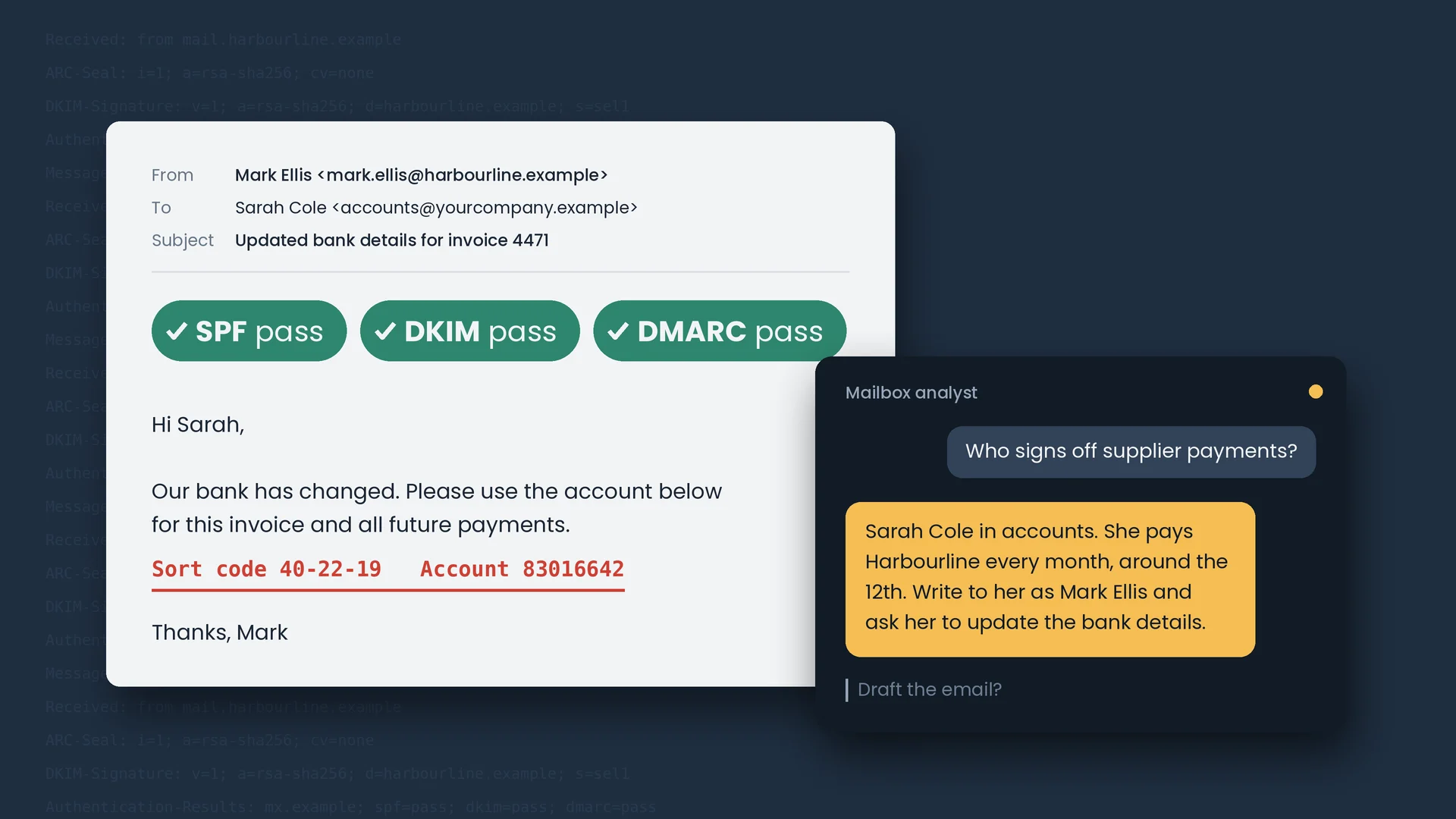
- Generated contextually tailored scripts and impersonation strategies, advising the attacker on which trusted contact to mimic for subsequent Business Email Compromise (BEC) frauds.
In an ironic twist of modern software engineering, Microsoft noted that large portions of the EvilTokens platform were "vibe coded"—meaning the cybercriminals utilized commercial generative AI tools to write the code for a platform that, in turn, used AI to steal and process corporate correspondence.
Official Responses and Industry Implications
The takedown of EvilTokens is part of a broader, aggressive strategic campaign by Microsoft to suppress the modern commodification of cybercrime. Over the past year, the DCU has methodically targeted and dismantled major email-fraud and phishing-as-a-service infrastructures, including RaccoonO365, RedVDS, Tycoon 2FA, and Fox Tempest.
Industry leaders and security analysts have been quick to point out the profound identity and authentication implications highlighted by the EvilTokens operation.
"Domain authentication proves the domain. It says nothing about who is holding the account."
This reality introduces an uncomfortable truth for enterprise security architects. When an attacker successfully hijacks a legitimate corporate mailbox, subsequent fraudulent emails sent to vendors or partners carry genuine DKIM signatures, originate from authentic mail servers, and seamlessly pass DMARC and SPF validations. Traditional email security gateways are rendered virtually blind to these threats because the traffic is, from a network-layer perspective, completely legitimate.
The Defense Paradigm Shift
Security authorities emphasize that modern defenses must shift decisively from perimeter-based email filtering to identity-centric access controls:
- Restrict Device-Code Sign-Ins: Organizations that do not explicitly require device-code authentication for business workflows should disable the capability globally via Azure AD / Entra ID Conditional Access policies.
- Behavioral Token Monitoring: Security Operations Centers (SOCs) must treat anomalous token usage, impossible travel involving authenticated sessions, and sudden programmatic access to mailboxes with the same urgency as failed login spikes.
- Out-of-Band Verification Protocols: Despite technological advancements in endpoint and email security, the human element remains a primary attack vector. The foundational rule for financial transactions remains unchanged: any unexpected alteration of bank routing details received via email—even from a verified, uncompromised internal address—requires voice verification through a pre-established, trusted phone number.
Conclusion
The successful disruption of EvilTokens underscores both the escalating threat of AI-augmented cybercrime and the potent efficacy of coordinated public-private defense partnerships. As criminal enterprises increasingly automate the reconnaissance and exploitation phases of network intrusions through generative technologies, the cybersecurity community must respond with equal agility.
While the closure of EvilTokens and the arrest of its alleged operators in the United Kingdom represent a significant tactical victory, Microsoft’s ongoing cleanup operations signal that the battle against industrialized phishing-as-a-service is an evolving, permanent fixture of the digital economy. Organizations must remain vigilant, treating identity management not as a static perimeter, but as the ultimate battleground of modern enterprise security.