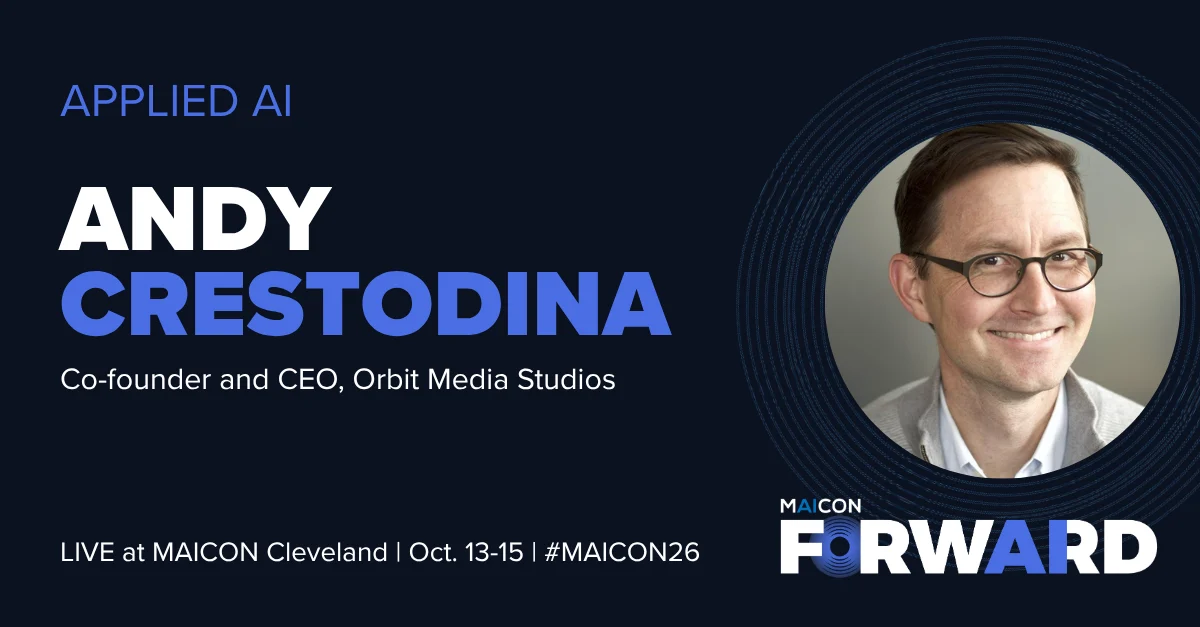
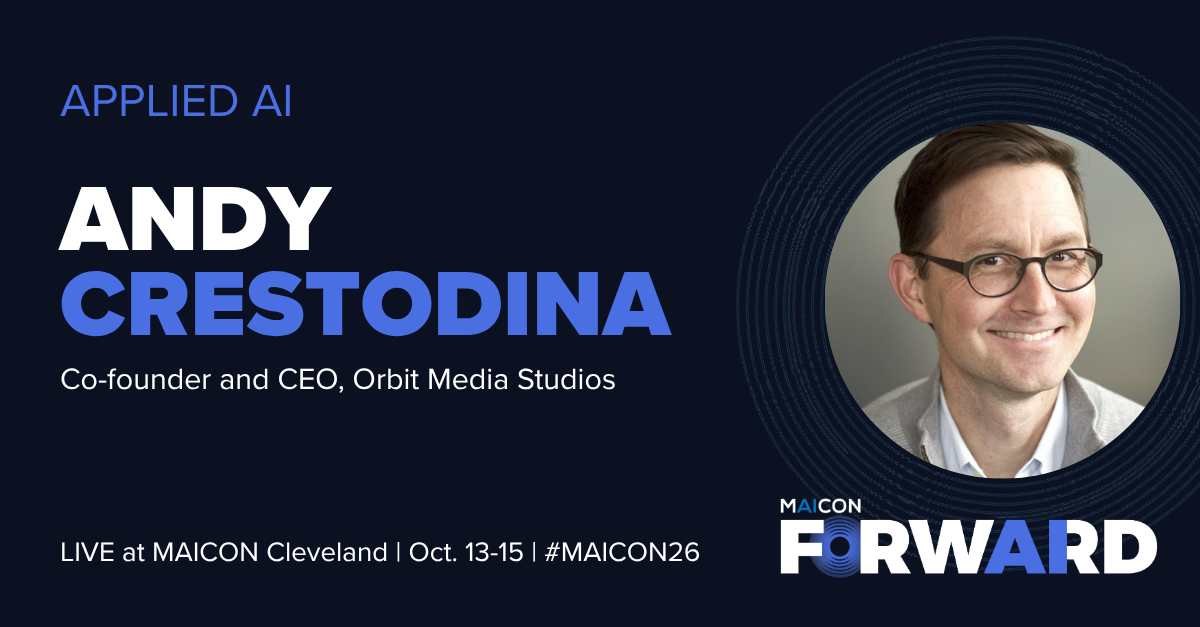
For the past two years, the marketing industry has been obsessed with a singular question: "How can AI make me faster?" Teams have rushed to integrate generative tools to draft emails, summarize meeting transcripts, and generate social media copy at unprecedented speeds. But according to Andy Crestodina, co-founder and CMO of Orbit Media, this focus on mere acceleration is a fundamental misunderstanding of the technology’s potential.
The real opportunity, Crestodina argues, isn’t using AI to do your job faster; it is transforming parts of your job into autonomous tools that work for you in perpetuity. This paradigm shift will serve as the centerpiece of his keynote at MAICON 2026, where he will present his session, "From Process to Prompt to Automation: How a Marketing Job Becomes a Marketing Tool."
The Evolution of Marketing Workflows
To understand where marketing is headed, one must first look at the trajectory of the modern workflow. Crestodina posits that marketing tasks exist on a spectrum that moves from purely manual effort to sophisticated, AI-augmented systems.
"The work of marketing has changed," Crestodina explains. "Modern marketing workflows evolve in a specific sequence from 100% done-by-human-hands to 100% done by assistants—and then reviewed by humans."
This progression is not an overnight transformation. It is a deliberate, iterative process. Crestodina warns against the common pitfall of expecting an "instant" solution. "My most powerful assistants evolved gradually," he notes. "I don’t think you can one-shot a great AI worker bee."
This evolutionary model requires marketers to stop viewing AI as a "magic button" and start viewing it as an apprentice that must be trained, refined, and audited over time. The goal is to move beyond the "one-off prompt"—a request made once for a single output—and toward the development of persistent, repeatable systems.
The Expert Advantage: Why Builders Matter
A recurring theme in the discourse surrounding AI is the fear of displacement. However, Crestodina challenges this narrative by highlighting a critical truth: the best AI tools are not being built by software engineers, but by subject matter experts.
"The best assistants are built by people who already do that job well," Crestodina asserts. "The expert at the job is the best suited to evaluate AI’s output, judge it, and make improvements."
This insight flips the script on traditional tool acquisition. Instead of scouting the market for the latest SaaS platform, marketing teams should be looking inward at their own high-performers. When a veteran content strategist or a seasoned SEO specialist spends time refining a prompt chain, they are essentially codifying their professional expertise.
AI, in this context, serves as the world’s most powerful "skill-transfer tool." By capturing the nuances of an expert’s decision-making process within a series of prompts, that expert can effectively "clone" their methodology, allowing less-skilled team members to operate at a higher level of competency.
Prompts as Code: The New Literacy
The most significant takeaway from the current AI boom is the democratization of programming. As Andrej Karpathy, co-founder of OpenAI, famously stated: "The hot new programming language is English."
Crestodina champions this philosophy, urging marketers to view their prompts not as casual requests, but as lines of code. "In other words, your prompts are code. They are functions. They are tools. Work hard on them," he says.
For the modern marketer, this requires a shift in technical discipline. It means:
- Testing: Running inputs through a prompt repeatedly to ensure consistency.
- Iteration: Refinement based on failures and successes.
- Combination: Linking multiple prompt-based functions together to create a cohesive workflow.
- Systematization: Keeping these prompts in a centralized, shared library so the entire team can benefit from the collective intelligence of the organization.
The implication is clear: the marketers who win in the next five years will be those who treat their "prompt library" as a proprietary asset—a digital toolkit that represents their company’s unique strategy and voice.
Implications for the Future of Marketing Roles
As teams shift from "using AI" to "building AI tools," the nature of the marketing job description will inevitably change. We are moving toward a future where the ability to articulate a process is just as important as the ability to execute it.
The Shift in Hiring and Training
Organizations will begin to value "prompt engineering" as a core competency. However, unlike traditional coding, this skill is rooted in business logic. Companies will need to invest in training programs that teach employees how to audit AI outputs and build internal "tool chains."
Scalability and Output
By turning a manual workflow into an automated tool, a single marketer can manage a volume of work that would have previously required a team of five. This does not necessarily mean downsizing; rather, it suggests an expansion of output. Marketing departments will be able to pursue more ambitious campaigns, deeper research, and more personalized customer interactions because the "busywork" has been offloaded to internal AI agents.
The "Expert-in-the-Loop" Model
While automation is the goal, the human element becomes more vital, not less. As AI takes over the heavy lifting, the human marketer’s role shifts from "creator" to "curator" and "architect." They must set the strategy, define the parameters, and provide the final sign-off, ensuring that the AI’s output aligns with brand standards and business goals.
Preparing for MAICON 2026
The upcoming Marketing Artificial Intelligence Conference (MAICON) 2026 is positioned to be the primary forum for this transition. For attendees, the value lies in moving beyond the hype and focusing on tangible implementation.
Crestodina’s session is designed to be highly tactical. It will provide attendees with:
- A Framework for Maturity: A guide to moving from manual work to prompt-driven prototypes, and finally to fully repeatable AI assistants.
- Workflow Auditing: Practical techniques for identifying which tasks within a department are "ripe" for automation.
- A Mindset Shift: Moving from the "consumer" mentality—constantly shopping for new software—to the "builder" mentality, where teams create their own internal, reusable solutions.
Crestodina’s work has always been grounded in performance-driven results. His classic work, Content Chemistry, remains a staple because it focuses on the intersection of data and creativity. By bringing this same rigorous, evidence-based approach to AI, he aims to help marketers navigate the current chaos of the tech landscape.
A Call to Action for Marketing Leaders
"Don’t look for new tools. Make your own tools," Crestodina says. "The only gap is our own imaginations."
This call to action is a challenge to leadership. It asks: Are you empowering your teams to build, or are you just buying subscriptions? As the barrier to entry for AI continues to fall, the competitive advantage will go to those who treat AI as an extension of their own internal processes.
For those ready to move past the novelty of generative AI and into the realm of true operational efficiency, the path is clear. It requires the documentation of expertise, the rigorous testing of prompts, and the willingness to iterate until a process becomes a tool.
The industry is currently at an inflection point. The early adopters who successfully move from "using" to "building" will define the next era of marketing excellence. Whether that happens through internal labs, cross-departmental "prompt share" sessions, or a total restructuring of the creative workflow, the shift is inevitable.
As we look toward MAICON 2026, the message is simple: the future of marketing isn’t being built in Silicon Valley by software engineers; it’s being built by you, at your desk, one prompt at a time. The question is no longer what the AI can do for you, but what you can build to ensure your team never has to do the "busywork" again.
To learn more about how to transform your marketing operations, register for MAICON 2026 and join Andy Crestodina along with 50+ other industry leaders as they explore the future of AI in business.