As B2B and artificial intelligence companies finalize their event budgets for the upcoming year, a familiar trap awaits many marketing leaders. The traditional playbook—spreading capital across a dozen conferences selected from organizer press releases and AI-generated "best of" lists—frequently unravels by the third quarter, leaving teams staring at half-empty booths and anemic pipeline growth.
While the events landscape is crowded with self-reported attendance figures and glamorous promotional decks, separating genuine buyer density from vanity metrics is critical for optimizing return on investment (ROI).
Main Facts: The Illusion of Scale in the Events Market
The core vulnerability in modern event planning lies in the verification of attendance data. Nearly every headline figure cited in promotional roundups or automated guides stems directly from event organizers. Independent audits are virtually nonexistent, leaving marketers to rely on inflated metrics.
- The Numbers Problem: A prominent case in point is HumanX, which reported 6,500 attendees for its San Francisco event, while concurrent roundups claimed upwards of 12,000 participants. Attendees on the floor, however, reported a significantly lower density than either figure suggested.
- The Sponsor Saturation Risk: Major conferences are scaling up sponsor counts to unprecedented levels. Certain 2027 guides list more than 700 sponsors for a single AI conference. At this density of competition, brand dilution is practically guaranteed for all but the highest-tier packages.
- The Financial Health Indicator: Publicly traded conference organizers provide a clearer reality check. While some firms report robust growth driven by pricing power rather than physical expansion, others experience double-digit declines in events revenue, forcing them to pivot toward shorter, smaller formats or rely on promotional discounting.
Chronology: Navigating the 2027 Conference Calendar
For companies mapping out their quarterly investments, understanding the timing and specific focus of key industry gatherings is essential. The 2027 calendar offers a diverse mix of GTM-focused environments, enterprise platform summits, and large-scale vertical events.
Q1 2027: Early-Year Strategy and Vertical Focus
- January 21, 2027: GTM Alliance: AI for GTM Festival (San Francisco) – A co-located event blending AI with RevOps and Sales Enablement, tailored for operational buyers.
- February 24–25, 2027: AI for Marketers Summit (Las Vegas) – A niche environment targeted specifically at marketing-centric AI buyers.
- March 7–10, 2027: HumanX (Las Vegas) – Returning to Las Vegas with heavy sponsor density; vendors are advised to leverage structured meeting programs rather than traditional booths.
- March 22–24, 2027: Shoptalk Spring (Las Vegas) – A dominant retail and e-commerce event renowned for its pre-booked buyer meeting model.
- March 23–25, 2027: Adobe Summit (Las Vegas) – A key platform event for ecosystem-specific ISVs.
Q2 2027: The Core GTM and Enterprise Season
- April 5–7, 2027: POSSIBLE (Miami Beach) – A rapidly growing marketing and ad-tech conference featuring the invitation-only CMO Lab.
- April 13–15, 2027: Google Cloud Next (Las Vegas) – A massive cloud ecosystem gathering, preceded by the Partner Summit on April 12.
- May 2–4, 2027: Forrester B2B Summit (Phoenix) – A CMO-centric enterprise marketing event operating amid shifting organizer formats.
- May 11–12, 2027: SaaStr AI Annual (SF Bay Area) – Focused heavily on AI agents, GTM deployment, founders, CROs, and revenue leaders.
- May (Dates TBD): Gartner CSO & Sales Leader Conference (Las Vegas) – A tightly defined room of CSOs and sales executives.
- June 7–9, 2027: Gartner Marketing Symposium/Xpo (Denver) – An analyst-driven event for enterprise marketing leadership.
- June 16, 2027: GTM Alliance: Go-to-Market Festival (London) – Expanding the RevOps and sales enablement dialogue internationally.
H2 2027: Scale and Vertical Depth
- October 2027: Money20/20 USA (Las Vegas) – The preeminent fintech and payments gathering, utilizing sophisticated matchmaking platforms for high-density networking.
Supporting Data: Evaluating Tier 1, Tier 2, and Tier 3 Opportunities
To build an efficient budget, marketing leaders must categorize events based on buyer quality, historical performance, and verified sponsor outcomes.

Tier 1: Events Built Around AI and GTM Buyers
These environments prioritize decision-makers holding real software budgets over broad engineering crowds.
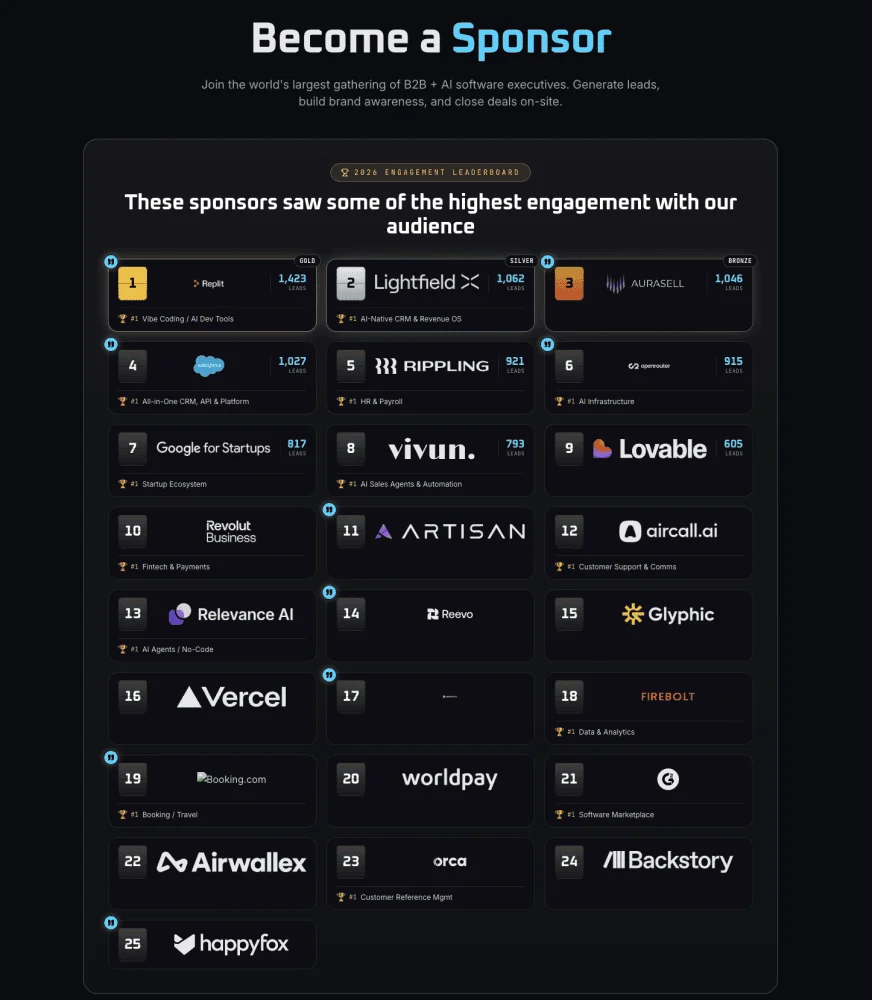
- SaaStr AI Annual (May 11–12, 2027): Tailored specifically for agents, GTM deployment, founders, and revenue executives. Historical performance data from prior events highlights strong lead generation across diverse tech stacks—from developer tools like Replit and OpenRouter to revenue tools like Aurasell, Salesforce, and Vivun. Notable successes include cases where live stage demonstrations yielded hundreds of qualified leads and six-figure closed-won ARR within days of the conference.
Tier 2: Strong Alignment for Specific Buyer Profiles
- Gartner CSO & Sales Leader Conference (Spring 2027, Las Vegas): Draws a concentrated audience of CSOs, sales operations, and enablement leaders. Gartner’s conference revenues reflect steady enterprise demand, though premium pricing applies.
- Google Cloud Next (April 13–15, 2027): Essential for CIOs, CTOs, and cloud architects. Sponsorship is best reserved for companies integrated into the Google Cloud Marketplace or participating in the April 12 Partner Summit.
- Gartner Marketing Symposium/Xpo (June 7–9, 2027, Denver): A robust choice for reaching enterprise CMOs, outperforming alternative analyst symposiums in health and attendance consistency.
Tier 3: High Caution and Specialized Focus
- HumanX (March 7–10, 2027, Las Vegas): Given the discrepancy between reported and perceived attendance in past editions, participants should rely on structured networking initiatives like SolutionBridge and VentureConnect rather than traditional floor footprints.
- Forrester B2B Summit (May 2–4, 2027, Phoenix): Operates within a shrinking events division, prompting organizers to introduce promotional incentives. Thorough reference checks with past sponsors are recommended before committing capital.
- Platform Events (Dreamforce, Knowledge, SAP Sapphire, Adobe Summit): Highly effective exclusively for ISVs and partners embedded directly within those specific corporate ecosystems.
Official Responses and Industry Guidance
Industry veterans emphasize that evaluating an event requires looking past marketing collateral and interrogating core structural metrics. When designing a 2027 strategy, marketing executives are advised to apply five foundational screening questions:
- Who controls the budget in the room? A single Chief Revenue Officer or VP of Sales with purchasing authority outweighs dozens of unbudgeted practitioners.
- What were the actual sponsor lead counts last year? Demand verifiable lead breakdowns by sponsor rather than relying on generalized ranges found in sales decks.
- What is the level of sponsor competition? In environments featuring hundreds of competing sponsors, brand fatigue diminishes lower-tier visibility.
- Is it a platform-centric event? Ecosystem events require deep alignment with the host platform’s go-to-market motion to yield positive unit economics.
- What is the organizer’s financial trajectory? Publicly reported event revenues provide an unvarnished look at whether an organization is genuinely expanding its footprint or merely adjusting pricing models.
Implications for 2027 Strategy
The overarching takeaway for B2B and AI organizations is a necessary shift away from passive event participation toward aggressive, data-backed selection. As market maturity accelerates, brute-force attendance strategies are being replaced by targeted engagements centered on verified buyer intent, structured matchmaking programs, and high-density executive rooms.
By prioritizing quality over vanity metrics, marketing leaders can protect their 2027 capital, eliminate wasted expenditures on empty booths, and focus their resources where decision-makers are actively deploying technology.