Subscription analytics giant RevenueCat has published one of the most comprehensive datasets on free trial behavior ever compiled. Drawing from an extensive cohort of over 17,000 mobile subscription apps over a full 12-month period—spanning August 2025 through July 2026—the study offers unprecedented visibility into how consumers and business users evaluate software.
Because RevenueCat powers the subscription management layer for more than 60% of all mobile subscription apps, its findings stretch far beyond the realm of consumer games and photo editors. The dataset includes B2B productivity tools, workflow managers, and enterprise applications that closely mirror the software-as-a-service (SaaS) products found in traditional tech stacks.
For founders, growth leaders, and product managers accustomed to relying on legacy conversion playbooks, this data serves as both a validation and a wake-up call. It challenges long-held assumptions regarding trial lengths, annual commitments, and the unique unit economic pressures facing artificial intelligence (AI) applications.
Main Facts: The Anatomy of the RevenueCat Study
The core of the RevenueCat report examines how varying free trial durations impact both upfront conversion rates (free-to-paid transitions) and long-term customer retention (first-year renewals).
Key High-Level Findings:
- Annual Plan Conversions Surge with Time: For annual subscriptions, conversion rates scaled upward with trial length, moving from 24% for trials of 4 days or less up to 44.6% for trials lasting 17 to 32 days.
- Retention Rises Proportionally: First-year renewals for annual plans jumped dramatically from 18.3% for short trials to 47.5% for extended trials.
- The AI Inference Penalty: For AI-powered applications, extending monthly trials beyond 16 days caused conversion rates to drop from 38.5% to 31.8%, while providing no tangible retention gains.
- The Monthly Sweet Spot: Monthly self-serve plans peaked in conversion (46.6%) during 10-to-16-day trial windows, aligning closely with traditional B2B product-led growth (PLG) benchmarks.
- Geographic Variations: North American and Western European markets reward longer annual trials, whereas developing regions often see peak conversions during shorter 5-to-9-day windows.
Chronology: The Evolution of the Software Free Trial
To understand why these findings matter, it is helpful to look back at how modern trial structures evolved.
The Salesforce and HubSpot Era (Mid-2000s)
Fifteen years ago, enterprise software pioneers like Salesforce and HubSpot standardized the 14-day free trial. At the time, this window was designed to force a rapid evaluation cycle for desktop-installed or early cloud-based systems, ensuring that sales teams could aggressively follow up before prospective buyers lost momentum.
The Mobile App Rush (2010s–Early 2020s)
As the app economy matured, mobile developers sought to capture immediate revenue. Influenced by top-performing apps that prioritized fast cash flow and low customer acquisition cost (CAC) payback periods, a vast majority of developers settled on ultra-short trials—typically 3 days or less—to quickly monetize ad-driven or impulse-driven downloads.
The Post-Pandemic Correction (2025–2026)
As subscription fatigue set in and buyers grew more selective about recurring software expenses, conversion metrics began to stall. Software buyers increasingly resisted impulsive purchases, particularly on annual agreements. This friction culminated in RevenueCat’s massive 2025–2026 dataset, which proves that the rigid 14-day or 3-day defaults of the past are no longer optimized for modern buyer behavior.
Supporting Data: Breaking Down the Numbers
The RevenueCat report breaks down its findings across multiple dimensions, providing granular insights into plan types, product categories, and geographic regions.
1. Annual Plans: Why 30 Days Outperforms 4 Days
When evaluating annual subscriptions, the data presents a clear trajectory:
| Trial Length | Conversion Rate | First Renewal Rate | Combined Retained Share of Trial Users |
|---|---|---|---|
| 4 days or less | 24.0% | 18.3% | 3.5% |
| 5 to 9 days | 33.0% | 25.3% | 8.3% |
| 10 to 16 days | 43.0% | 36.4% | 15.6% |
| 17 to 32 days | 44.6% | 47.5% | 18.5% |
By combining conversion and renewal metrics, the data reveals a striking insight: while the number of trial starts remains identical, offering a 30-day trial instead of a 4-day trial yields more than five times the number of retained, long-term customers (18.5% vs. 3.5%).
According to growth analysts, committing to an annual contract requires a major financial outlay. Buyers want sufficient time to integrate the tool into their routines before making a binding financial commitment. Those who receive that time—and still choose to buy—demonstrate significantly higher stickiness.
2. Monthly Plans and the PLG Sweet Spot
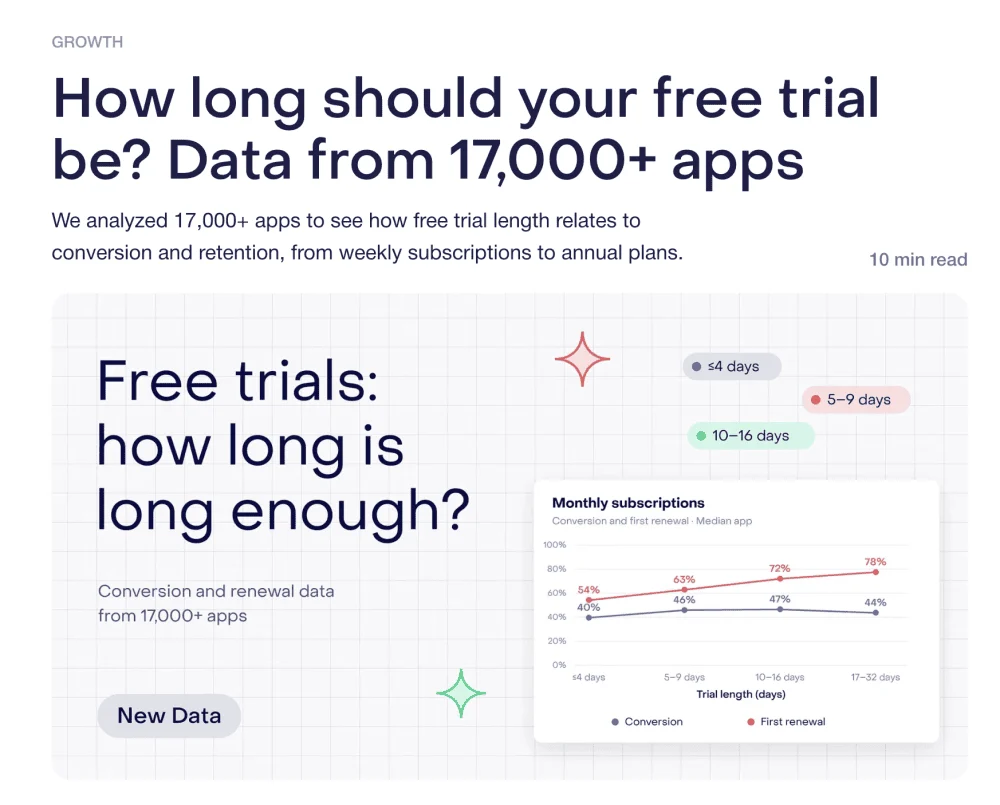
For monthly subscription models—which closely resemble self-serve B2B SaaS—the results are more nuanced. Conversion rates peak at 46.6% during the 10-to-16-day window.
While pushing trials out to 30 days yields marginal improvements in retention, it depresses the initial conversion rate. For standard B2B applications, the traditional 14-day trial remains a mathematically sound middle ground, balancing initial conversion velocity with downstream retention.
3. The Special Case of B2B and AI Applications
For founders building AI-native tools, the economic reality of trials introduces a critical constraint: inference costs.
Every free trial user who interacts with an AI model burns compute resources and tokens. Consequently, extending free trials indefinitely creates a heavy financial drain with diminishing returns.
The RevenueCat data highlights this exact phenomenon for monthly AI apps:
- 5 to 9 day trials: 38.2% conversion
- 10 to 16 day trials: 38.5% conversion (with higher 64.2% renewal)
- 17 to 32 day trials: Conversion drops to 31.8%, while renewal stagnates at 64.1%
Extending an AI trial past two weeks results in lost conversions and wasted compute spend without improving customer retention.
Official Responses and Industry Perspectives
Industry leaders and investors have been quick to weigh in on the implications of the dataset.
"In B2B, most of us run 14-day trials simply because Salesforce and HubSpot did it 15 years ago," notes SaaS investor Jason Lemkin. "If you want a 12-month commitment from a customer, this data demonstrates that you need to give buyers closer to 30 days to evaluate the product. On annual plans, a short trial often performs worse than offering no trial at all."
Observers also emphasize the distinction between calendar time and usage time. While AI and productivity apps require careful management of free resources, forcing a decision too early backfires.
"A user can experience a tool’s core value after completing a single task, which is enough to drive an initial conversion," industry analysts note. "However, true renewal depends on whether the tool becomes embedded in a daily or weekly workflow. Longer evaluation windows allow that habit formation to take root."
Strategic Implications for Founders and Product Leaders
For software executives looking to optimize their go-to-market motions, the RevenueCat dataset provides several actionable takeaways:
1. Decouple Annual and Monthly Trial Lengths
Many companies maintain a blanket 14-day trial regardless of whether the customer selects a monthly or annual subscription. Given that annual buyers face higher friction and commitment barriers, product teams should test extending annual trials to 30 days while keeping monthly trials capped near 14 days.
2. Implement Usage Caps Instead of Time Limits for AI Apps
Because extended time-based trials burn unnecessary inference tokens for AI startups, product leaders should consider hybrid models. Rather than giving AI users 30 open-ended days of free access, provide a generous credit allocation or a capped number of workflow runs. This gives customers the flexibility they need to evaluate the product without exposing the business to runaway infrastructure costs.
3. Re-Evaluate Regional Funnels
Geographic purchasing behaviors differ significantly. While North American and European buyers respond well to extended evaluation periods, emerging markets in Latin America, Southeast Asia, and the Middle East show higher conversion efficiency with shorter 5-to-9-day windows. Localization should apply to trial architecture as much as it does to language and pricing.
4. Test Before You Roll Out
While industry-wide benchmarks provide a valuable starting point, every product has a unique time-to-value metric. Growth teams should treat these findings as a hypothesis to validate through A/B testing rather than an immediate mandate to overhaul pricing pages.
Ultimately, the data shows that rigid, legacy trial structures are costing software companies valuable annual customers. By aligning trial duration with buyer psychology and infrastructure economics, modern B2B and AI companies can unlock significant upside in both conversion and long-term retention.