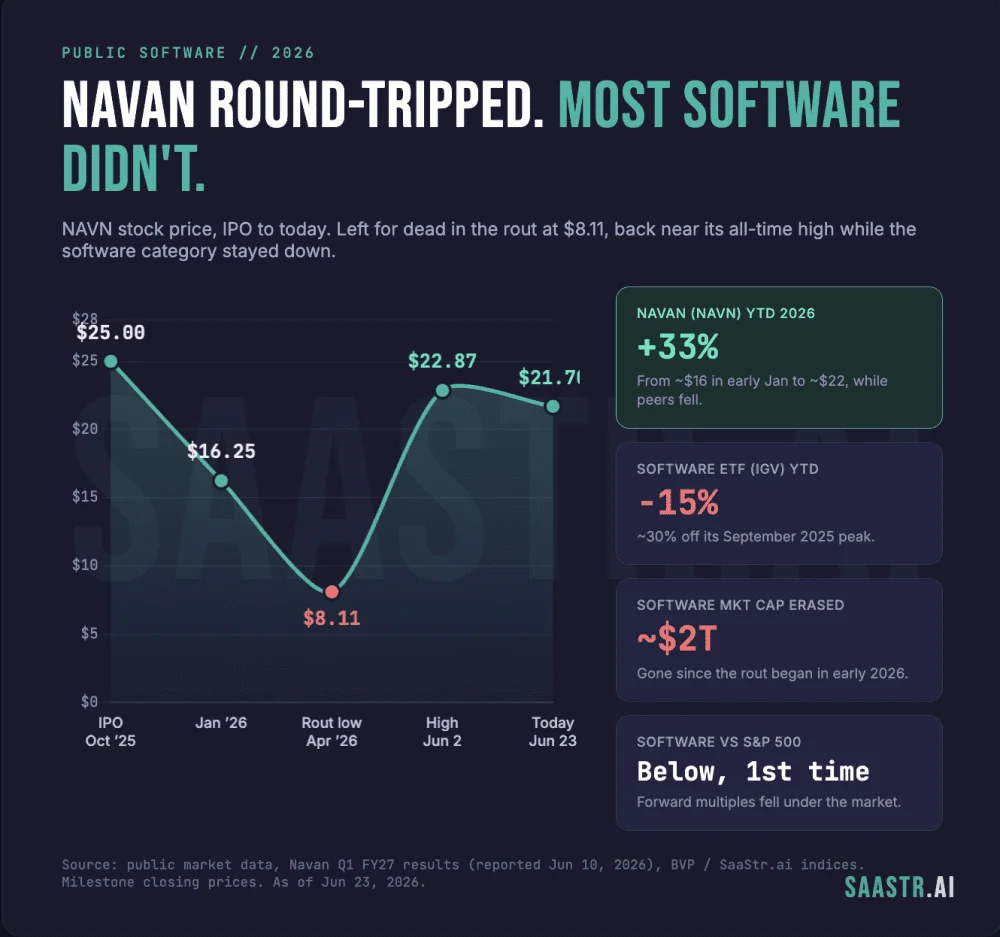
The B2B software landscape in 2026 is defined by a paradoxical reality: while traditional software markets are experiencing their deepest valuation crisis in decades, a new wave of AI-driven productivity is creating unprecedented revenue growth for those who adapt. The industry has effectively split into two distinct camps: the "re-accelerators," who are aggressively integrating agentic workflows to capture new budget, and the "legacy practitioners," who remain tethered to the playbooks of 2024, waiting for a market recovery that shows no sign of materializing.
This is not merely a shift in technology; it is a fundamental restructuring of the B2B business model. For founders and executives, the cost of identifying which camp they occupy has never been higher.
The Chronology of the Shift: From SaaS-pocalypse to Agentic Dawn
To understand the current environment, one must look at the rapid erosion of the "Software-as-a-Service" promise. For over a decade, the mantra of "write once, sell everywhere" drove premium valuations. However, the public markets have signaled a definitive end to that era.
- 2024 (The Realization): The market began to question the durability of high Net Revenue Retention (NRR) and the viability of three-year contracts that masked declining renewal rates. Public software companies, including giants like HubSpot, Atlassian, and Monday.com, faced significant drawdowns, reflecting a broader disillusionment with legacy SaaS models.
- 2025 (The Pivot): The "hallucination" concerns that paralyzed early AI adoption began to fade. Companies that moved from passive chatbots to autonomous, task-oriented agents—those capable of booking deals and managing complex workflows—began to see immediate, measurable ROI.
- 2026 (The Bifurcation): We have reached the point of no return. Total software spend is projected to grow by 15%, outpacing previous years, yet that growth is concentrated exclusively in AI-centric solutions. The "middle" has evaporated. Companies are either thriving by capturing AI budgets or dying by being consolidated out of the CIO’s procurement list.
Supporting Data: The Case for Exponential Productivity
The most compelling evidence for this shift comes from internal operational data at SaaStr, where the organization transitioned from a 20-person team to a lean operation of three humans supported by 21 specialized AI agents.
Productivity Metrics
The financial implications are stark. By utilizing AI VPs of Marketing and Customer Success, the organization reduced operational costs significantly while increasing throughput. The combined monthly cost for these two agents—a mere $257—replaced roughly $500,000 in annual human headcount costs.
The Software Spend Paradox
According to Gartner, while software spend is accelerating from 12.8% to 15% growth, the underlying composition of that spend has shifted. Roughly half of current CIO budget growth is directed toward new AI-native infrastructure, such as Anthropic’s ecosystem. Legacy vendors are being cannibalized to fund these innovations. This confirms a vital truth: if your product is not tapping into the new AI-centric budget, your addressable market is effectively shrinking.
Key Strategic Pillars for the Modern B2B Enterprise
1. The Death of "Vibe Coding" as a Competitive Moat
The ability to quickly prototype apps—or "vibe coding"—has become commoditized. While it is now possible to build software in a fraction of the time, the market does not reward mediocre clones of legacy platforms. Building a "prettier" version of Salesforce is a failed strategy. The market rewards vendors who can put qualified deals on a calendar, not those who iterate on the aesthetic of an "opportunity" tab.
2. AI vs. The Mediocre Human
The era of the "human-in-the-loop" as a bottleneck is over. In complex environments, a well-trained AI agent that executes tasks autonomously and updates its own guardrails weekly will consistently outperform a human who requires weeks of onboarding and ongoing administrative support. As demonstrated by the "QB" AI agent during the 2026 SaaStr event, agents now possess the institutional memory and operational accuracy to manage frontline customer success better than manual teams.
3. The API Report Card: Being "Agent-Friendly"
The most leverageable move for any B2B company today is to ensure their API is built for agentic consumption. Agents—the software that will be buying your software—are programmed to prefer platforms that are easy to integrate. If your API limits data pulls or throttles usage, you will be bypassed by the autonomous systems that are increasingly responsible for vendor selection. Stripe’s A+ rating in the SaaStr API Report Card serves as the gold standard for this new reality.
4. Buy, Don’t Build (Unless it’s the 10%)
While the urge to build custom tools is strong, organizations should only build what the market refuses to provide. The 10% of utility that is highly specific to a niche—such as automated custom document generation—is where developers should focus. If a tool exists, buy it. If you are building standard CRM functionality, you are wasting cycles that should be spent on differentiation.
Implications: The Bottleneck is Talent, Not Tech
The most profound implication of this shift is that the barrier to entry is no longer capital; it is the human capacity for change.
The Reskilling Crisis
Companies are currently facing a "reskilling wall." A significant portion of the workforce remains resistant to the agentic model, preferring the traditional, slower workflows they are comfortable with. By the end of 2026, many organizations will likely abandon broad reskilling initiatives, choosing instead to double down on the "hacker" talent—those already experimenting with agents in their spare time—to drive their transition.
The Four Buckets of the Future
As outlined by industry observers, the market is organizing into four distinct buckets:
- AI-Native Winners: Companies building products that leverage the unique capabilities of LLMs to solve problems previously thought to be unsolvable.
- Legacy Adapters: Older companies that are successfully pivoting their core platforms to be "agent-friendly" and essential to the new tech stack.
- The Middle-Ground Casualties: Companies that are too slow to innovate and are being squeezed out of procurement budgets as clients consolidate their spending.
- Niche Dominators: Smaller, specialized firms that have expanded their TAM by 10x to 100x by using agents to provide services that were previously too expensive to deliver at scale.
Conclusion: The Choice for Founders
The dichotomy of 2026 is clear: B2B is either the best industry to be in, or the most dangerous. For those who cling to the legacy of "grandpa’s software," the path leads toward obscurity. For those who embrace the agentic paradigm—by optimizing APIs for agents, prioritizing consistency in training, and ruthlessly focusing on delivering actual outcomes rather than just features—the opportunity is limitless.
The market has bifurcated. There is no longer a safe middle ground. Founders must decide today whether they are building for the past or the autonomous future. The cost of delay is no longer just a slower growth rate; it is the total loss of relevance in a market that is rapidly automating its own future.