For years, the "niche site" business model relied on a singular, precarious assumption: that if you produced high-quality, human-written content, Google would reward you with a steady stream of organic traffic. That assumption was shattered for thousands of publishers during Google’s recent Helpful Content Updates (HCU).
In the latest episode of the Niche Pursuits podcast, Amy Aitman—COO of Venture 4th Media and Director of Discovery & Delivery for ScaleVisible—deconstructs the post-HCU landscape. For Aitman, the update was not just a traffic dip; it was a "gut punch" that forced a total strategic pivot. Her experience offers a masterclass in how to move away from platform dependency and toward a diversified "visibility" model.
The HCU Hit: When "Helpful" Felt Punitive
For many publishers, the HCU felt less like a search quality adjustment and more like an existential threat. Aitman recounts that her team had spent years leaning into "human-first" content strategies, following every best practice suggested by the industry. Yet, when the updates rolled out, the traditional recovery playbooks failed.
"If a site looked like a ‘content site,’ it got hammered," Aitman explained. The operational fallout was immediate and severe. Faced with vanishing revenue, the team had to halt publishing cycles entirely, leading to difficult layoffs of contractors and core staff. Beyond the balance sheet, there was a profound psychological toll: many veteran publishers were forced to question whether the entire industry model they had built was fundamentally broken.
The realization was stark: Google’s algorithm had shifted from favoring individual expert publishers to favoring brand authority and platforms where communities congregate.
The Pivot: From Traffic Addiction to Visibility Strategy
When organic search traffic craters, the natural instinct is to scramble for alternatives. Many publishers attempt to plug the gap with newsletters or social media, only to find that growth is stagnant without a consistent top-of-funnel pipeline.
Aitman realized that the answer wasn’t just finding a new traffic source—it was about following where the users were actually going. The data was clear: Reddit was dominating the search results. While many SEOs viewed the rise of Reddit as an annoyance—a platform where anonymous users replaced subject-matter experts—Aitman chose to treat the trend as a signal rather than a grievance.
The Rise of the "Consensus-Driven" SERP
The modern search environment is no longer "winner-take-all" based on a single blue link. It has become "consensus-driven." When a user searches for a product or a solution, they are presented with a mix of Reddit threads, YouTube tutorials, and third-party editorial reviews. In this landscape, you cannot simply rank for a keyword; you must be present in the conversation wherever it is happening.
Reddit as a Business Intelligence Tool
Aitman argues that Reddit should not be viewed merely as an advertising channel. In fact, approaching it as such is the fastest way to get banned. Instead, she frames Reddit as a vital source of market research.

By listening to Reddit, brands can identify:
- Customer Language: How do real people describe their problems, rather than how a marketer describes them?
- Objections: What are the specific reasons users choose a competitor?
- Sentiment: Is the brand perceived as a "hero," a "ghost," or a "villain" in the eyes of the public?
The "Listen-First" Mandate
Aitman warns against the "brand mention" rush—using AI tools to scrape Reddit for keywords and then spamming those threads with links. This is a losing strategy. Instead, she advocates for a "listen-first" approach. Brands should create their own subreddits early—not to dominate, but to secure the brand name and establish a home base. Participation should be limited to genuine engagement, answering questions, and learning community norms before attempting to steer any discourse.
The Three-Legged Stool: A New Framework for Growth
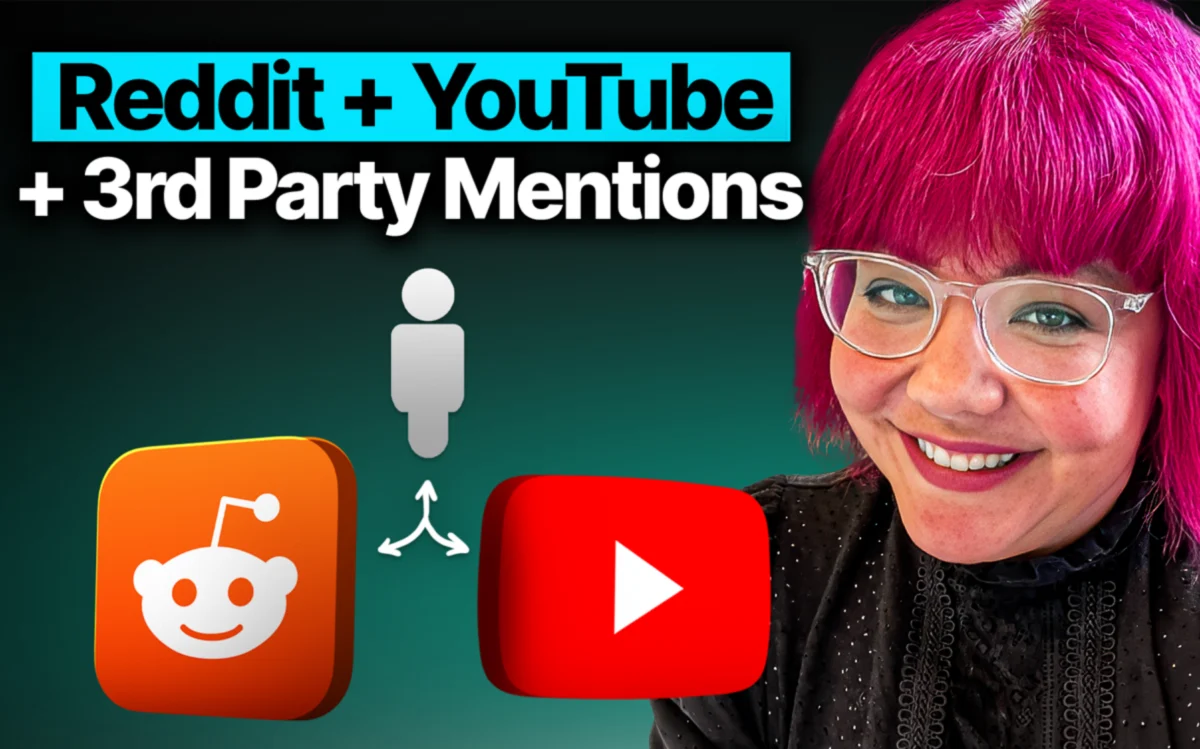
To reduce platform risk, Aitman proposes a "three-legged stool" strategy. Relying on one leg (Google SEO) is the definition of fragility. A resilient brand must stand on:
- Reddit: For community sentiment, social proof, and long-tail search visibility.
- YouTube: For visual demonstrations, "best-of" lists, and high-trust product comparisons.
- Third-Party Editorial: For authoritative mentions and external validation.
Why This Works
This ecosystem functions as a self-reinforcing loop. When a user researches a product, they might find a helpful Reddit thread, watch a YouTube review, and then land on an authoritative third-party article. By appearing in all three, the brand creates a "consensus" of authority that Google’s AI and search algorithms are designed to favor.
Tactical Execution: How to Audit Your Visibility
How does a brand measure success if it isn’t just looking at raw traffic? Aitman suggests a shift toward manual, qualitative audits.
- Incognito Audits: Search for your core product or niche queries using VPNs and incognito windows to see the "raw" search experience.
- The "Ghost vs. Villain" Test: Are you invisible in AI-generated summaries (a "ghost"), or are you being cited for the wrong reasons (a "villain")?
- Content Mapping: Instead of publishing 100 articles, focus on a set of "visibility assets"—a YouTube video, a Reddit discussion thread, and a high-quality editorial piece—all centered around a single high-intent customer question.
Implications for the Future of Publishing
The era of "set it and forget it" niche site building is effectively over. The implications for the industry are profound:
- Operational Complexity: Marketing is no longer just about writing content; it is about community management, video production, and PR-style outreach.
- Platform Diversification: The "platform risk" of relying on Google has been proven. Brands must prioritize building audiences on platforms where they own the relationship (like email lists) while engaging on platforms where the users reside (like Reddit).
- The Death of Anonymity: As search results increasingly prioritize real human experiences and community consensus, faceless niche sites that lack a brand identity will continue to struggle.
Final Thoughts: The Shift to Consistency
Aitman’s final advice is perhaps the most difficult to implement: consistency. Building visibility is not a sprint; it is a slow process of becoming a trusted voice in a community.
If you are a publisher currently staring at a flatline in your search traffic, stop asking, "How do I get my rankings back?" and start asking, "Where is my brand being shaped, and how can I contribute to that conversation?" By shifting your focus from the search engine to the human beings using it, you move from a vulnerable position to a sustainable, defensible business model.
The "Helpful Content" era has forced a harsh reset, but for those willing to adapt, it has also cleared the field of low-effort competitors. The future belongs to those who build brands, not just pages.