By The Content Desk
Published: March 2026
Main Facts
As marketing teams mark three years of widespread experimentation with generative artificial intelligence, a stark realization has settled across the corporate landscape: the gap between AI’s grand promises and its practical value remains frustratingly wide. While organizations have discovered genuine efficiency gains in isolated tasks, far too many marketing departments have simply accumulated an expensive stack of tool subscriptions while team frustration mounts.
At the same time, the digital marketing ecosystem is undergoing a tectonic shift. Clicks and organic traffic are experiencing a sharp, continuous decline, disrupted by the rapid rise of AI search engines and zero-click search engine result pages (SERPs). According to landmark 2025 research from Ahrefs, Google’s AI Overviews alone reduce outbound clicks to top-ranking traditional web pages by an alarming 34.5%.
Industry leaders emphasize that while AI remains a powerful force multiplier for talented teams, the era of unbridled, undisciplined experimentation must come to an end. To survive and thrive, marketing organizations are being forced to separate reality from fiction, discarding pervasive "marketing myths" that promise effortless transformation. The focus for marketing directors heading through 2026 is shifting away from breathless technological predictions and toward measurable operational discipline, structured data optimization, and authentic human-led editorial differentiation.
Chronology: The Three-Year Evolution of AI in Marketing
To understand where marketing stands today, it is necessary to examine how generative AI has evolved within enterprise organizations over the past three years:
- The Wild West Phase (2023): Following the public explosion of large language models, marketing teams rushed to adopt generative AI tools. Adoption was primarily driven by fear of missing out (FOMO). Teams experimented recklessly with automated content creation, keyword scaling, and rapid-fire publishing without established governance or clear strategic intent.
- The Tool Saturation and Fatigue Phase (2024): Organizations began accumulating dozens of overlapping software subscriptions. While individual copywriters or researchers found minor productivity bumps, marketing directors noticed that overall pipeline growth, conversions, and revenue metrics were largely stagnant. Frustration mounted as teams realized that layering disparate AI tools on top of broken internal workflows only created more operational friction.
- The Search Disruption and Reckoning Phase (2025): Organic traffic plummeted as AI-driven search experiences reshaped how users consume information. Search engines stopped simply ranking pages and began compressing and rewriting answers directly on the search results page. Industry benchmarks from Ahrefs confirmed a steep 34.5% drop in clicks for top-tier organic results, forcing marketers to rethink visibility entirely.
- The Era of Operational Discipline (2026 and Beyond): The current landscape is defined by a pivot toward calculated strategy. Organizations are auditing their software stacks, consolidating workflows, recognizing that AI cannot fix fundamentally flawed strategies, and adopting a collaborative model where AI accelerates execution while human subject-matter experts drive perspective, accuracy, and brand trust.
Supporting Data and Market Insights
The friction between AI adoption and actual business outcomes is backed by a growing body of industry data.
- The Traffic Penalty: According to Ahrefs’ 2025 research on AI Overviews, the deployment of AI-generated summaries at the top of search engines has siphoned off 34.5% of the traffic previously directed to traditional top-ranking organic links.
- The Tool Accumulation Trap: Enterprise audits show that marketing teams using three or more standalone generative AI applications frequently report lower cross-departmental productivity than teams using a single, deeply integrated platform. The administrative overhead of context-switching between disjointed tools often outweighs the time saved by the AI models themselves.
- The Trust Gap: Audiences are increasingly fatigued by homogenous, AI-generated copy. Because foundational language models naturally gravitate toward the statistical "safest" phrasing, unedited AI content consistently fails to drive high-intent conversions or establish authentic thought leadership.
Official Responses and Industry Perspectives
Industry analysts, platform executives, and content strategists are increasingly vocal about the need for a recalibration in how enterprises deploy artificial intelligence.
"Marketing teams have spent three years experimenting with generative AI, and while some have discovered genuine efficiency gains, far too many others have simply accumulated tool subscriptions while frustration mounts," notes the strategic advisory team at Contently. "There’s still a persistent gap between AI’s promise and its practical value—namely, all those ‘AI best practices’ that no one can quite trace back to real, sustainable business outcomes."
Experts stress that AI must not be viewed as a standalone replacement for human intellect, but rather as an execution engine.
"AI optimizes execution," content strategists point out. "However, it cannot fix fuzzy positioning or off-base business goals. Speed amplifies direction—including the wrong direction. If your messaging is weak or your conversion paths are broken, AI will only help you fail faster and at a much larger scale."
Furthermore, compliance and legal departments are sounding alarms regarding unregulated AI usage. Industry leaders emphasize that as enterprises scale content production, the lack of rigorous editorial oversight, fact-checking, and schema structuring exposes brands to severe brand safety, copyright, and data privacy risks.
Implications for Marketers in 2026 and Beyond
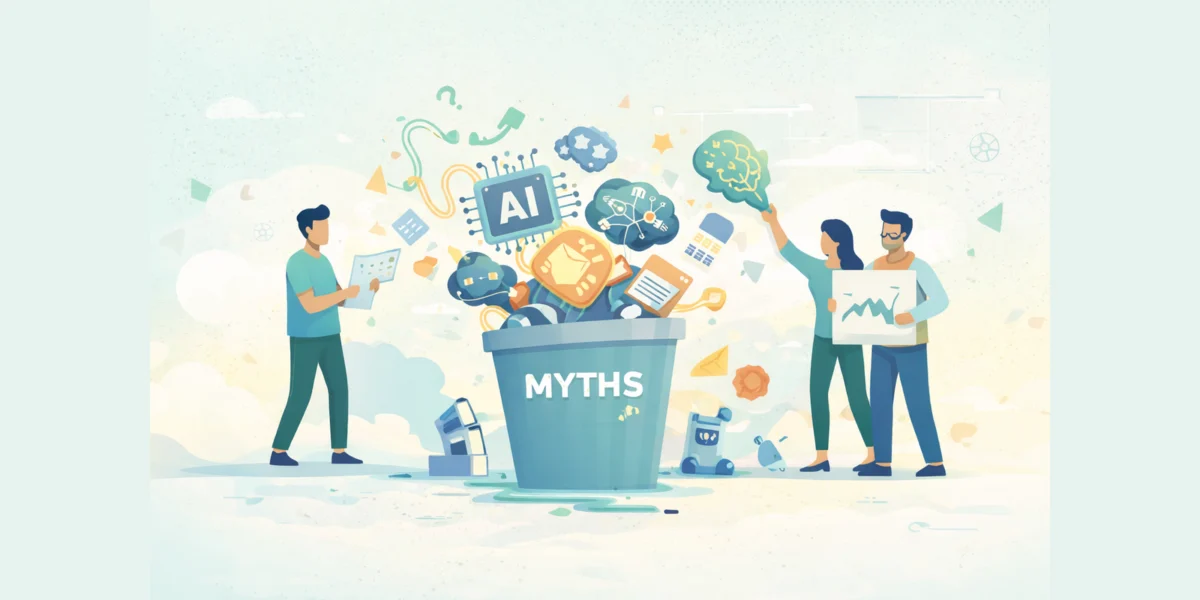
The convergence of plunging organic traffic, shifting search algorithms, and tool fatigue has profound implications for marketing departments. To navigate this new environment successfully, organizations must debunk and dismantle five persistent industry myths.
Myth 1: More AI Tools Automatically Mean More Efficiency
On paper, adding more AI applications to the tech stack sounds logical. In practice, it creates departmental silos and cognitive overload. True efficiency does not come from hoarding subscriptions; it comes from connected workflows.
- What Works: Map your content creation process end-to-end before procuring new software. Identify actual bottlenecks, consolidate redundant point solutions, and embed AI directly into existing environments—such as editorial calendars, Content Management Systems (CMS), and creative briefs. Invest heavily in internal training so teams know how to maximize existing tools safely.
Myth 2: AI Content Performs Just as Well on Its Own
Publishing volume is no longer a competitive advantage. When anyone can generate thousands of words in seconds, differentiation depends entirely on lived experience, unique perspectives, and undeniable expertise. Unedited AI copy defaults to generic phrasing that fails to build trust.
- What Works: Treat AI as a collaborative partner for research, structural outlining, and rough first drafts. Always layer in rigorous human editing for factual accuracy, brand voice, narrative depth, and proprietary customer insights.
Myth 3: AI Will Solve Bad Strategy
No algorithm can compensate for a lack of product-market fit or unclear value propositions. When teams use AI to scale production without a solid strategy, visibility increases while conversions stall.
- What Works: Establish crisp messaging, clear buyer personas, and optimized conversion pathways before attempting to scale output. Let AI accelerate a strategy that is already pointing in the right direction.
Myth 4: Everyone Needs to Adopt AI for Everything Immediately
Fear of missing out (FOMO) frequently leads to catastrophic software deployments. Adopting tools because competitors use them—rather than solving a diagnosed internal problem—builds organizational cynicism.
- What Works: Isolate a single, high-impact use case where AI can tangibly reduce friction. Run a controlled pilot project, carefully document performance metrics, and expand adoption outward only after proving value and establishing governance frameworks.
Myth 5: AI Search Is Basically the Same as SEO
Traditional search engine optimization focused on keyword rankings, meta tags, and site architecture. AI-powered search engines operate differently: they synthesize, compress, and rewrite information across multiple distinct sources, completely bypassing traditional link-clicking behavior.
- What Works: Maintain foundational SEO hygiene while actively adopting optimization practices designed specifically for AI visibility. This includes implementing robust schema markup, clear entity definitions, and direct, question-driven content formats that make it easy for language models to cite your brand as a primary source.
Frequently Asked Questions (FAQs)
How do I know if my team is ready for AI adoption?
Assess your current content operations first. If your team operates with documented workflows, strict brand guidelines, and consistent publishing cadences, you are ready to pilot AI tools. If basic operations feel chaotic and disorganized, strengthen those foundational processes before introducing the complexity of artificial intelligence.
What is the minimum investment needed to see results from AI?
Most marketing teams can begin with their existing software ecosystems, as many major content platforms now bundle generative AI capabilities into standard tiers at no extra charge. The true investment is time: expect to dedicate two to four weeks to training staff on advanced prompting, editing standards, and verification workflows before realizing consistent productivity gains.
How should I balance traditional SEO with AI Search optimization?
Treat traditional SEO and AI search optimization as mutually supportive disciplines. Continue building domain authority, optimizing site speed, and securing high-quality backlinks. Simultaneously, layer on AI-specific optimizations—such as structured data markup, clear entity relationships, and conversational formatting—to ensure your content is regularly cited by generative search engines.
Ready to build scalable AI workflows that actually drive real business outcomes? Contently’s AI-assisted content platform combines the speed of generative technology with elite editorial oversight, ensuring your team accelerates production without ever sacrificing quality, compliance, or brand safety. Book a Content Strategy Call today.