As the marketing industry enters its fourth year of experimentation with generative artificial intelligence, a palpable fatigue has set in across corporate headquarters. While early adopters anticipated an era of frictionless productivity, many marketing departments find themselves managing a bloated stack of tool subscriptions while organic traffic and click-through rates steadily decline.
The core issue is a widening chasm between the grand promises of AI and its practical, measurable value. In response, industry analysts, content strategists, and enterprise brands are reassessing how generative tools fit into the modern marketing ecosystem.
Main Facts: The Reality Check of AI Integration
The initial gold rush of generative AI in marketing was defined by rapid, often undisciplined adoption. Organizations rushed to integrate language models into every facet of the content supply chain, operating under the assumption that volume equates to success.
However, recent data indicates that this strategy has backfired. Instead of streamlining operations, overlapping tool subscriptions have created administrative friction and operational silos. Furthermore, the rise of AI-driven search experiences—such as search engine result page (SERP) overviews—has radically altered how audiences discover information, leading to a steep decline in traditional organic traffic.
Key developments in the current landscape include:
- The Subscription Trap: Many teams accumulate disparate AI point solutions without integrating them into existing workflows, resulting in employee frustration rather than efficiency.
- The Shift in Search Dynamics: According to recent industry research, modern AI search features have drastically reduced outbound clicks to top-ranking organic URLs, forcing a pivot in how brands measure digital visibility.
- The Return to Fundamentals: Enterprise organizations are moving away from unguided experimentation toward deliberate, workflow-integrated AI strategies that emphasize human editorial oversight.
Chronology: Three Years of Transformation and Fatigue
Phase 1: The Novelty Era (2022–2023)
When generative AI tools first entered the mainstream market, marketing teams treated them as novelty text-generators and brainstorm assistants. The focus was primarily on capability rather than integration. Organizations marveled at the speed of output, generating large volumes of blog posts, social media updates, and ad copy with minimal human intervention.
Phase 2: The Scaling Obsession (2024)
Encouraged by early productivity metrics, leadership teams mandated aggressive scaling. Content volume surged across the digital landscape. However, this period exposed the limits of unguided AI generation. Audiences were inundated with homogeneous, safe, and easily recognizable AI-generated text, leading to a gradual erosion of brand trust and digital engagement.
Phase 3: The Reckoning and Realignment (2025–Present)
As organic traffic metrics began to dip and search engines evolved to favor synthesized, direct answers over traditional blue links, marketers faced a reckoning. The focus shifted away from raw volume toward differentiation, brand voice, and structured data. Organizations began auditing their tool stacks, trimming redundant subscriptions, and prioritizing integrated workflows over standalone applications.
Supporting Data: What the Metrics Reveal
To understand why traditional marketing playbooks are failing in the age of AI, industry researchers have tracked the intersection of content production and audience behavior.
- Decline in Organic Click-Through Rates: Data from prominent search analytics firms highlights that modern AI search integrations (such as AI Overviews) can reduce clicks to top-ranking traditional pages by upwards of 30% to 35%. When search engines answer user queries directly on the results page, ranking well no longer guarantees traffic.
- The Homogeneity Penalty: Content produced entirely by default, unguided language models tends to regress toward the statistical mean. It offers the safest, most generalized answers, which fail to capture consumer interest or drive downstream conversions.
- Workflow Friction: Organizations that fail to map their content operations before introducing new technologies often experience a net loss in productivity. Training employees to prompt multiple, disjointed tools takes up hours that could otherwise be spent on strategic creation.
Official Perspectives and Industry Responses
Thought leaders and enterprise platforms are actively redefining best practices to help marketing leaders navigate the noise.
Proponents of balanced AI integration emphasize that technology should act as a force multiplier for human talent rather than a complete replacement. By offloading mechanical tasks—such as initial research, structural outlining, and metadata generation—human creators are freed up to focus on original reporting, executive thought leadership, and nuanced storytelling.
Furthermore, compliance-driven industries are raising the bar for AI usage. Financial, legal, and medical sectors require strict accuracy and attribution. Enterprise-grade content operations increasingly rely on vetted human experts—such as credentialed professionals (CFAs, MDs, JDs) and rigorous editorial oversight—to ensure that AI-assisted drafts meet compliance standards before publication.
Implications for Content Leaders
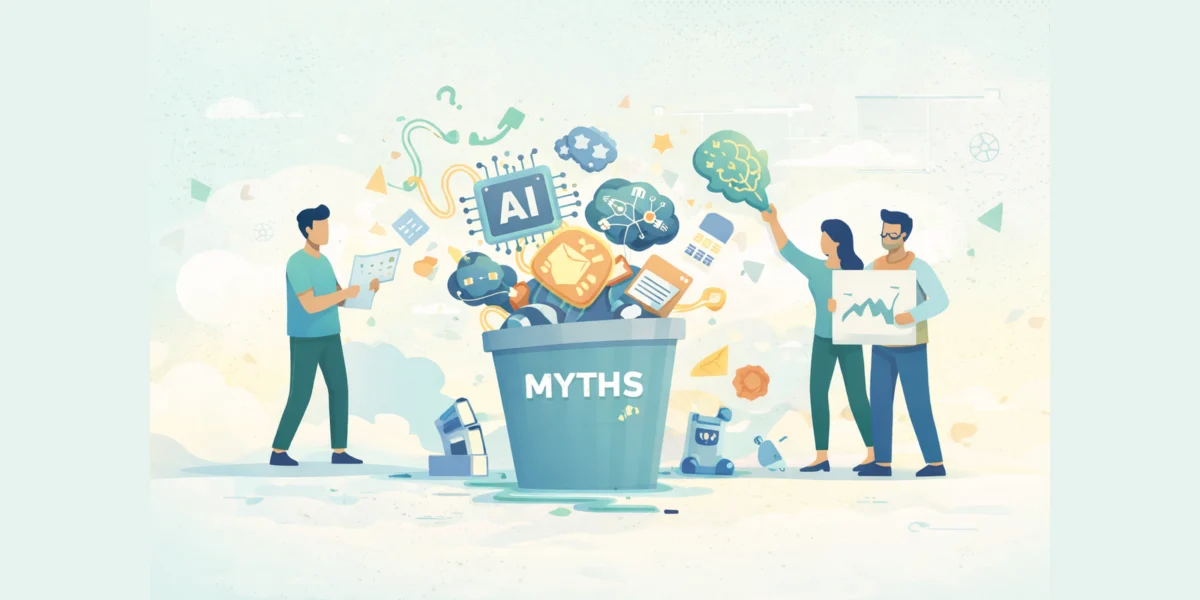
For marketing directors and Chief Marketing Officers, the path forward requires a fundamental shift in mindset. Success in the current landscape depends on shedding persistent myths and adopting a disciplined, outcome-oriented framework.
Myth 1: More Tools Equal More Efficiency
Accumulating standalone AI applications creates administrative drag. True efficiency emerges when AI is embedded directly into existing operational environments, such as content management systems (CMS), editorial calendars, and structured creative briefs.
- Actionable Takeaway: Map the end-to-end content workflow, identify genuine bottlenecks, and consolidate tools before purchasing new subscriptions.
Myth 2: AI Content Performs Autonomously
Grammatically correct copy is not synonymous with a compelling narrative. Unsupervised AI defaults to safe, generic ideas that fail to build trust or drive conversions.
- Actionable Takeaway: Use AI for initial ideation and drafting, but mandate human intervention to inject proprietary data, customer insights, brand voice, and rigorous fact-checking.
Myth 3: AI Can Fix Flawed Strategy
Accelerating production via AI only serves to amplify an existing direction—whether that direction is correct or fundamentally flawed. If a brand suffers from fuzzy positioning, scaling output will merely generate more invisible content.
- Actionable Takeaway: Solidify messaging, buyer personas, and conversion funnels before scaling production through automation.
Myth 4: Immediate, Universal Adoption is Mandatory
Fear of missing out (FOMO) often drives wasteful technology spending. Teams that rush into adoption without defined use cases frequently encounter resistance and skepticism.
- Actionable Takeaway: Begin with targeted pilot programs that address single, high-friction tasks. Document measurable improvements before expanding adoption across departments.
Myth 5: AI Search Parallels Traditional SEO
Traditional search engine optimization relies heavily on keyword rankings, site architecture, and backlinks. AI-powered search engines, conversely, compress, synthesize, and rewrite information from multiple sources.
- Actionable Takeaway: Maintain classic SEO best practices while incorporating AI-centric structures, such as clear entity definitions, robust schema markup, and direct, question-driven formatting.
Frequently Asked Questions (FAQs)
How do I evaluate if my organization is genuinely ready for advanced AI adoption?
Assess your foundational content operations. If your team operates with clearly documented workflows, established brand guidelines, and predictable publishing cadences, you are prepared to pilot AI tools. If your baseline operations remain chaotic or ad-hoc, resolve those structural challenges prior to introducing AI complexity.
What is the realistic financial and time investment required to see returns?
Many modern content platforms integrate basic generative AI features at little to no additional cost, meaning new software purchases are often unnecessary. The primary investment is time: expect a two-to-four-week learning curve as team members adapt to effective prompting, editing, and governance workflows.
How should marketing teams balance legacy SEO with AI search optimization?
Treat traditional search optimization and AI-driven visibility as complementary strategies. Continue building topical authority, securing quality backlinks, and optimizing site performance. Simultaneously, layer on practices designed for machine comprehension, including structured data markup and concise, authoritative answers to complex user inquiries.
Conclusion
The era of breathless, uncritical AI hype has run its course. As the marketing industry matures, the differentiator between thriving brands and stagnating competitors will not be the sheer volume of content produced, but the discipline, strategic clarity, and human expertise behind every published piece. By discarding counterproductive myths and focusing on measurable business outcomes, marketing teams can build sustainable, high-impact operations for the years ahead.