Main Facts
Website administrators and cybersecurity professionals are racing to patch a critical security flaw affecting the wildly popular Mailgun for WordPress plugin. Tracked as CVE-2026-78003, the vulnerability has been assigned a near-maximum Common Vulnerability Scoring System (CVSS) severity rating of 9.8 out of 10. This zero-click, unauthenticated Server-Side Request Forgery (SSRF) flaw allows malicious actors to weaponize a target website’s stored Mailgun API key, directing it toward arbitrary Mailgun API endpoints without requiring any user interaction, administrative privileges, or prior authentication.
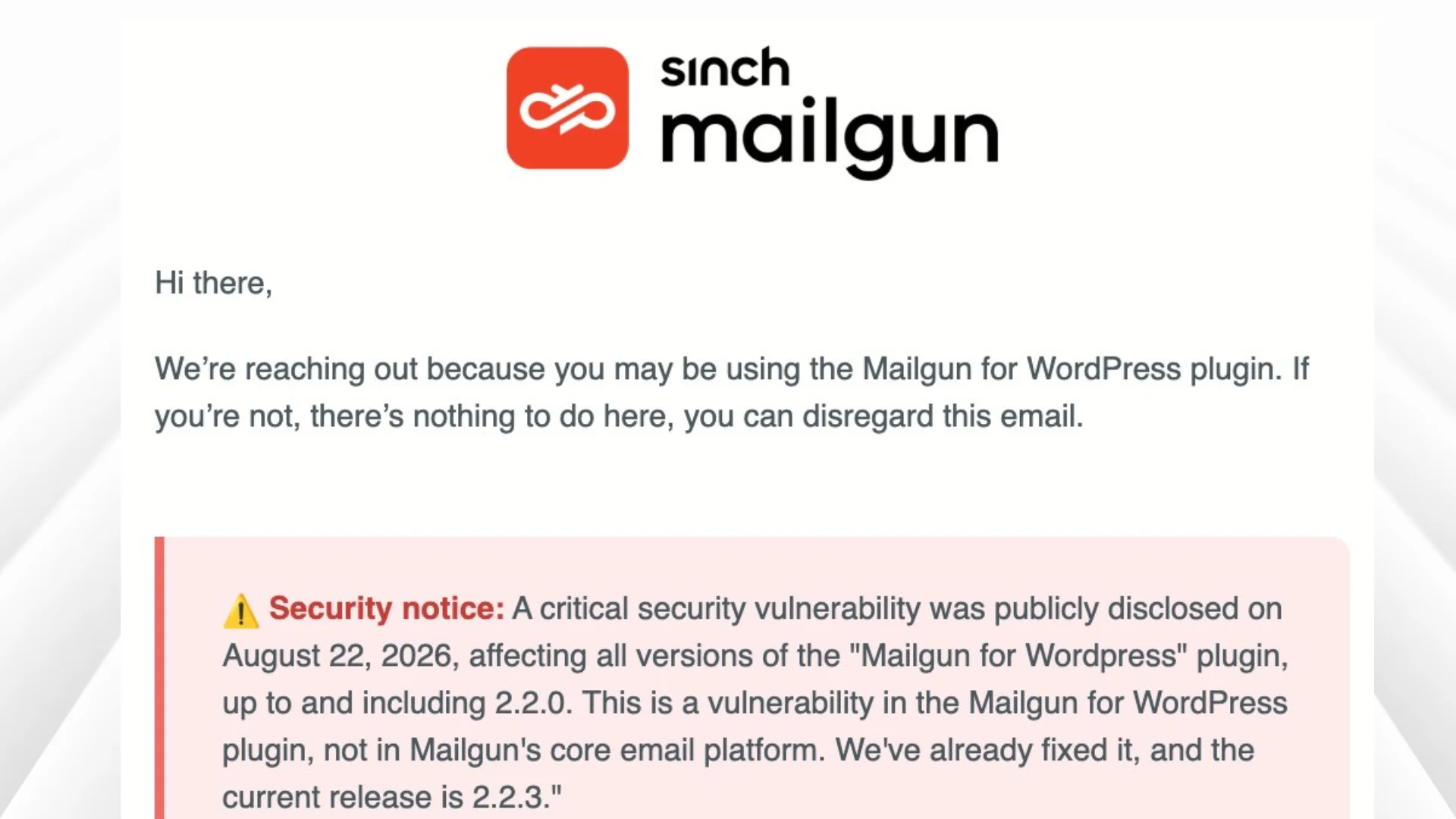
The scope of the threat is immense. According to WordPress repository metrics, the Mailgun plugin currently boasts more than 80,000 active installations globally, powering email delivery, tracking, and list management for a massive cross-section of corporate websites, e-commerce stores, and blogs. Versions up to and including 2.2.0 are confirmed to be vulnerable.
At the heart of the vulnerability lies a critical oversight in how the plugin handles visitor-supplied input. Specifically, the add_list() function—responsible for managing mailing list sign-ups—improperly sanitizes incoming data arrays. While developers utilized WordPress’s built-in sanitize_text_field() function to clean user input, this function is completely ineffective against path traversal characters. Consequently, an attacker can craft a malicious HTTP request featuring manipulated array keys, forcing the server to route requests to virtually any section of the Mailgun API while remaining cryptographically signed by the compromised site’s legitimate API key.
Security researchers at Wordfence have classified this flaw as a severe SSRF vulnerability. Because the exploit vector requires no authentication, zero social engineering, and zero user interaction, malicious operators can easily automate the attack at scale using botnets or scripted routines.
The downstream consequences of a successful exploit are devastating. The most prominent attack vector involves creating malicious inbound routes on the target’s Mailgun account. By configuring custom routes, an attacker can effortlessly intercept, capture, and divert all incoming emails destined for the WordPress site. Because modern websites rely heavily on email for core functionality, this interception includes intercepting password reset links. Once an attacker captures a password reset link for an administrative account, they can seamlessly hijack the WordPress dashboard, achieve remote code execution, inject malicious payloads, or compromise sensitive user databases.
Chronology
The discovery, patching, and disclosure timeline of CVE-2026-78003 reveals a concerning gap between the initial implementation of a patch and the public realization of its true severity.
- July 9: Mailgun silently released version 2.2.1 of its WordPress plugin. The changelog for this release was minimal, noting only that the update prevented “unauthenticated arbitrary list subscription.” It contained no mention of API key vulnerabilities, server-side request forgery, or potential account takeovers. Because the patch notes downplayed the risk as a minor spam-prevention update, many site administrators running manual updates deferred installation, assuming that minor list spam could wait.
- August 22: Exactly six weeks after the patch was quietly deployed, the underlying SSRF vulnerability (CVE-2026-78003) was officially published and publicized by independent security researchers, sending shockwaves through the WordPress security community.
- August 25: The Cybersecurity and Infrastructure Security Agency (CISA) released its initial assessment of the vulnerability, stating that there was no confirmed evidence of active exploitation in the wild at that exact time.
- August 28: Threat intelligence firm VulnCheck publicly contradicted earlier containment reports, publishing indicators of compromise (IoCs) and confirming that active, automated exploitation attempts targeting CVE-2026-78003 had begun in the wild.
- Present Day: The current stable release of the plugin is 2.2.3, which patches all known vectors. However, millions of distinct sites utilizing older iterations remain exposed due to delayed manual update cycles.
Supporting Data
To fully understand the gravity of CVE-2026-78003, one must look at the technical architecture of the bug and its relationship to an earlier, companion vulnerability patched simultaneously.
When Mailgun released version 2.2.1 on July 9, it actually closed two distinct security holes with a single code modification. The first flaw, tracked as CVE-2026-14834, received a CVSS score of 6.5. This specific bug allowed unauthorized users to arbitrarily inject email addresses into a site’s mailing lists—a nuisance that could pollute marketing databases or be leveraged for spam campaigns.
However, the second flaw—the 9.8-rated SSRF vulnerability that would later become CVE-2026-78003—was entirely obscured by the vague changelog entry. Because the release notes focused exclusively on "arbitrary list subscription," security teams and system administrators reading the changelog in July treated the update as a routine anti-spam measure rather than a critical infrastructure patch.
Technical Deep Dive: The Code Flaw
The vulnerability resides in the plugin’s source code, specifically within the add_list() function located around line 557 of mailgun.php. The function was designed to process user-submitted data during newsletter or mailing list sign-ups.
// Conceptual representation of vulnerable input handling
$list_key = sanitize_text_field($_POST['mailgun_list']);
While sanitize_text_field() strips out HTML tags and octets, it does nothing to prevent path traversal characters (such as ../) or structural alterations in multidimensional arrays. An attacker could supply a specially crafted array key that bypasses standard validation filters. When the plugin passes this data to the Mailgun API wrapper, the manipulated key alters the destination URL path of the API call. Because the script appends the site’s authentic Mailgun API key to authorize the request, the API endpoint treats the request as a legitimate, authenticated command from the domain owner.
The Scope of API Key Exposure
A critical factor determining the impact of this exploit is the type of Mailgun API key stored within the WordPress plugin settings. Mailgun utilizes two primary tiers of API keys:
- Primary Account Keys: These master keys grant full administrative control across every sending domain associated with the Mailgun account. If a WordPress site utilizes a primary account key within the plugin settings, a successful SSRF exploit grants the attacker total control over the entire Mailgun account, affecting every domain and subdomain tied to that profile.
- Domain Sending Keys: These restricted keys are scoped solely to send mail for one specific domain. While an attacker utilizing a compromised sending key could theoretically spoof emails from that specific domain, they are heavily restricted from creating new inbound routes or modifying account-wide configurations.
Unfortunately, many deployments of the Mailgun for WordPress plugin require extensive permissions—such as managing mailing lists and handling inbound triggers—meaning that simple domain-sending keys are often insufficient for the plugin’s full feature set. Consequently, many administrators have configured higher-privilege keys, inadvertently expanding the blast radius of any potential compromise.
Official Responses
As news of CVE-2026-78003 spread across security mailing lists and vulnerability databases, response from the cybersecurity community and software vendors was swift.
Mailgun addressed the flaw internally prior to public disclosure, bundling the fix into the v2.2.1 release. However, the vendor faced widespread criticism from cybersecurity analysts regarding the lack of transparency in their initial changelog documentation. By masking a critical, nearly-un-bypassable remote control vulnerability behind vague language regarding "unauthenticated arbitrary list subscriptions," the vendor inadvertently contributed to a delayed patch-adoption rate. Communication experts and vulnerability coordinators note that obscure changelogs routinely undermine patch management strategies, as overworked sysadmins often prioritize updates based on how severe the changelog makes the issue sound.
Independent security entities, including Wordfence and VulnCheck, stepped in to bridge the communication gap. Wordfence’s Threat Intelligence team published a comprehensive advisory detailing the mechanics of the server-side request forgery, enabling firewall rules to block exploit payloads before they reached vulnerable PHP functions. VulnCheck provided critical early warning telemetry on August 28, alerting the global community that threat actors had begun scanning for and exploiting unpatched WordPress instances at scale.
Cybersecurity agencies have reiterated standard emergency protocols: automated updates remain the single most effective defense against widespread zero-day and n-day vulnerabilities. Sites configured to update plugins automatically were protected almost immediately upon the rollout of subsequent stable patches (versions 2.2.2 and 2.2.3). Conversely, sites reliant on manual intervention found themselves dangerously exposed for nearly two months.
Implications
The fallout from CVE-2026-78003 extends far beyond a single WordPress plugin, raising critical questions regarding third-party API integration security, plugin supply chain transparency, and the inherent risks of storing high-privilege credentials in content management systems.
1. The Dangers of Over-Privileged API Keys
The incident underscores a fundamental principle of least privilege: third-party integrations should never hold more operational power than strictly necessary. Developers of WordPress plugins that interface with external Email Service Providers (ESPs)—such as Sendgrid, Mailchimp, Amazon SES, and Mailgun—must design their architectures to utilize scoped, restricted API tokens rather than master account keys. When an application stores a master key that can manipulate billing, routing, and multi-domain configurations, a single vulnerability in a minor form handler transforms into an enterprise-wide catastrophe.
2. Supply Chain and Disclosure Ethics
The gap between the release of version 2.2.1 on July 9 and the public disclosure of CVE-2026-78003 on August 22 highlights ongoing friction in vulnerability disclosure norms. While "silent patching" (deploying a fix without immediately broadcasting its security implications) is sometimes practiced to give administrators a head start on updates, it backfires when the changelog minimizes the risk. Administrators who triage updates based on risk metrics routinely skip patches labeled as minor bug fixes or spam filters. Vendors must adopt transparent, explicit security advisories to ensure that critical patches receive the urgent attention they demand.
3. Actionable Remediation Steps for Administrators
For webmasters and IT professionals managing WordPress infrastructure, the immediate path forward is clear:
- Verify Plugin Versions: Log into all managed WordPress instances immediately and check the installed version of the Mailgun plugin. Ensure that the site is running version 2.2.3 or higher.
- Audit Automatic Update Settings: Enable automatic background updates for security-critical plugins to ensure future vulnerabilities are mitigated instantly without requiring manual intervention.
- Rotate API Keys Immediately: If a site was running a vulnerable version of the plugin (2.2.0 or earlier) after July 9, administrators must assume the stored Mailgun API key may have been exposed or queried via SSRF. Log into the Mailgun dashboard, revoke the old API key, generate a new one, and update the WordPress configuration.
- Review Mailgun Ingress/Egress Logs: Inspect Mailgun account routing rules and logs for any unauthorized inbound routes, unexpected webhook configurations, or anomalous forwarding rules designed to capture password reset tokens.
- Harden Administrative Accounts: Implement multi-factor authentication (MFA) across all WordPress administrative accounts. Even if an attacker manages to intercept an email password reset link via an API exploit, requiring a secondary hardware token or authenticator app code will effectively block unauthorized dashboard access.
CVE-2026-78003 serves as a stark reminder that in the modern web ecosystem, a single vulnerable input field can become a master key to an organization’s digital infrastructure. Vigilance, rapid patching, and strict adherence to the principle of least privilege remain the ultimate defenses against escalating automated threats.