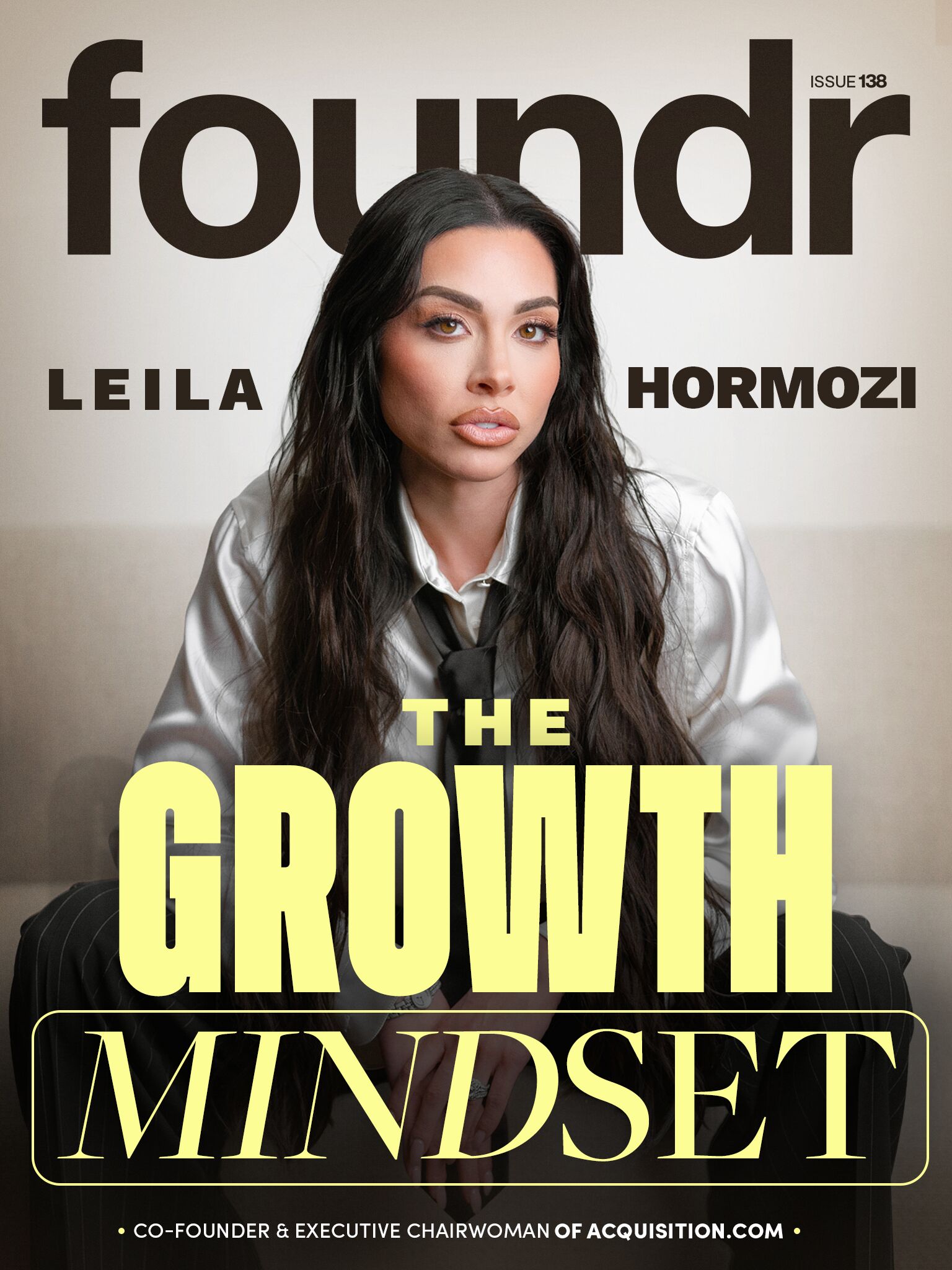
Leila Hormozi’s trajectory is not a conventional rags-to-riches tale; it is a profound study in the alchemy of transformation. By the age of 30, she had co-founded Acquisition.com, a portfolio powerhouse generating over $250 million in annual revenue. Yet, her path to the apex of the business world was paved not with academic accolades or venture capital connections, but with six arrests, a battle against addiction, and an unwavering commitment to radical self-honesty.
In a candid, wide-ranging interview with Foundr CEO Nathan Chan, Hormozi dismantles the myth that success is a linear progression of triumphs. Instead, she posits that the same intensity and "capacity for excess" that nearly cost her her life were the precise instruments she refined to build a modern business empire.
The Turning Point: When Pain Becomes the Catalyst
The narrative of Hormozi’s early life is defined by a turbulent 18-month period that saw her arrested six times. It was a cycle of self-destruction fueled by anger and personal trauma. However, it was not a sudden revelation that sparked her turnaround, but rather the crushing weight of reality.
Waking up on the couch at her father’s home after her sixth arrest, Hormozi was braced for a lecture. Instead, she was met with a quiet, devastating truth: her father’s fear that her trajectory would inevitably end in her death.
"I was ready for him to just completely rail into me," Hormozi recalls. "Instead, he was sitting on the couch… and he was like, ‘I’m not gonna tell you what to do. I just want to tell you that I really think that you’re gonna kill yourself if you keep doing this.’"

That interaction shattered the facade of victimhood she had constructed. She realized the consequences of her actions were no longer theoretical; they were existential. She describes this as the moment where "the pain of change was less than the pain of remaining the same." It was a visceral, non-negotiable decision to reinvent her identity. She did not rely on "discipline" in the traditional sense; she relied on a profound aversion to her previous state of being, effectively burning the bridges to her past by clearing her environment of everything—from substance abuse to unhealthy habits—that tethered her to her former self.
Chronology of a Builder: From Personal Trainer to CEO
Hormozi’s rise is rooted in the "survival-level" business experience she gained as a personal trainer. With only $5,000 to her name and a $1,500 monthly rent, she adopted a hyper-local approach to growth: she walked to every gym in her immediate vicinity to secure work. This period taught her the fundamental mechanics of sales, client acquisition, and fiscal responsibility.
When she met her future business partner and husband, Alex Hormozi, on a dating app, the proposition was unconventional. He pitched her on the concept of Gym Launch—a business model aimed at helping gym owners scale—on their very first date. Her decision to say yes was calculated: "The worst-case scenario is I end up right back where I am now… I can accept that."
This partnership was not without its trials. The early days of Gym Launch were marred by systemic disasters, including a fraudulent business partner who drained their accounts, merchant processors freezing their capital during the holiday season, and the immense pressure of managing a team that had quit stable jobs to join a venture that, at times, had no money.
Through sheer operational grit, she and Alex scaled Gym Launch from zero to $50 million in just 20 months. Yet, this rapid growth exposed a critical weakness: the gap between the desire to succeed and the specialized skill required to manage that success.

Data and Disruption: The Lessons of Leadership
One of the most defining moments in Hormozi’s professional life occurred when a surge of aggressive hiring led to a cultural and structural crisis. In a bid to scale, she hired 35 employees when the business only required five. The resulting layoffs were handled poorly, causing her company’s Glassdoor rating to plummet from a 4.9 to a 2.2.
This, she admits, was a failure of leadership. She had the ambition but lacked the management maturity to steer such a complex machine. She acknowledges that she previously harbored a hidden desire to be "liked," which manifested as a failure to provide honest, critical feedback to her team.
"I realized it’s really not better to be nice in that way, because the two personalities [being harsh vs. being overly nice] have the same effect on people long term," she explains. "Whether I’m yelling at my team, or I’m being so nice I don’t tell them the truth, the same result occurs. That person doesn’t know what they need to do better."
By shifting her perspective to that of a coach—modeled after the legendary John Wooden—she began to prioritize the professional growth of her employees over her own comfort. She learned that true empathy involves holding people to the standards they need to meet to excel, rather than shielding them from uncomfortable truths.
Scaling the Human Capital: Building a Culture of Growth
Hormozi’s current obsession is the development of "people infrastructure." At Acquisition.com, she maintains a dedicated people team of six—a significantly higher ratio than most companies of similar size. She argues that this investment is essential because the "employee experience" is just as vital as the "customer experience."
She emphasizes that founders often underestimate the importance of operational capacity. In her framework, there are four pillars of business capacity:
- Financial capacity
- Personnel capacity
- Systems capacity
- Thinking capacity
Most businesses fail not because of a flawed strategy, but because of poor execution. Hormozi maintains that she has only seen two companies in her portfolio capped by strategy; the other 50 failed to reach their potential due to the inability to execute on these four pillars.
Implications: The Mirror Effect
Leila Hormozi’s leadership style is rooted in the "Mirror Effect." She acknowledges that every action, word, and reaction from the founder is amplified and scrutinized by the team. The founder is the heartbeat of the organization; if the leader is not disciplined, the culture will inevitably become fragmented.
For aspiring entrepreneurs, her message is clear: do not seek to avoid the crucible of failure. Instead, understand that the traits required to reach the pinnacle of success are the same ones that make you susceptible to falling. Her journey from the brink of personal ruin to the helm of a $250 million portfolio is not just about money; it is about the mastery of self-leadership.
"Do you think we would have had the massive success without the massive failures?" she asks. "No. The same muscle that allows you to succeed at that level and take those risks also means you’re gonna fall on your face. It’s a rite of passage."

Conclusion: The Path Forward
Leila Hormozi represents a new generation of operators who prioritize transparency, rigorous execution, and human development. By treating business as a vehicle for personal growth—for both the founder and the employee—she has created a model that transcends simple profitability. Her story serves as a reminder that the most significant growth often begins in the moments of our deepest discomfort, and that the ultimate competitive advantage is the ability to look in the mirror, acknowledge your shortcomings, and commit to the hard work of change.