Main Facts
In an era where digital infrastructure is treated as an invisible, omnipresent utility, the physical reality of the internet can still be upended by something as mundane as an unannounced air filter replacement. On August 27, privacy-focused tech provider Proton experienced a sweeping service disruption that temporarily took platforms like Proton Mail offline for users worldwide.
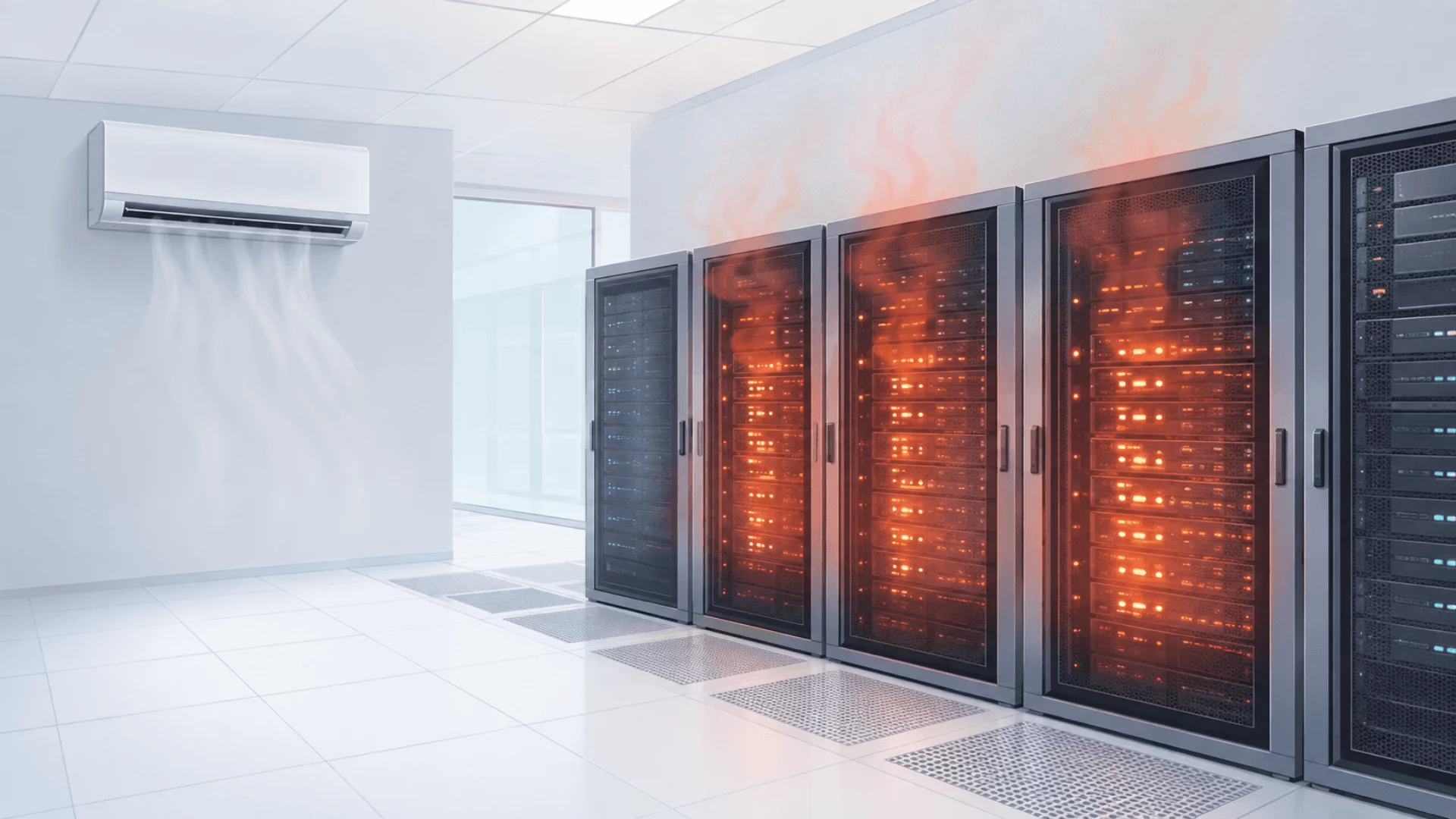
The root cause of the incident was neither a sophisticated cyberattack, a distributed denial-of-service (DDoS) assault, nor a catastrophic software bug. Instead, it was a total cooling failure at a third-party data center located in Frankfurt, Germany—one of Europe’s primary digital transit hubs. The failure sent ambient temperatures inside the server halls soaring to extreme levels within minutes, forcing automated safety protocols to shut down critical hardware to prevent permanent thermal damage.
While Proton’s engineering teams managed to restore full service within roughly three hours of the initial user-facing disruption, the incident has reignited critical conversations across the technology sector. Specifically, it highlights the inherent vulnerabilities of relying on third-party physical infrastructure facilities, the critical dependencies of complex database failovers, and the cascading risks associated with uncoordinated maintenance work by data center operators.
For Proton, which prides itself on rigorous data security and high availability for millions of privacy-conscious journalists, activists, and everyday users, the event served as an unwelcome stress test. Crucially, post-incident forensic audits confirmed that no user data was compromised or permanently lost during the thermal spike, though message delivery queues faced significant bottlenecks. Nevertheless, the disruption underscores a troubling trend: infrastructure-level environmental failures are increasingly capable of knocking out major software-as-a-service (SaaS) providers, echoing a remarkably similar cooling-induced outage suffered by domain registrar and hosting provider Namecheap just two weeks prior.
Chronology of the Incident
To understand how a major European digital hub nearly suffered catastrophic hardware damage, one must examine the precise timeline of events as documented in Proton’s official post-incident report. The crisis unfolded with terrifying speed, leaving automated systems and human operators little time to react.
The Spark: Late-Night Maintenance Without Notice
The chain reaction began late in the evening on August 26, 2025. According to investigative findings released by Proton, technicians at the Frankfurt data center facility initiated routine maintenance involving the replacement of air filters on the facility’s redundant air compressors.
Crucially, this work was carried out by the data center operator without prior notice given to Proton’s engineering teams. More alarmingly, when the maintenance triggered a total failure of the cooling apparatus, the facility operators failed to immediately communicate the emergency to Proton’s on-call site reliability engineers (SREs).
The Thermal Spike: 30 Minutes to Critical Mass
Without active climate control, the thermal dynamics of a high-density server room turned hostile almost instantly. Shortly after 11:00 PM CEST on August 26, sensors recorded an initial baseline ambient temperature of approximately 21.8°C within the affected server enclosures.
What followed was an exponential rise in heat. In under 30 minutes, the ambient temperature in the server room climbed to a blistering 51.9°C (125.4°F). In localized pockets directly adjacent to high-draw processing units, individual sensors recorded peak air temperatures soaring as high as 60°C (140°F).
Modern enterprise-grade servers are engineered with robust thermal throttling and emergency shut-off mechanisms designed to protect silicon components from literally melting or warping under extreme heat. As the mercury crossed safety thresholds, servers, storage arrays, and networking equipment began automatically cutting power to protect themselves from thermal destruction.
User Impact and Network Switch Failures
While the hardware began bailing out internally just after 11:30 PM, the disruption did not immediately manifest as a full-scale external outage. However, the situation deteriorated sharply around midnight (00:00 CEST).
At this juncture, both the primary and backup network switches on a critical infrastructure rack failed simultaneously—a casualty of the compounded thermal and electrical stress. This dual-switch failure severed the vital communication pipelines linking Proton’s internal databases to the outside world, instantly translating the physical overheating into a tangible, user-facing outage for Proton Mail, Proton Calendar, and associated web services.
The Human Element and Slow Recovery
As automated safety measures tripped across multiple hardware clusters, system architectures were forced into emergency recovery states. While many stateless services can recover automatically once power and cooling are restored, stateful systems—particularly complex relational databases—frequently require manual intervention to prevent data corruption or split-brain scenarios.
Proton noted that its database failover architecture required active human supervision by its engineering teams. Because engineers had to manually verify database integrity and authorize safe re-routing sequences, the recovery timeline was extended.
Despite these hurdles, rapid triage yielded results. Most services were successfully restored for the vast majority of users by approximately 1:30 AM CEST on August 27. The remaining lingering systems, background synchronization queues, and edge nodes fully recovered by roughly 2:00 AM CEST, bringing an end to a frantic three-hour operational nightmare.
Supporting Data and Technical Metrics
An analysis of the operational telemetry released by Proton and industry observers provides a stark illustration of just how close the Frankfurt data center came to a structural catastrophe.
| Metric Category | Data Point / Value | Significance |
|---|---|---|
| Initial Ambient Temperature | ~21.8°C | Standard, healthy operating climate for enterprise server rooms. |
| Peak Ambient Temperature | 51.9°C to 60°C | Extreme thermal load capable of triggering automatic hardware self-preservation shutdowns. |
| Time to Critical Heat | Under 30 minutes | Demonstrates the terrifying speed at which uncooled server rooms can reach hazardous heat levels. |
| Total Duration of Outage | ~3 hours | Time elapsed from initial user-facing disruption at midnight to near-complete system restoration at 2:00 AM CEST. |
| Data Loss Rate | 0% | Comprehensive confirmation that redundant storage arrays and transactional logs preserved all user data. |
| Queued Impact | Delayed inbound/outbound mail | While no mail was lost, message delivery pipelines experienced significant latency during the recovery phase. |
The metrics underscore a fundamental law of modern computing: software is only as reliable as the physical environment housing it. Even with state-of-the-art software encryption, zero-knowledge architectures, and geographically distributed nodes, a single-digit percentage increase in ambient room temperature can render millions of lines of code temporarily inaccessible. Furthermore, the data highlights the resiliency of modern storage protocols; despite hardware abruptly cutting power in 60°C heat, robust journaling and database transaction logs ensured zero data loss occurred—a testament to the fault-tolerant design of Proton’s core storage layers.
Official Responses and Industry Precedent
The fallout from the Frankfurt incident has prompted sharp commentary from both Proton’s leadership and the broader cloud infrastructure community regarding accountability, maintenance transparency, and third-party risk management.
Proton’s Post-Incident Assessment
In its transparent post-incident report published on the official Proton blog, the company did not mince words regarding where responsibility lay for the crisis. Proton explicitly pointed the finger at the third-party data center operator, citing two fatal operational errors:
- Unannounced Maintenance: Carrying out high-risk infrastructure work—specifically touching the air filter systems of redundant air compressors—without issuing a formal change-management notification or warning to hosted tenants.
- Communication Breakdown: Failing to immediately notify Proton’s engineering teams when the cooling system failed, thereby robbing SREs of precious minutes to prepare for thermal mitigation or preemptively shed load.
"While our systems are built to withstand failures, unexpected environmental shocks combined with a lack of operational transparency from facility management create severe challenges," a Proton infrastructure representative noted in follow-up technical briefs. "We are engaging directly with our facility partners to enforce stricter communication protocols and service-level agreements."
A Fortnight of Facility Failures: The Namecheap Parallel
What makes the Frankfurt incident particularly alarming is that it is not an isolated anomaly. Just two weeks prior, on August 13, the web hosting and domain registrar industry experienced an almost identical crisis.
Namecheap was forced to take its shared hosting, Private Email, and DNS management infrastructure completely offline following a catastrophic cooling failure at the RadiusDC Phoenix data center in Arizona. Much like the Proton incident, the root cause of the Namecheap outage had nothing to do with internal software bugs or malicious cyber activity; it was an environmental control failure originating entirely at the facility level.
In both instances—Phoenix and Frankfurt—industry analysts noted striking structural similarities:
- The Vulnerability Point: The failure sat squarely with the physical real estate operator rather than the software platform provider.
- The Recovery Bottleneck: In both cases, the speed of recovery was ultimately dictated by the facility operator’s responsiveness, physical access allowances, and the complexity of recovering stateful hardware after thermal trauma.
These consecutive high-profile outages have sparked an urgent industry-wide debate. As enterprises increasingly migrate critical workloads to outsourced colocation facilities and hyperscale data centers, the "black box" nature of physical infrastructure management represents an unmitigated single point of failure that software providers struggle to insulate themselves against entirely.
Implications and Future Resilience
For Proton, the Frankfurt meltdown has served as a powerful catalyst for architectural evolution. While the company successfully navigated the crisis without losing a single user email, management has made it clear that relying on localized physical infrastructure without deeper multi-site redundancy is no longer acceptable in an era of tightening reliability expectations.
Shifting Toward Deeper Infrastructure Resilience
In the wake of the August 27 incident, Proton’s engineering divisions have accelerated several long-term infrastructure overhauls designed to permanently reduce the platform’s dependency on any single physical data center site.
Key initiatives currently underway include:
- Enhanced Database Resilience: Upgrading automated cross-site replication topologies to ensure that stateful database failovers can execute seamlessly without requiring manual human intervention, thereby slashing recovery time objectives (RTO).
- Distributed Infrastructure Capacity: Expanding geographical load balancing to ensure that if a primary regional hub suffers an environmental catastrophe, traffic can be instantly diverted to entirely separate, isolated facilities without dropping network connections or triggering switch failures.
- Stricter Vendor Audits: Imposing rigorous compliance frameworks on third-party data center operators, including mandatory real-time telemetry sharing, automated emergency alerting integrations, and strict penalties for unannounced maintenance operations.
The Broader Outlook for Cloud and Privacy Services
As cloud-dependent societies demand "always-on" availability, the Frankfurt and Phoenix incidents offer a sobering reminder that the cloud is not an abstract, ethereal space floating in cyberspace. It is fundamentally tethered to physical server racks, copper wiring, chilled water pumps, and air compressors residing in concrete buildings across the globe.
For users relying on privacy-centric services like Proton, incidents like these test brand loyalty and trust. Proton’s swift, highly transparent post-incident reporting—admitting faults, detailing temperatures down to the decimal point, and outlining concrete remediation steps—has largely mollified user anxiety. However, the broader lesson for the tech sector is clear: as climate change drives up ambient temperatures globally, and as data center density reaches unprecedented levels, physical climate control is no longer just a facility concern. It is a core cybersecurity and business continuity imperative.
As of the latest updates on Proton’s official status dashboard, all Proton Mail, Calendar, Drive, and VPN services are fully operational, running smoothly behind reinforced infrastructure guardrails designed to ensure that the next time a maintenance crew picks up a wrench in Frankfurt, the digital world won’t feel the heat.