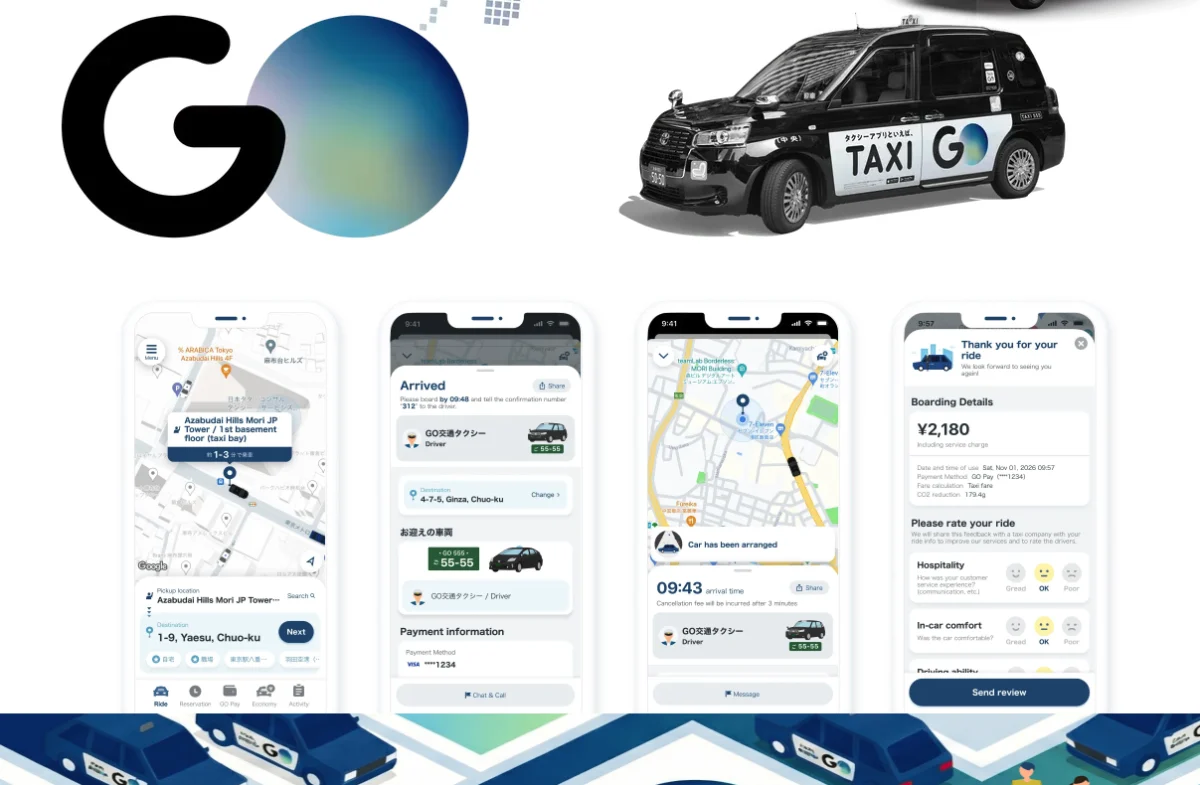
In a landmark moment for Japan’s financial markets, the Tokyo-based ride-hailing giant GO recently completed its initial public offering (IPO), raising ¥88.6 billion ($553 million). As the largest Japanese IPO of the year, the debut has done far more than inject life into a stagnant domestic listing season; it has provided the strategic capital necessary to address an existential crisis: the nation’s rapidly shrinking pool of professional drivers.
While the stock market debut faced immediate headwinds—with shares closing at ¥2,314 on Friday, representing a 4% dip from the ¥2,400 offering price—the long-term narrative surrounding the company is centered on a radical transformation of the Japanese transit landscape. By leveraging its dominance in the ride-hailing sector, GO aims to pivot toward a future defined by autonomous mobility and strategic consolidation.
The Strategic Imperative: Solving the Human Shortage
The urgency behind GO’s expansion into robotaxis is not merely driven by technological idealism; it is a response to a demographic emergency. Japan’s taxi industry is currently facing a precarious decline in workforce availability. Data from the Ministry of Land, Infrastructure, Transport and Tourism indicates that the number of active taxi drivers has plummeted by roughly 20% in recent years.
This contraction is largely structural, rooted in Japan’s rapidly aging population and a shrinking labor force. As seasoned drivers retire and fewer younger workers enter the profession, the gaps in service have become glaring. While the Japanese government authorized limited ride-sharing services in April 2024 to mitigate these issues, the current regulatory framework remains restrictive, requiring ride-share drivers to be employed by established taxi companies. These measures have thus far proven insufficient to fill the void.
For GO, which boasts an 80% market share by usage time and 35 million downloads, the robotaxi represents a necessary evolution—a way to maintain service levels in a market where human labor can no longer keep pace with demand.
Chronology: From Traditional Operator to Digital Titan
To understand GO’s current trajectory, one must look at its historical evolution. Founded in 1977 as a traditional taxi operator, the company has successfully navigated the shift from analog dispatch to digital ride-hailing.
- 1977: Company founded as a conventional taxi service provider.
- The Digital Pivot: The company evolves into a platform-based entity, eventually capturing 85,000 partner vehicles across 46 of Japan’s 47 prefectures.
- March 2024: Japanese government opens the door to limited ride-sharing, providing a regulatory testing ground for new mobility solutions.
- Late 2024: GO announces strategic partnerships to bolster its international profile, including integrations with platforms like Kakao T, Alipay, and WeChat Pay to serve the booming inbound tourism sector.
- December 2024: GO formalizes a partnership with Alphabet’s Waymo and Nihon Kotsu to explore the integration of autonomous driving technology into the Tokyo market.
- 2025 (Current): GO completes its IPO on the Tokyo Stock Exchange, setting the stage for future acquisitions and R&D investment.
Supporting Data: The Market Landscape
GO’s market position is fortified by significant institutional interest. Despite the volatility of its public debut, the IPO attracted capital from heavyweight investors including BlackRock, Wellington Management, and M&G Investment Management. This backing underscores a broader trend: global institutional money is seeking exposure to Japanese companies that are actively tackling the country’s unique socio-economic challenges.
The scale of GO’s operation is substantial, providing it with the data-rich environment necessary to train and deploy future autonomous systems. With 85,000 partner vehicles and a ubiquitous presence across the Japanese archipelago, the company functions as the primary nerve center for urban mobility in Japan.
However, the competition is heating up. The race for the robotaxi market is not a solo pursuit. In a high-profile move, Uber, Wayve, and Nissan announced a joint plan to pilot robotaxi services in Tokyo by late 2026. This initiative will utilize Nissan Leaf electric vehicles powered by Wayve’s "AI Driver" technology, directly challenging the ecosystem that GO is attempting to cultivate. Other players, such as S.Ride and Didi Mobility Japan (a joint venture between SoftBank and Didi Chuxing), are also vying for the international tourist market, creating a crowded and highly competitive landscape.
Official Responses and Corporate Strategy
In an official statement regarding the allocation of the ¥88.6 billion raised, a GO spokesperson clarified the company’s dual-track approach to growth.
"We intend to use the proceeds from the sale of newly issued shares toward investment in research and development related to robotaxis and investment in business expansions, including strategic mergers and acquisitions in our business inside and outside of the taxi industry," the spokesperson stated.
Crucially, the company has adopted a pragmatic approach to autonomous development. Rather than attempting to reinvent the wheel, CEO Hiroshi Nakajima has indicated that GO will not invest in the underlying autonomous driving systems themselves. Instead, the company is positioning itself as the critical "strategic coordinator" of the ecosystem. By partnering with established tech giants like Waymo, GO aims to integrate advanced autonomous software into the existing taxi infrastructure of partners like Nihon Kotsu.
Regarding the timeline for full automation, the company remains cautious, emphasizing regulatory compliance and safety validation over speed. "We plan to begin driving fully autonomously, without a human specialist present, when we validate our technology and receive approval to do so," the spokesperson noted. No firm date for full-scale driverless operations has been set, reflecting the complex legal and safety hurdles that still exist in Japan’s urban centers.
Implications: A Shifting Regulatory and Economic Environment
The broader context of GO’s IPO is a government-led push for startups to prioritize sustainable growth over rapid public listings. The Japanese government has been actively encouraging startups to focus on private capital raises and strategic sales, making GO’s decision to go public an outlier in the current climate.
1. The Survival of the Taxi Ecosystem
The move towards robotaxis is not intended to destroy the traditional taxi industry but to preserve it. By digitizing the fleet and preparing for an autonomous future, companies like GO are attempting to ensure that taxi operators remain viable in a world where labor is scarce and expensive.
2. International Interoperability
GO’s partnerships with Alipay, WeChat Pay, and Kakao T signify a pivot toward the "inbound" market. As Japan continues to see record levels of tourism, the ability to provide a seamless, app-based experience for international travelers—who expect the same functionality they have at home—is a key competitive advantage.
3. The Autonomous "Coopetition"
The landscape in Tokyo is shifting toward "coopetition." While companies like Uber, Wayve, and GO are competitors, they are all working within a shared regulatory sandbox that requires close cooperation with the Japanese government. The success of the robotaxi model in Tokyo will depend less on who has the best algorithm and more on who can navigate the complex web of local regulations, municipal support, and labor union concerns.
4. The Investor Verdict
The initial dip in GO’s share price suggests that the market is waiting for clearer evidence of profitability in the robotaxi sector. Investors are balancing the long-term potential of autonomous transport against the immediate, high-cost reality of R&D and market expansion. The coming fiscal quarters will be critical for GO as it seeks to demonstrate that its IPO was not just a fundraising exercise, but the foundation for a sustainable, tech-enabled future.
Conclusion
GO stands at a crossroads. As it transitions from a traditional ride-hailing app into an integrated mobility platform, it carries the weight of an entire industry’s future. By securing the capital to invest in autonomous technology and strategic acquisitions, the company is attempting to outrun the demographic decline that threatens its business model. While the path to fully autonomous, driverless streets remains long and filled with regulatory unknowns, GO’s recent public debut marks a definitive point of no return for the Japanese transportation sector. The question remains: can they successfully bridge the gap between their current reliance on human drivers and the automated future they envision? Only time—and the rigorous validation of their technology—will tell.