For U.S.-based merchants and global e-commerce brands, the European Union has long represented a lucrative but complex market. However, as of December 2024, the threshold for entry has shifted significantly. The updated General Product Safety Regulation (GPSR) has officially come into force, replacing the aging 2001 directive with a robust, modernized framework designed to govern the realities of digital commerce, global supply chains, and the proliferation of internet-connected (IoT) devices.
For those doing business in the EU, the GPSR is no longer an optional guideline; it is a fundamental pillar of operational compliance. Whether you are a boutique artisan on Etsy, a mid-sized brand on eBay, or a major retailer on Amazon, the regulation demands a comprehensive overhaul of how products are labeled, listed, and tracked.
The Evolution of EU Safety Standards: A Chronology
To understand the gravity of the current regulation, one must look at the timeline of European consumer protection.
- 2001: The original General Product Safety Directive (GPSD) was enacted. At the time, it was designed for a world of brick-and-mortar retail and traditional supply chains.
- 2010s: As e-commerce exploded and online marketplaces became the primary gateway for global trade, the 2001 directive began to show its age. It lacked specific provisions for digital platforms and the nuances of cross-border drop-shipping.
- 2023: The EU finalized the text of the new GPSR, signaling a move from a "directive" (which allows member states to interpret rules) to a "regulation" (which is directly applicable and binding in all EU member states).
- December 2024: The regulation officially became effective. This date marked the end of the transition period, requiring all non-compliant listings to be updated or removed.
- 2025 and Beyond: Regulators are now focusing on enforcement, with marketplaces acting as the first line of defense in identifying non-compliant sellers.
The Scope: What Does the GPSR Cover?
The GPSR acts as a "safety net" for the European consumer. While there are sector-specific regulations for toys, electronics, and cosmetics, the GPSR covers almost everything else. If you sell home goods, sports equipment, lifestyle accessories, kitchenware, or hardware that isn’t covered by a more specific safety regime, the GPSR applies to you.
Crucially, the regulation ignores the distinction between "online" and "offline." It applies to any merchant selling into the EU, regardless of where that merchant is physically located. If your website allows a customer in France or Germany to purchase your product, you are subject to these rules.
The "Responsible Person": A Mandatory Liaison
The most significant—and often the most difficult—hurdle for non-EU merchants is the requirement to appoint an EU-based "Responsible Person" (also known as a Responsible Economic Operator).
Why the EU Demands an On-the-Ground Presence
Previously, regulators struggled to hold foreign manufacturers accountable for faulty or dangerous products. By requiring an EU-based entity, the regulation ensures that there is always a legal point of contact that can be held accountable, served with documentation, or tasked with facilitating a product recall.
Who Qualifies as a Responsible Person?
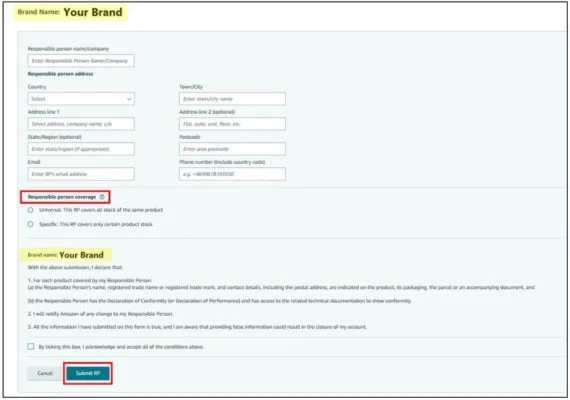
A Responsible Person can be an importer, an authorized representative, a fulfillment service provider (such as an Amazon FBA center, though they may have specific requirements), or a distributor. This person or entity must be based within the EU and be willing to take on the legal burden of acting as the safety liaison for your brand. Their contact details—name, address, and email—must be clearly visible on the product, its packaging, or accompanying documentation.
For U.S. sellers accustomed to "shipping direct" from domestic warehouses, this represents a significant structural change. It may necessitate the use of a third-party compliance firm or a formal agreement with a European distributor.
Transparency in the Digital Age: Listing Requirements
The GPSR mandates that safety information must be available to the consumer before they hit the "buy" button. It is no longer sufficient to include safety warnings inside the box.
The Digital "Safety Label"
E-commerce platforms are now required to display specific safety data on product pages. Depending on the product category, this may include:

- Manufacturer Information: Full name and contact details.
- Responsible Person Details: The name and contact info of your EU representative.
- Traceability Markers: Batch numbers, serial numbers, or unique product identifiers.
- Safety Documentation: Clear warnings, instructions for use, and maintenance guidelines in the language of the target market.
For a merchant, this requires a significant audit of their product database. If you are selling on a marketplace like Amazon.de or a private Shopify store, you must implement a "Product Safety" section on every listing that is as prominent as the price or the shipping policy.
The Role of Marketplaces as Compliance Gatekeepers
Perhaps the most notable shift in the GPSR is the role of online marketplaces. Under the new rules, platforms like Amazon, eBay, and Etsy are legally liable for the compliance of the products sold on their sites.
This has turned these platforms into "frontline gatekeepers." Marketplaces are now using automated systems to scan listings for missing contact information or suspicious documentation. Sellers who fail to provide the requested data risk having their listings suspended or, in severe cases, having their accounts permanently deactivated. For many merchants, the first notice of the GPSR comes not from a government regulator, but from a "Compliance Alert" inside their seller dashboard.
Strengthening the Supply Chain: Traceability
Traceability is the backbone of the new regulation. Authorities must be able to track a faulty product from the consumer back to the manufacturer within a reasonable timeframe.
Manufacturers are now required to maintain technical documentation, including risk assessments and safety testing results, for a period of up to 10 years. For small businesses with hundreds of SKUs, this is an immense administrative undertaking. Digital record-keeping systems are no longer a luxury; they are a legal requirement. Failure to produce this documentation upon request can lead to an immediate ban from the European market.
Official Responses and Industry Implications
Consumer advocacy groups in the EU have largely praised the GPSR, arguing that it closes loopholes that allowed "junk" or dangerous items to flood the market from overseas. They maintain that the burden of safety should lie with the seller, not the consumer.
Conversely, industry associations representing SMEs (Small and Medium-sized Enterprises) have expressed concern regarding the cost of compliance. For a small US-based business, the cost of hiring an EU representative, conducting formal safety assessments, and updating thousands of product listings can be prohibitive.
The Cost of Doing Business
The prevailing view among legal experts is that GPSR compliance should be viewed similarly to VAT registration. It is not an "optional" project; it is the price of entry for the European market. Businesses that fail to plan for these costs will eventually find themselves excluded from the region entirely.
Strategic Next Steps for Merchants
If you are currently selling into the EU, or planning to expand there, you should follow this three-part roadmap:
- Assess Your Scope: Conduct a thorough audit of your catalog. Determine which products are subject to the GPSR and which may be covered by more specific regulations. Do not assume that because a product is safe, it is compliant.
- Appoint Your Responsible Person: If you do not have an entity in the EU, begin the process of vetting authorized representatives. This should be a legal partnership, not a handshake deal. Ensure your contracts clearly outline the responsibilities and liabilities of the representative.
- Audit Your Listings: Go through every product page on every platform. Use the "Product Safety" template provided by marketplaces to input your manufacturer details, Responsible Person contact info, and necessary safety warnings.
Conclusion: A New Era of E-Commerce
The implementation of the GPSR marks the end of the "Wild West" era of global e-commerce. While the regulations impose significant administrative burdens, they also serve to professionalize the market. By ensuring that only safe, traceable, and transparent products reach the European consumer, the EU is building a more resilient and trustworthy marketplace.
For the savvy merchant, the GPSR is not just an obstacle—it is a competitive advantage. Those who move quickly to achieve full compliance will find themselves in a much stronger position to dominate the European market, while their non-compliant competitors struggle to overcome the regulatory hurdles that they chose to ignore. The future of global trade is safe, transparent, and strictly regulated; the time to adapt is now.