
In the contemporary landscape of digital product development, the pressure to innovate has never been higher. As User Experience (UX) practices continue to balloon, the demand for actionable, data-backed insights has outpaced the traditional, often laborious, methods of user research. To maintain the velocity required by agile development, organizations are increasingly turning to "Rapid Research"—a streamlined, standardized, and highly efficient approach to gathering human insights.
This article outlines the strategic imperative for Rapid Research, providing a comprehensive roadmap for building a program from scratch, scaling your research operations, and unlocking untapped ROI by aligning user feedback with the speed of product sprints.
The Strategic Imperative: Why Rapid Research Matters
The maturation of UX Research has brought about a need for scalability. As organizations shift toward iterative product development, the "old guard" of research—which often involved months of planning, recruiting, and analysis—is frequently perceived as a bottleneck.
Rapid Research is not about cutting corners; it is about "standardizing and templatizing" the research lifecycle to deliver consistent, repeatable insights on a weekly cadence. By creating a dedicated track for evaluative, tactical research, teams can free up expert researchers to focus on high-level, complex discovery work that requires deeper investigation.

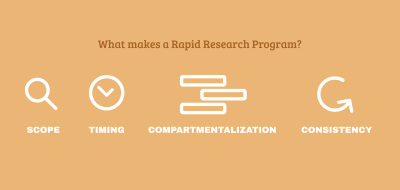
Key Pillars of the Program
To build a successful framework, leadership must focus on four distinct pillars:
- Scope: Defining which methods (e.g., usability testing) fit within tight timeframes.
- Timing: Ensuring the end-to-end process is significantly faster than standard studies.
- Compartmentalization: Breaking down the research workflow to eliminate dependencies.
- Consistency: Maintaining a predictable cadence so stakeholders know exactly when to expect results.
A Chronology of Implementation: Building the Program
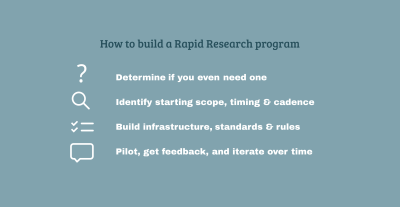
Establishing a Rapid Research program is not an overnight task; it requires a systematic approach to operational design.
Phase 1: The Audit (Months 1–3)
Before launching, perform an audit of the previous year’s research. Identify the most frequent requests, the average time-to-insight, and the most common methodologies used. This data serves as your baseline. Ask: "Are we doing too much evaluative work that should be automated?" If the answer is yes, you have a clear mandate for a Rapid Research pilot.
Phase 2: Defining the Rules of Engagement (Months 4–6)
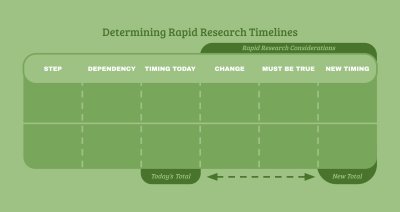
Establish clear "rules" for the program. This includes defining the service-level agreements (SLAs) for turnaround times. For instance, if you aim for a one-week turnaround, what is the maximum number of participants? What is the limit on stakeholder feedback rounds? Establishing these guardrails early prevents scope creep and ensures the program remains "rapid."
Phase 3: Infrastructure and Staffing (Months 6–9)
You will need to build the "research factory." This involves:
- Templatization: Standardizing discussion guides, recruitment screeners, and reporting formats.
- Staffing Models: If headcount is tight, consider partnering with a specialized research vendor. At many large-scale organizations, hybrid models—where junior researchers manage rapid cycles while senior staff oversee strategic discovery—have proven highly effective.
- Tooling: Implement tools that automate participant scheduling and data synthesis.
Phase 4: The Pilot (Months 9–12)
Launch the program with a small group of friendly stakeholders. Treat these initial projects as "beta tests." Collect feedback after every milestone to identify friction points, such as slow recruitment or bottlenecks in legal/compliance approvals.
Supporting Data and Evidence
The business case for Rapid Research is built on efficiency and cost mitigation. According to industry benchmarks, catching usability issues during the early, rapid stages of design can prevent significant downstream costs.
The "100x" Rule
Industry data suggests that fixing a usability issue during the design phase is exponentially cheaper—often cited as up to 100 times less expensive—than fixing a post-launch bug. By integrating Rapid Research into the sprint cycle, teams catch these errors before they reach production.
Throughput Metrics
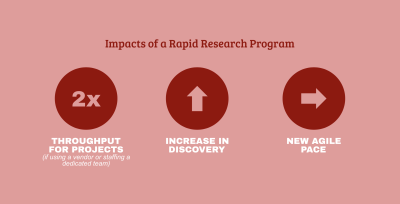
Organizations that successfully implement a Rapid Research program typically see a doubling of research throughput. By offloading tactical usability testing to a templatized system, the research department can support twice as many product teams without a corresponding increase in headcount.
Official Perspectives: Balancing Rigor and Speed
While the push for speed is universal, research leadership must remain cautious. As one veteran UX researcher noted, "Rapid Research is not a replacement for deep discovery; it is a complement."
The "Right-Sized" Approach
The consensus among UX experts is that Rapid Research must be applied judiciously. It is ideal for:
- Iterative Testing: Evaluating prototypes or UI changes.
- Targeted Validation: Verifying if a specific feature meets user needs.
- Mid-Sized Discovery: Quick pulse checks on user sentiment.
It is not appropriate for complex, longitudinal diary studies or high-stakes strategic initiatives that require deep ethnographic rigor. Leaders warn that if the program is not clearly defined, stakeholders may attempt to force complex, long-term studies into a "rapid" box, which will inevitably lead to poor data quality and team burnout.
Organizational Implications and ROI
The introduction of a Rapid Research program transforms the organizational culture around data.
1. Shift from Evaluative to Generative
When tactical testing is handled by a rapid program, the research department’s core team gains the "bandwidth of expert time." This allows for a pivot toward generative research, where researchers can spend weeks exploring long-term market opportunities, ultimately fueling product innovation rather than just maintenance.
2. Democratization and Education
A well-run program serves as a training ground. It provides a structured environment for junior researchers to sharpen their skills in recruitment, moderation, and synthesis. By following standardized templates, these practitioners learn the discipline of the craft before moving on to more complex, bespoke studies.
3. Achieving Agile Harmony
The most significant implication is the ability to align with the "Agile" rhythm. When research results arrive within the same two-week sprint that the design was created, the product team can pivot, adjust, and iterate in real-time. This reduces the "wait time" for insights, which is often the biggest killer of development momentum.
Conclusion: Starting Your Journey
Building a Rapid Research program is a significant undertaking that requires buy-in from leadership, a clear understanding of your current research maturity, and a commitment to operational discipline.
If your organization is struggling to keep up with the demands of iterative development, or if your researchers are perpetually bogged down in repetitive, small-scale studies, it is time to reconsider your structure. By following the roadmap—auditing your needs, defining your scope, building standardized infrastructure, and piloting the process—you can transition your research team from a bottleneck into an engine of growth.
The goal is not to be fast for the sake of speed. The goal is to be efficient enough to be impactful. In a market that rewards agility, a Rapid Research program is not just a benefit; it is a competitive necessity. Start your pilot today, track your successes, and watch as your organization’s capacity for innovation begins to scale.