By the Global Business Insights Desk
Published: Autumn 2026
Main Facts: The Shift from Novelty to Necessity
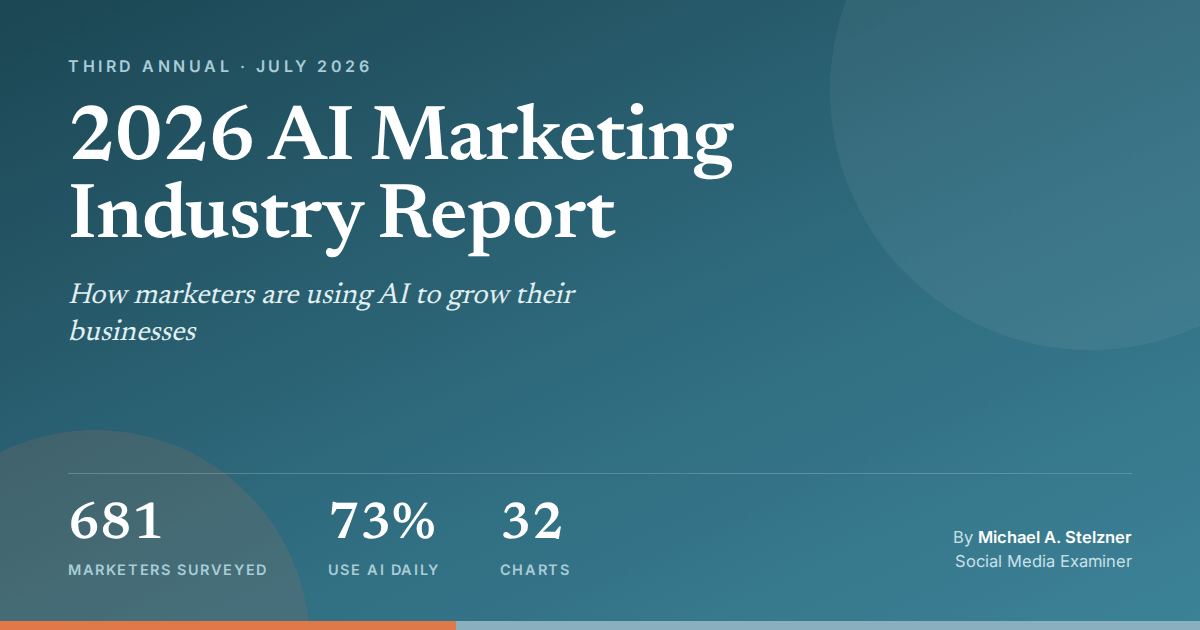
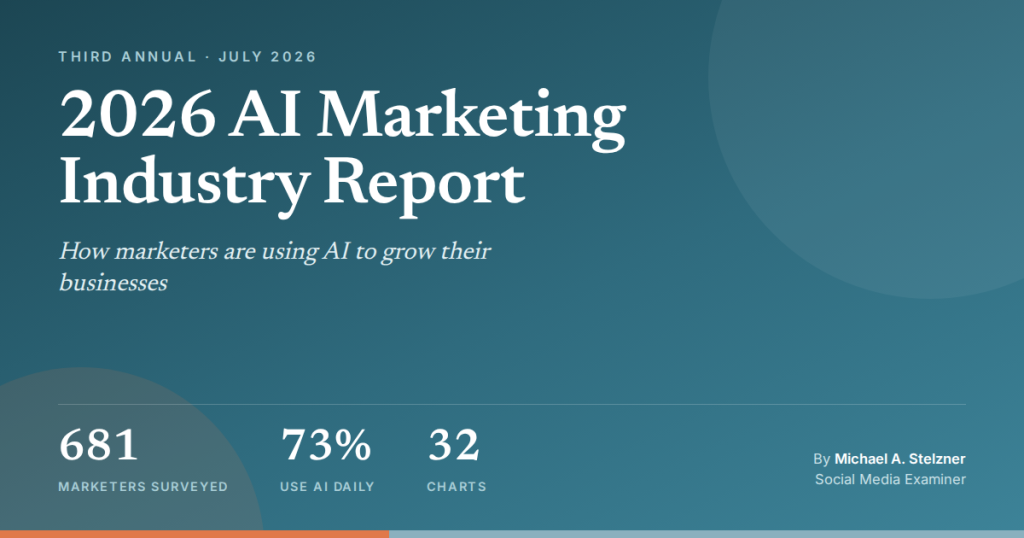
Artificial intelligence has officially crossed the threshold from an experimental tech trend into the foundational infrastructure of modern business. According to the newly released 2026 AI Marketing Industry Report by Social Media Examiner, daily utilization of artificial intelligence among marketers has skyrocketed. Two years ago, only 37% of marketing professionals engaged with AI on a daily basis. Today, that figure stands at a staggering 73%.
Crucially, this is not a phenomenon driven solely by deep-pocketed tech giants or enterprise conglomerates. Approximately 60% of the respondents in the 2026 study represent small businesses—organizations operating with 10 or fewer employees. The data reveals that everyday commerce, local enterprises, and lean independent agencies are successfully integrating AI to match the output of much larger operations.
Yet, beneath the massive adoption rates lies a complex narrative. While nearly 90% of marketers report using AI at least weekly, a distinct measurement gap persists: while overwhelming majorities feel the qualitative benefits of time-saving and productivity, fewer than a third can empirically prove concrete, measurable financial returns. Furthermore, as the industry looks toward autonomous AI agents and AI-generated video, a massive capability gap presents a high-growth opportunity for agile small business owners willing to pioneer these emerging tools.
Chronology: How AI Became the New Normal
To understand where small business marketing stands in 2026, it is vital to trace the rapid evolution of generative and analytical artificial intelligence over recent years:
- The Pre-2024 Era (The Hype Cycle): AI was largely viewed as a novelty tool or a futuristic concept. Small business owners watched from the sidelines, assuming advanced automation required technical expertise or massive enterprise software budgets. Utilization rates hovered below 40% for daily interactions, and skepticism was high regarding content quality and brand safety.
- 2024–2025 (The Free-Tier Boom): Driven by the accessibility of large language models and early text-generation tools, adoption surged. Businesses experimented with writing blog posts, drafting social media captions, and brainstorming campaigns. However, adoption was decentralized, heavily reliant on free versions of tools, and largely unsupported by formal corporate training.
- 2026 (The Infrastructure Shift): As revealed in the latest industry data, AI usage has matured. Daily usage has nearly doubled since the 2024 baseline. The "free tier" era has rapidly faded, with 85% of professionals now paying out-of-pocket or via company budgets for specialized capabilities. AI is no longer a peripheral experiment; it is deeply embedded in the daily workflow of nearly 90% of the marketing workforce.
Supporting Data: 5 Eye-Opening Findings from the 2026 Report
The 2026 report outlines 32 distinct data charts tracking year-over-year market changes. Five core findings highlight the current state of play for lean businesses:
1. Daily AI Usage is Near-Universal
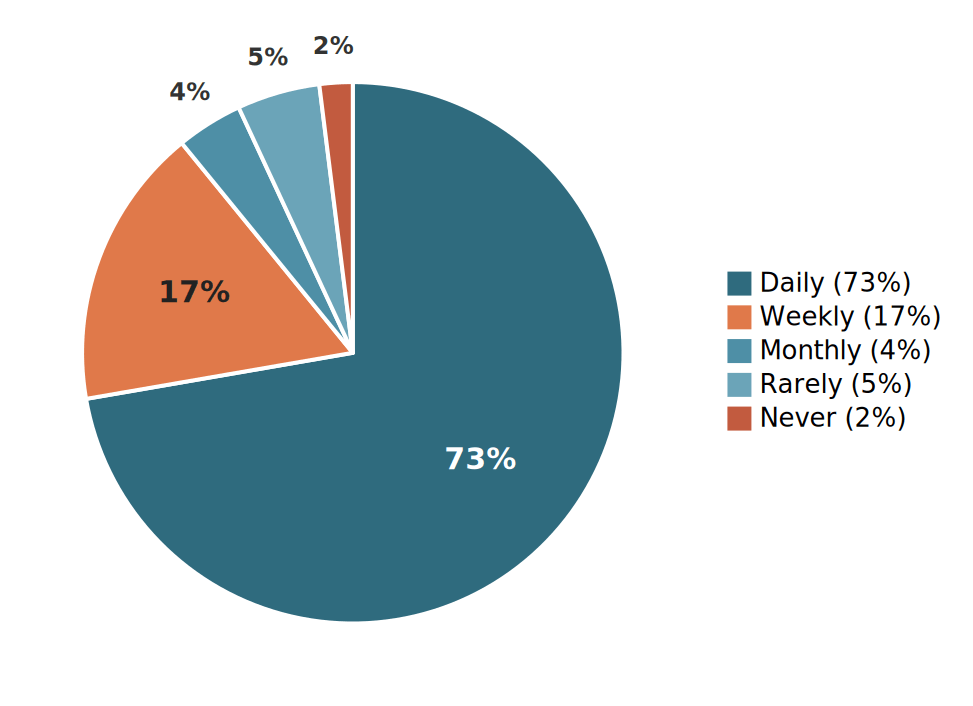
- 73% of marketers use AI every day (compared to 37% two years prior).
- 90% use AI at least on a weekly basis.
- Only 7% rarely or never interact with AI tools—a dramatic drop from 23% in 2024.
- Momentum continues to climb, with 84% reporting increased usage over the past year and 78% expecting further expansion.
2. The DIY Mindset Dominates Budgets and Training
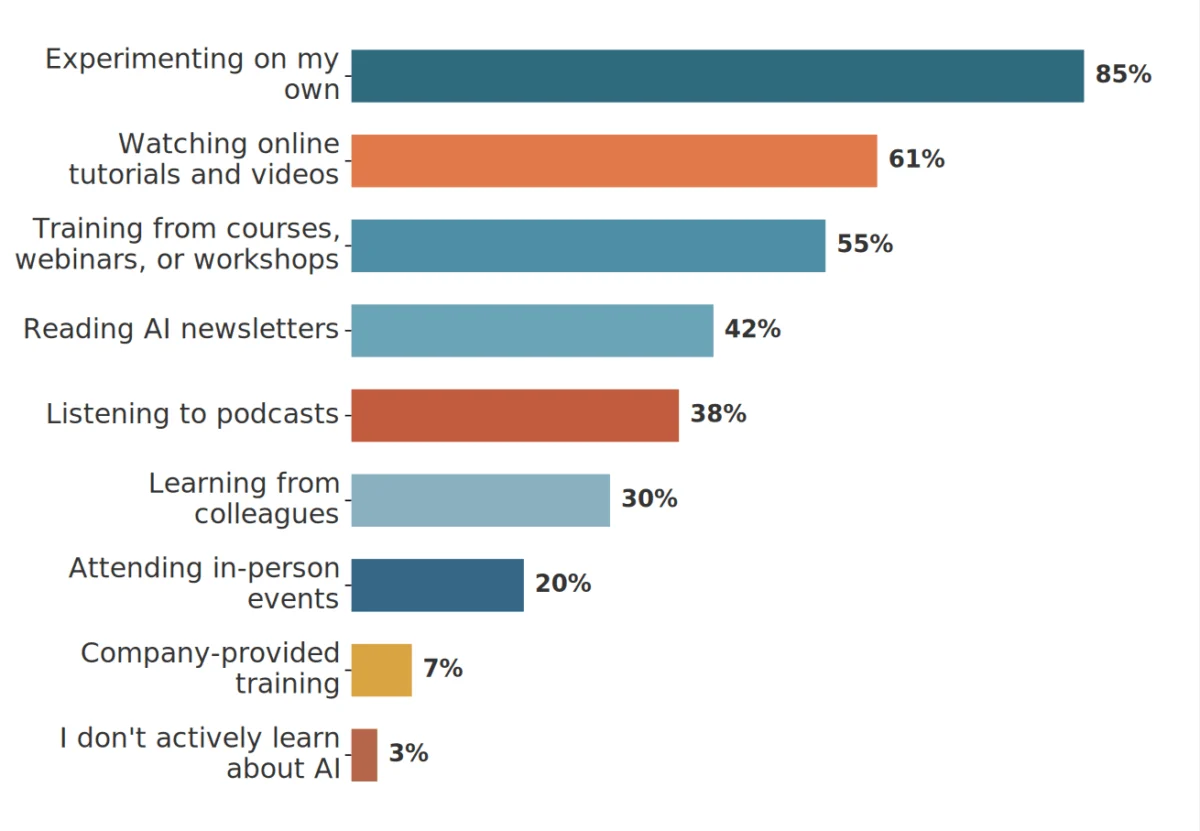
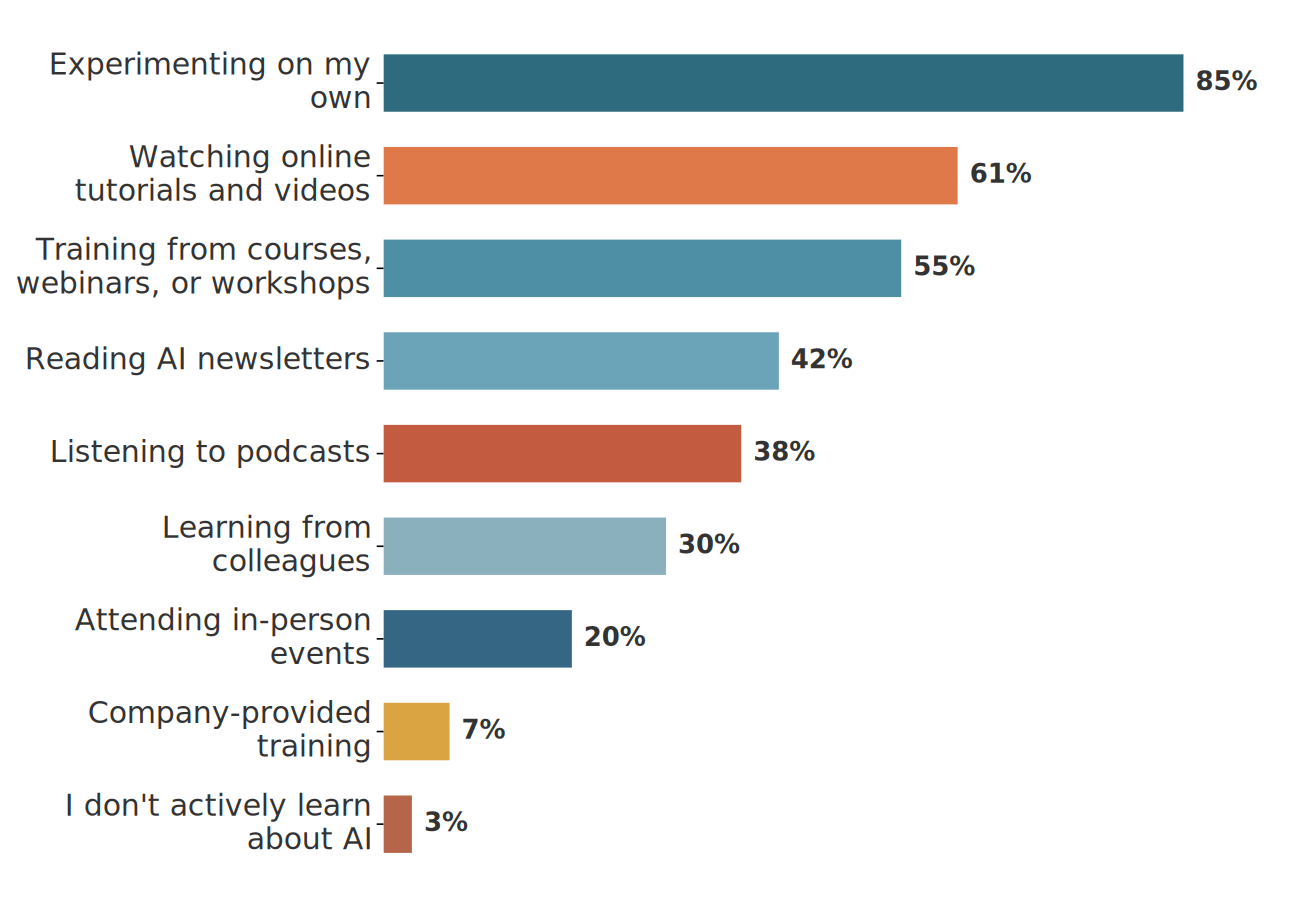
- 85% of marketers learn how to use AI entirely through independent experimentation.
- Only 7% receive formal, company-provided training.
- 53% of professionals pay for AI subscriptions out of their own pockets, with 85% paying in some capacity.
- When asked who drives AI implementation, 55% of respondents stated simply: "Me."
3. The Productivity Paradox: High Value, Low Measurement
- 86% of marketers agree that AI successfully saves them time.
- 86% report a direct boost to their overall productivity.
- However, only 30% can point to significant, quantified financial or operational results.
- An additional 39% observe positive outcomes but lack the metrics to prove them, while 10% have made no attempt to measure the impact.
4. The Video Content Gap
- 95% of marketers utilize AI for written content.
- 67% utilize AI for image generation (nearly double the figures from 2024).
- Yet, only 37% currently leverage AI for video production.
- Paradoxically, 74% of marketers report that learning to create AI video is their highest priority, creating a massive 37-point adoption gap.
5. The Rise of Autonomous AI Agents
- 11% of marketers currently use AI agents (tools capable of executing multi-step tasks autonomously) on a regular basis.
- 24% are actively experimenting with them.
- 44% plan to adopt agents in the near future, bringing total current or prospective adoption to 79%.
- Just like video, mastering AI agents ranks as the #1 desired learning topic for marketing professionals.
Official Responses and Industry Perspectives
Industry leaders and analysts reviewing the 2026 report emphasize that the data challenges traditional corporate assumptions about technology adoption.
Michael Stelzner, founder of Social Media Examiner and architect of the report, noted that the findings offer a vital reality check for independent operators. "We surveyed marketers to find out how they’re actually using AI—not the hype, not the headlines," Stelzner stated. Because the vast majority of respondents operate within small teams of ten people or fewer, Stelzner emphasizes that the research directly reflects the constraints and realities of small business owners.
"The marketers who are furthest ahead didn’t get there through corporate training programs or massive budgets. They got there the same way you would—by rolling up their sleeves and figuring it out," Stelzner added.
Tech analysts point out that the shift away from corporate-mandated software toward individual, bootstrap tool adoption signifies a democratization of technology. Small business owners no longer need to wait for IT departments to greenlight software suites; they can deploy powerful LLMs, image generators, and nascent video tools directly to solve immediate operational bottlenecks.
Implications: What This Means for Small Businesses
For small business owners and lean marketing teams, the implications of the 2026 data are both urgent and encouraging.
Closing the Measurement Gap
Because 70% of marketers struggle to quantify the exact return on investment from their AI tools, a significant competitive advantage awaits those who implement basic tracking metrics. Business owners who systematically measure hours saved per week, output velocity, or cost reductions will be uniquely positioned to allocate their limited budgets far more efficiently than their competitors.
Embracing the Video and Agent Frontiers
The massive gaps in AI video adoption (37% usage versus 74% demand) and AI agent deployment represent wide-open territory. Small businesses that begin experimenting with basic AI video tools now will easily outpace legacy competitors who remain tethered to traditional, costly video production pipelines. Furthermore, the advent of AI agents—systems capable of handling routine customer inquiries, automated email sequences, and data monitoring autonomously—offers micro-teams the operational leverage of a much larger workforce.
The Window is Narrowing
While the data proves that formal training departments and big budgets are unnecessary to succeed with AI, the window for easy early-adopter advantage is closing. With 73% of professionals using AI daily, non-users are no longer just behind the curve; they are increasingly disadvantaged in speed, output quality, and market responsiveness.
Ultimately, the 2026 data sends a clear message to small business owners: AI is no longer a corporate luxury item. It is the fundamental operating system of modern commerce, and the tools to master it are already in your hands.