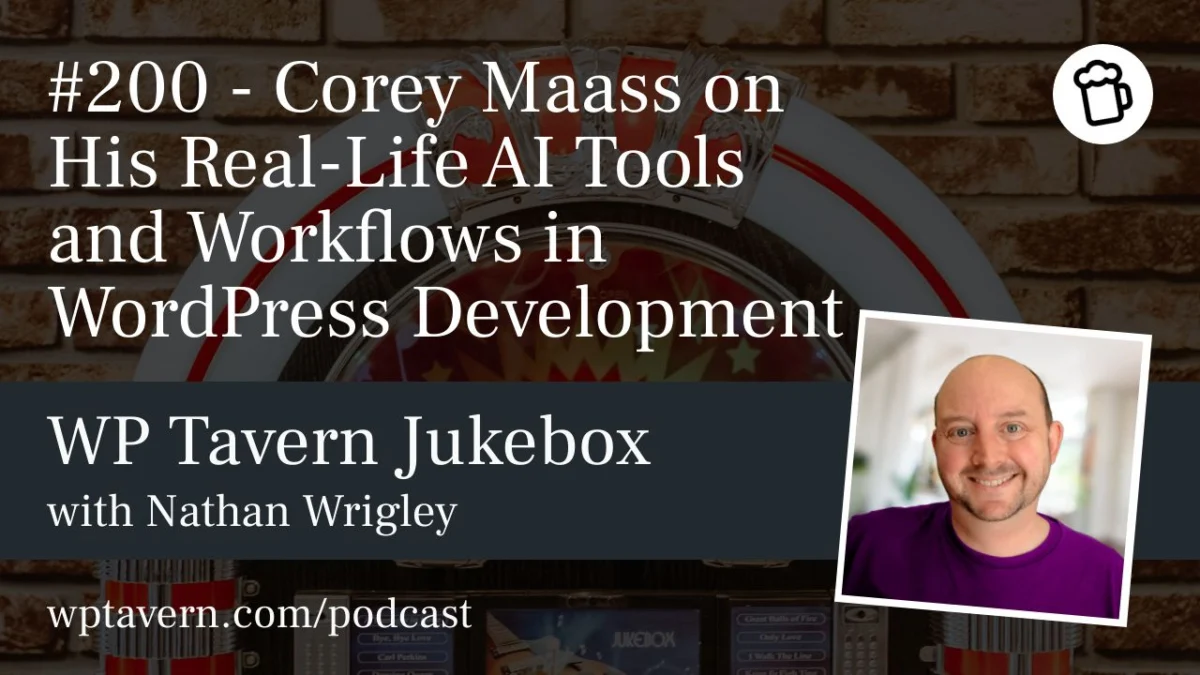
The integration of Artificial Intelligence into software development is no longer a futuristic concept—it is the present reality. For developers like Corey Maass, who has been building for the web since the late 1990s, the introduction of AI companions into his daily stack has fundamentally altered how he approaches client projects, project management, and creative problem-solving. In a recent episode of the WP Tavern Jukebox podcast, Maass explored the practical, technical, and philosophical implications of this shift, offering a roadmap for developers navigating an increasingly automated digital landscape.
The Evolution of the Developer Stack
Maass’s journey in web development mirrors the history of the internet itself. From the early days of slicing Photoshop designs into HTML tables to the maturation of PHP and the rise of WordPress in 2010, he has remained a pragmatic early adopter. However, the emergence of AI in 2024 and 2025 has brought about a more seismic shift than any previous technological upgrade.
Currently, Maass’s workflow is centered around a sophisticated interplay of tools. He utilizes Cursor as his primary Integrated Development Environment (IDE), though he notes that he is often more interested in the raw output of specialized models. He frequently executes code through the terminal using Claude Code, while employing GitHub Copilot as a secondary layer for automated code reviews. This "agent-based" workflow allows him to separate the act of writing code from the act of verifying it—a process that has significantly increased his velocity.
A Chronology of Adoption
The journey began in earnest around March 2024, during a trip to Thailand. With time to experiment away from the immediate pressures of client deadlines, Maass decided to rebuild Timerdoro, a productivity tool he had previously developed. This served as his "sandbox," allowing him to test how much control he should relinquish to AI models.
From Granular Control to Conceptual Freedom
Early in his AI journey, Maass admitted to being "too granular." He would provide the AI with highly specific instructions, effectively treating it as a faster version of a junior developer. Over the last 18 months, however, his approach has evolved toward "conceptualization." He now finds that giving the model the freedom to interpret his high-level goals leads to more creative and robust outcomes.
This shift in strategy reflects a broader trend in the industry. As models like Claude and Gemini have become more adept at understanding context, the need for micromanagement has plummeted. Maass notes that he no longer spends hours debugging simple syntax errors; instead, he spends his time managing the architecture of the project and ensuring that the AI’s output aligns with his long-term maintenance standards.
The Philosophical Implications of AI Creativity
One of the most profound aspects of Maass’s discussion is the transition from AI as a time-saver to AI as a creative partner. He compares this to the "Oblique Strategies" cards created by musician Brian Eno, which were designed to introduce randomness and new perspectives into the creative process.
For Maass, AI now functions as a "sounding board." Whether he is generating slogans for a SaaS landing page or seeking advice on music production, he uses AI to inject elements of surprise. He specifically mentioned using Google’s Gemini to analyze frequency peaks in his dance music tracks—a task that previously required a high level of technical audio engineering expertise. By utilizing AI to identify these technical bottlenecks, he can focus his energy on the artistic "why" rather than the technical "how."
The "Point of the Thing"
This leads to a critical question: What is the point of the work? Maass and podcast host Nathan Wrigley suggest that we are entering an era where the value of a project is defined by its intent. If the goal is a functional piece of software for a client, the client rarely cares about the underlying process. If the goal is art or a live musical performance, the human struggle and the "soul" of the work remain paramount. Distinguishing between these two domains will be the defining challenge for developers in the coming years.
Client Perspectives and the Future of Responsibility
Perhaps the most pressing concern for many developers is the impact of AI on the client-contractor relationship. Maass shared a recent experience where he was able to rebuild a client’s failing software for half the cost and time, thanks to his AI-assisted stack.
Efficiency vs. Value
The client’s primary concern was not the process, but the outcome: the software needed to function efficiently. Maass argues that as long as the developer remains the "pilot" of the AI, the responsibility for the code rests with the human. He remains diligent in checking the AI’s work, ensuring the project remains maintainable for future developers—a task he insists is still best handled by human oversight.
However, the question remains: will clients eventually demand lower fees as development time decreases? Maass believes that the value of the developer is shifting away from "typing code" and toward "project management." He is no longer selling his ability to write a function; he is selling his ability to architect a solution, manage the AI, and ensure the final product meets the client’s needs.
WordPress: The Final Frontier for Automation
While AI is currently highly effective at building SaaS applications from scratch, Maass notes that the WordPress ecosystem presents unique challenges. The "click-heavy" nature of the WordPress admin dashboard—which relies on navigating menus and configuring plugins—is harder to automate than a clean code base.
The Rise of AI-Friendly Stacks
Maass predicts that the WordPress ecosystem will bifurcate into AI-friendly and AI-hostile stacks. Developers who choose plugins and page builders that prioritize structured data (like JSON-saved field groups) will find it much easier to leverage AI for site maintenance and updates. He envisions a future where an AI-powered agent can look at a site’s configuration, understand its architecture, and execute changes on the fly—a prospect that could revolutionize how nonprofits and small businesses manage their digital presence.
Conclusion: The Path Ahead
As we look toward 2026 and beyond, the role of the developer is becoming more expansive, not less. While the "grunt work" of coding is being rapidly offloaded to AI, the demand for human judgment, architectural foresight, and ethical decision-making has never been higher.
Corey Maass’s approach offers a template for survival: embrace the tools, maintain a healthy level of skepticism, and never lose sight of the "point" of the project. Whether you are a seasoned veteran or a newcomer to the WordPress world, the lesson is clear: the future belongs to those who view AI not as a replacement for human intellect, but as an essential, high-speed engine for human creativity.
For those looking to follow Maass’s journey, he remains active in the WordPress community, particularly through Post Status and his own firm, Gelform. His work serves as a reminder that even in an age of automation, the human element remains the most critical component of the web.