In an era where linear television is rapidly losing its grip on the mass audience, sports remains the final, impenetrable fortress of live, communal viewing. Last year, nearly every one of the top 50 most-watched telecasts in the United States was tied to sports. The few exceptions—the 97th Oscars, the 50th Anniversary of Saturday Night Live, a high-profile 60 Minutes interview, an episode of The Floor, and the 67th Grammys—serve only to highlight how dominant the sports-entertainment industrial complex has become. Even an event titled "NFL Weather Delay" cracked the top 30, proving that modern audiences will consume almost anything provided it bears the imprimatur of professional sport.
This gravitational pull has sent streaming giants and global brands into a frenzy, aggressively acquiring broadcasting rights and pouring billions into sponsorships. From team jerseys and stadium naming rights to the sideboards and back-panels visible during post-match interviews, the presence of corporate branding in sports is ubiquitous. Yet, as marketing budgets swell, a fundamental question is finally being asked by senior leadership: "I’ve enjoyed the hospitality suite and shaken hands with icons, but is this $38 million investment actually moving the needle for the business?"
The Paradox of Visibility: Why Sports Marketing Fails (And How It Succeeds)
The primary trap for many organizations is the assumption that sports marketing operates by a different set of physical laws than traditional advertising. It does not. The fundamental principles of consumer attention, frequency, and creative efficacy remain constant. If a brand’s creative and narrative arc is too weak to capture attention in a 1.2-second scroll on TikTok, it will be equally ineffective when plastered across a race car or a stadium banner. In fact, sports marketing is arguably more difficult: because the primary purpose of the viewer is to watch the game, the threshold for distraction is higher, and the tolerance for intrusive branding is lower.
Consider the Seattle Seahawks, a franchise that has famously maintained a singular corporate logo on their uniforms for decades. Despite its visibility, many fans would struggle to identify the brand instantly if asked in a vacuum, demonstrating that even "slam dunk" placements can fade into the background noise.
For a brand to derive value from a sports association, it must move beyond "spike and silence" marketing. To achieve a halo effect—where the prestige of the athlete or the intensity of the sport is transferred to the brand—companies require a strategy of "spike and sustain." If your baseline for traditional marketing is a frequency of three exposures per user per week, that standard does not decrease just because you are sponsoring an athlete; it becomes even more critical. Organic social posts by sports stars often suffer from the same reach issues as standard influencer marketing, making a well-integrated, paid-media strategy the only way to ensure the brand’s message is heard over the roar of the crowd.
A Hierarchy of Measurement: From Vanity to Value
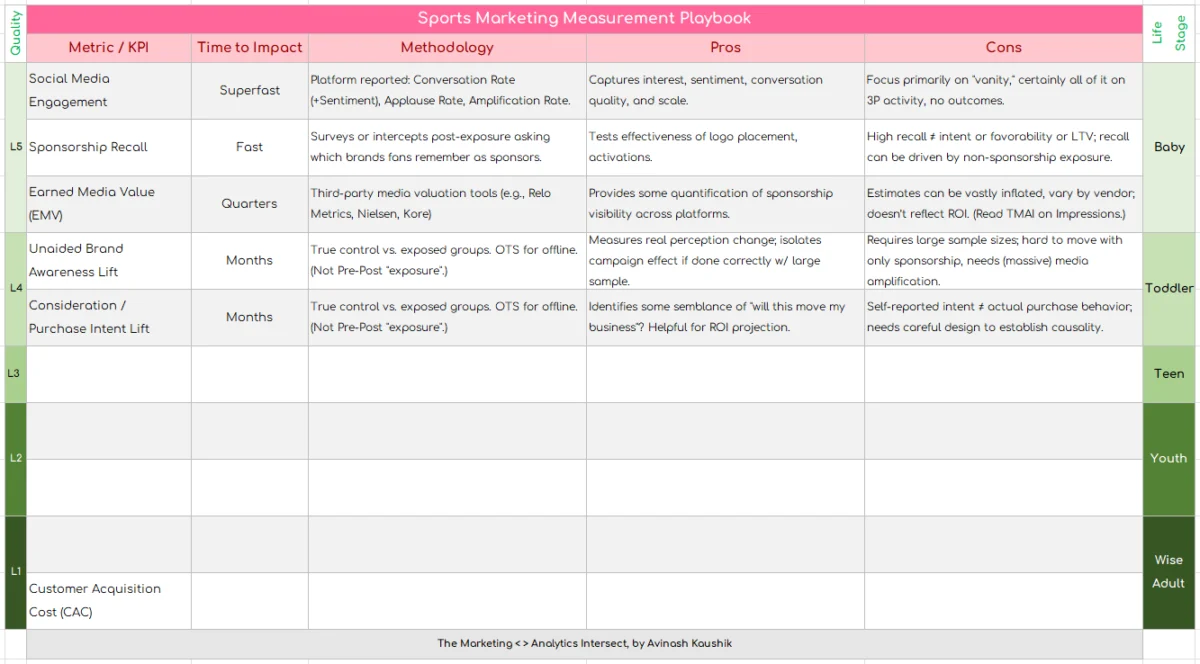
To move beyond the hospitality suite and into the realm of data-driven strategy, marketers must adopt a rigorous measurement framework. The "Impact Intelligence Score" (IIS) provides a way to categorize the sophistication of a brand’s analytical approach, ranging from Level 5 (Vanity) to Level 1 (The Gold Standard of Incrementality).
Level 5: The Opening Gambit (Vanity Metrics)
Most brands begin their sports marketing journey here. It is characterized by "Big Numbers"—millions of impressions that look impressive on a slide deck but lack any causal link to revenue.
- Social Media Engagement: Tracking conversation and applause rates is standard, but these metrics measure activity, not outcomes.
- Sponsorship Recall: While companies often rely on post-exposure surveys to see if fans remember them, these are frequently flawed. Relying on "aided" recall (asking if a fan knows you are a sponsor) leads to inflated, unreliable data.
- Earned Media Value (EMV): Often called the "biggest con" in marketing, EMV calculates the cost of what those logo placements would have cost in ad spend. It ignores audience quality, brand message, and the cluttered environment. It is a metric designed to justify spend rather than measure impact.
Level 4: The Quest for Brand Impact
Moving to Level 4 requires a shift from measuring "noise" to measuring human perception. This level focuses on how a sponsorship shifts the "think and feel" metrics of a target audience.
- Unaided Brand Awareness (UBA) Lift: This is a long-term driver of revenue. Effective sports marketing should eventually move this needle, but it requires patience.
- Consideration and Purchase Intent: This is where the CFO begins to pay attention. By using control groups—comparing those exposed to the sponsorship against those who were not—brands can isolate the impact of the sports association on a consumer’s future purchasing decisions.
The Strategy: Integrating Creative and Commerce
The "dirty little secret" of the industry is that many brands struggle with the core tenets of storytelling. Because creative work is responsible for 60% to 70% of marketing success, there is a compelling, albeit risky, logic in "outsourcing" your brand identity to a sports property. By aligning with a team or athlete, a brand inherits the values and emotions associated with that entity.
However, this must be a conscious decision. If a brand chooses this path, it must be prepared to support that creative with significant paid media to ensure the message reaches the right audience with the right frequency. When combined with a Marketing Mix Model (MMM), this approach can prove incremental profitability—turning a brand’s sports sponsorship from a cost center into a growth engine.
Implications for the Future of Sports Marketing
The trend toward streaming giants acquiring sports rights—such as Amazon’s Thursday Night Football or Apple’s MLS deal—is accelerating the convergence of content and commerce. As these platforms integrate shopping capabilities directly into the viewing experience, the distinction between "watching" and "buying" will vanish.
For the modern CMO, the imperative is clear: stop sponsoring in the dark. The era of writing million-dollar checks based on the promise of "brand love" or "visibility" is ending. The future belongs to organizations that treat sports marketing as a measurable, iterative, and data-driven discipline.
As we look toward the higher levels of the measurement playbook—Level 3 (Heart & Mind Influence), Level 2 (Digital Trace), and Level 1 (Incrementality)—the focus will shift entirely to proving the direct financial contribution of every dollar spent. Brands that fail to bridge this gap will find themselves left behind, holding tickets to the hospitality suite while their competitors capture the actual market share.
In conclusion, sports marketing remains one of the most potent tools in the marketer’s arsenal, provided it is treated with the same analytical rigor as a digital performance campaign. The "halo effect" is real, but it is not a magical byproduct of a logo on a jersey; it is the result of disciplined, sustained, and measurable engagement. Turn on the lights, stop measuring the noise, and start measuring the business.