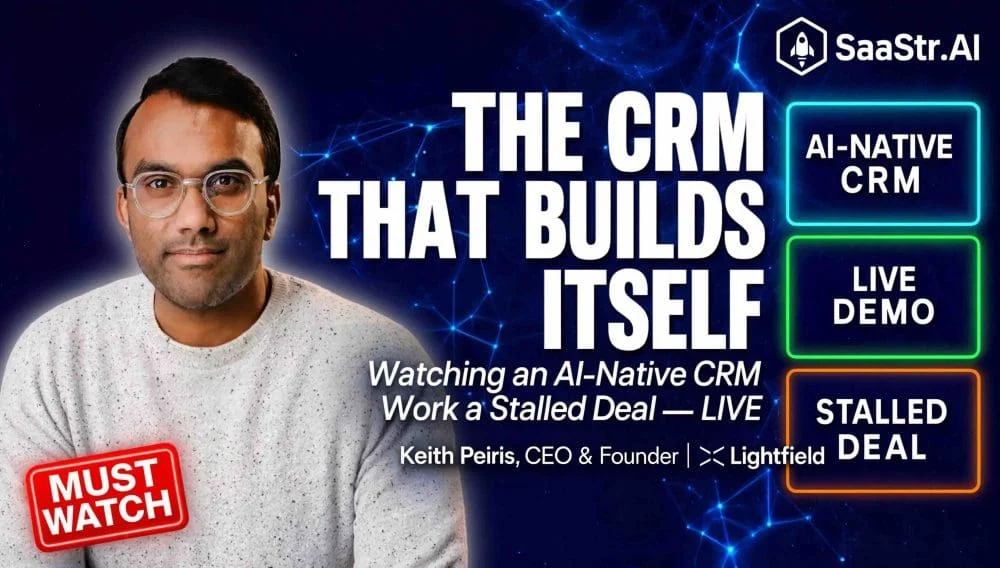
In the landscape of modern enterprise software, the Customer Relationship Management (CRM) platform has long been viewed as a necessary evil—a digital filing cabinet where sales representatives dutifully deposit data, hoping that management’s reporting requirements are satisfied. But at this year’s SaaStr, Lightfield CEO and co-founder Keith Peiris offered a radical alternative: a CRM that doesn’t just store information, but actively drives the Go-To-Market (GTM) strategy through autonomous intelligence.
In a live demonstration that eschewed pre-recorded slides for the high-wire act of real-time software manipulation, Peiris showcased a platform that is effectively an "AI-native" evolution of the legacy systems companies have used for decades. The premise is simple but profound: if a system holds complete customer context and possesses an integrated automation layer, the manual labor of "doing CRM" vanishes, replaced by the high-level art of selling.
The Foundation: A Self-Assembling CRM
The most striking element of the Lightfield demonstration was not an AI feature, but a structural one. Peiris opened the session by making a bold declaration: every single piece of data in the demo instance was generated without a single manual keystroke.
By integrating directly with mail servers, calendars, data warehouses, and call recording platforms, Lightfield essentially "self-assembles." Accounts are automatically enriched via multiple third-party data providers; opportunities are synthesized from email threads and transcribed calls; and contact books are populated through a cross-reference of roughly ten different vendors.
This creates a "customer context engine." Unlike traditional CRMs, which are essentially sophisticated forms that sales reps must fill out, Lightfield acts as a connective tissue between the systems where work actually happens. The implication is clear: the CRM is no longer a graveyard for data, but a living, breathing map of the sales cycle.
Chronology of a Deal: From Stalled to Scaled
To prove the efficacy of the system, Peiris walked the audience through the lifecycle of a real-world, stalled deal involving Johnson Controls, a major industrial manufacturer.
The Diagnosis
The deal, which involved selling process automation, had been stuck in a 30-day Proof of Concept (POC) limbo. Rather than relying on gut instinct or a static sales playbook, Peiris queried the CRM in natural language: "Why is this deal stalled?"
Lightfield’s response was immediate and analytical. It did not merely summarize the email thread; it cross-referenced the current opportunity against the company’s entire historical data set—including closed-won deals, closed-lost deals, and quarterly business reviews (QBRs). The system identified a clear pattern: successful deals at similar companies almost always involved the early participation of a CIO or a Director of IT. The Johnson Controls deal, conversely, lacked this stakeholder.
The Intervention
The system recommended an immediate course of action: secure a meeting with the CIO. With a simple prompt, the AI began a series of complex tasks:
- Research: It scoured the web and twenty enrichment tools to identify the correct CIO.
- Integration: It created the contact and automatically associated it with the existing opportunity.
- Drafting: It composed a personalized outreach email—matching the specific tone of the sales rep—that referenced the pilot program details and the specific value proposition for an IT leader.
The Codification
Once the deal was unstuck, Peiris didn’t just move on. He converted that successful intervention into a persistent automation. In a single natural-language sentence, he instructed the system: "Run this process every time a deal reaches the POC stage without an IT contact."
Unlike traditional CRM automation (which often requires technical expertise in languages like Salesforce Apex), Lightfield allows for iterative development in plain English, running Python-based logic in the background. The system then performed a permissions check, ensuring that the automation remained within the governance boundaries of the RevOps team.
From Single Deal to Pipeline Generation
Having mastered the "micro" level of a single deal, Peiris then scaled the insight to the "macro" level of pipeline generation. He asked the system to analyze why certain deals were won in the past to find similar prospects.
The AI identified a common denominator among successful accounts: large industrial hardware manufacturers struggling with "downtime." It then scanned the CRM’s existing database of prospects to find companies matching that profile, cross-referencing their tech stacks to identify those still relying on legacy SCADA and PLC systems—the exact demographic most likely to feel the pain that Lightfield solves.
Finally, it generated a custom three-step email sequence for these high-signal leads. By pulling proof points from previous QBRs and tailoring the messaging to address the "opportunity cost" of legacy systems, the system effectively performed the work of a seasoned SDR team in mere minutes.
Addressing the Skeptics: Governance and Adoption
The demonstration concluded with a rigorous Q&A session that tackled the primary concerns of enterprise operators: data integrity, security, and adoption.
Data Governance and Security
When asked how the system prevents "AI drift" or manual data corruption, Peiris explained that the system tracks version history at the field, attribute, and object level. Because every edit—whether performed by a human or an AI agent—is logged, rollbacks are trivial. Regarding security, the agent is constrained by the same Role-Based Access Control (RBAC) as the user. An agent cannot perform an action that the human operator doesn’t have the permissions to execute, eliminating the need for a separate, complex security model.
Adoption and Deliverability
For sales leaders, the barrier to entry for new software is usually the "reps won’t use it" problem. Peiris argued that Lightfield solves this through a low-friction migration process (often completed in under two hours) and by removing the "administrative tax" of sales. By automating forecasting and reporting, the platform gives time back to the reps.
Furthermore, regarding email deliverability, the system uses an intelligent sync rule: outbound contacts only enter the CRM when a conversation is initiated. This prevents the "database rot" that plagues most large-scale sales teams, ensuring that the CRM remains a source of high-quality, actionable data rather than a junk drawer of dead leads.
Implications: The New Era of AI-Native GTM
The Lightfield demo suggests a paradigm shift in how revenue teams will operate over the next decade. There are five key takeaways from this demonstration that represent the future of CRM:
- Cleanliness by Default: By refusing to sync unresponsive outbound leads, the system maintains high data hygiene automatically, avoiding the need for periodic, labor-intensive cleanup projects.
- Emergent Automations: The best workflows aren’t designed in planning meetings; they are discovered in the trenches. By working a deal and codifying the solution, teams can build playbooks that actually reflect reality.
- Unstructured Data as a Signal: Job postings and public hiring data are now recognized as high-intent signals. Systems that can read and interpret this data hold a distinct competitive advantage over those that only track static firmographics.
- Version Control is Critical: For autonomous agents to be trusted, they must be transparent. The ability to see exactly what an AI changed and revert it instantly is the baseline requirement for enterprise adoption.
- Permission-Inheritance: By binding AI agents to the existing permission structure of the user, companies can deploy AI at scale without rewriting their entire governance and compliance infrastructure.
In summary, Lightfield has moved the conversation from "How do we store our data?" to "How do we use our data to drive outcomes?" By turning the CRM into a proactive engine of intelligence rather than a passive repository of facts, the company is signaling that the era of manual data entry is rapidly drawing to a close. For sales organizations, the choice is becoming clear: evolve toward an AI-native infrastructure, or remain buried under the weight of the work that machines are now capable of doing for us.