The age-old debate of "build versus buy" has long been settled by a simple heuristic: the 90/10 rule. For years, the prevailing wisdom in the B2B SaaS ecosystem has been that if a product meets 90% of your requirements, you buy it. You avoid the hidden costs of maintenance, the technical debt of bespoke infrastructure, and the distraction of managing software that isn’t core to your mission.
However, a quiet shift is occurring in the software landscape. With the advent of advanced AI development tools—what some call "vibe coding"—the barrier to building custom internal tools has collapsed. For SaaStr, a company that operated for six years using a reliable, paid newsletter-building tool, that boundary was finally crossed. This isn’t a story about saving $4,000 a year; it is a story about the fragility of stagnant point solutions in the age of generative AI.
The Chronology of a Quiet Exit
For more than half a decade, SaaStr relied on a third-party newsletter platform to manage its audience outreach. It was a "slick, simple" tool that worked exactly as advertised. It wasn’t perfect, but it was reliable. Then came the realization that the product had effectively frozen in time.
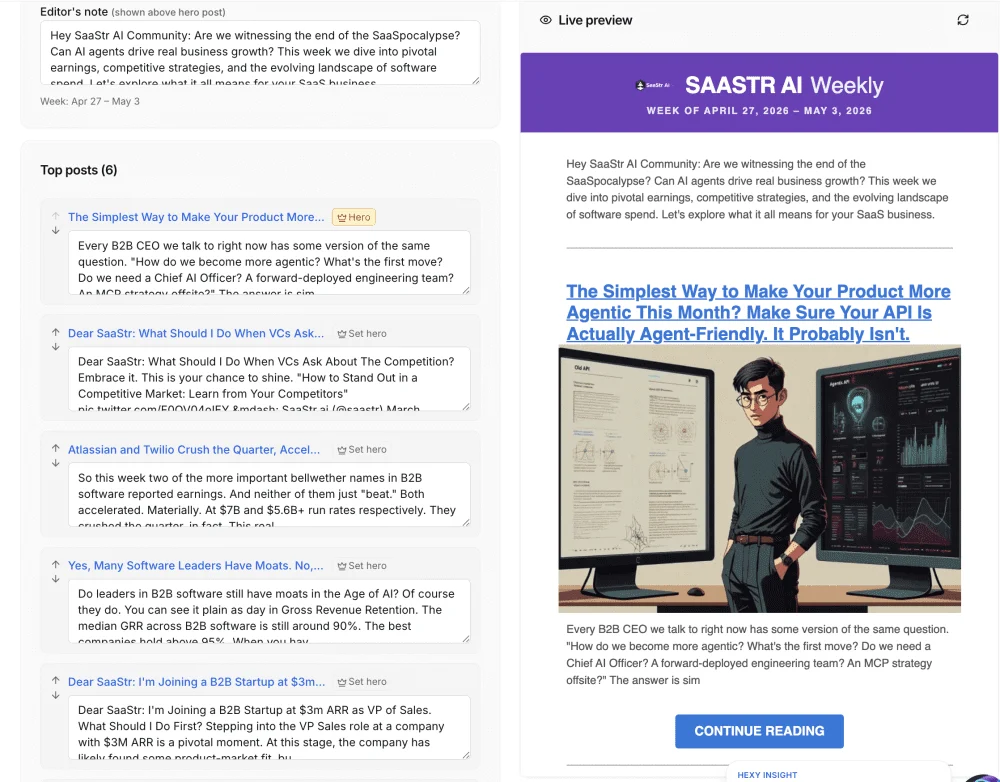
In early May 2026, the team made a pivot. Instead of upgrading or seeking a new vendor, they decided to "vibe code" their own agentic solution. Using modern AI-powered development environments like Replit and Claude, the team built a replacement in roughly two hours.
The shift was not born out of a sudden desire to become a software house. It was a tactical decision driven by productivity. The legacy tool offered no automation, no AI-driven content summarization, and no meaningful API integrations. By building their own, the team gained a tool that now automatically pulls content, summarizes posts, and integrates real-time data from platforms like X and YouTube. The result? A savings of 90 minutes per week for their Chief AI Officer, Amelia. In the high-stakes world of B2B leadership, 90 minutes of executive time is worth far more than the $4,000 annual subscription fee of a stagnant vendor.
Supporting Data: The Hidden Cost of Stagnation
The "90/10 rule" remains valid for complex enterprise platforms—Salesforce, Snowflake, and deep-infrastructure SaaS are not going anywhere. The complexity, compliance, and data moats protecting these giants remain insurmountable for a weekend coding project.
However, the "point solution" category—tools priced between $200 and $2,000 per month that perform a single, specific function—is facing an existential crisis. The following factors illustrate why these tools are now vulnerable:
- The Velocity Gap: In 2020, building a custom tool required specialized engineering resources that were 10x the cost of a subscription. In 2026, that gap has closed. A non-technical operator can now deploy a functional, custom-built application in an afternoon.
- The Maintenance Tax: Vendors often justify subscription fees by promising to handle maintenance. But if that vendor isn’t shipping new value, the "maintenance" becomes a tax on the user’s efficiency.
- Workflow Integration: Off-the-shelf tools are designed for the "average" user. Custom-built AI agents are designed for the "specific" user. When an organization can build a tool that fits their workflow like a glove, the generic, stagnant alternative becomes obsolete.
The Phenomenon of "Stealth Churn"
For SaaS founders, the most alarming takeaway from this shift is the rise of "stealth churn." This is not the type of churn that appears in standard health metrics. There are no support tickets complaining about bugs, no requests for feature roadmaps, and no warning signs in the engagement data.
In this new paradigm, usage often stays flat—or even increases—right up until the moment of cancellation. The customer doesn’t churn because they are unhappy with the software’s performance; they churn because they have quietly moved to an in-house solution that is fundamentally better aligned with their unique operational needs.

Once a company has built its own custom tool, they are unlikely to return to a third-party vendor. They own the IP, the code fits their specific workflow, and they have eliminated the dependency on a vendor that failed to innovate. This is a permanent loss of a customer, one that a standard "win-back" campaign cannot reverse.
Implications for the SaaS Industry
The lesson is not that everyone should start coding their own software. Attempting to build everything in-house is a recipe for distraction and organizational bloat. The lesson is that "stable, reliable, and no-surprises" is no longer a viable business strategy for point-solution providers.
1. The Death of "Good Enough"
If your product has not changed materially in the last 18 months, you are not stable; you are a legacy product waiting to be replaced. Customers are no longer looking for a vendor that provides a service; they are looking for a vendor that provides velocity.
2. The AI Integration Imperative
Baking AI into the core of the product is no longer a luxury. It is a defensive necessity. If a customer can replicate your AI "features" in two hours on a weekend, you aren’t selling a product; you’re selling a commodity. You must build features that are structurally impossible to replicate without deep data, complex integrations, or proprietary network effects.
3. Rethinking the Feature Roadmap
Vendors must be brutally honest about which of their features are susceptible to "vibe coding." If a significant portion of your value proposition can be replicated by a competent engineer with an AI agent, you need to pivot to deeper, more complex workflows immediately.
4. Proactive Customer Monitoring
SaaS companies must watch their sophisticated users more closely than ever. Look for patterns in their API usage and data consumption. If your best, most technically capable customers are using less of your platform’s core interface, they may be preparing to jump ship to an in-house solution.
Conclusion: A New Standard for Value
The boundary of the 90/10 rule has undeniably shifted. While enterprise platforms are safe for now, the "middle-market" of point-solution SaaS is being hollowed out by the very tools those vendors failed to adopt.
For the founder, the mandate is clear: shipping speed is the only real moat. If you are not evolving, your customers will eventually realize that they are paying for a stagnant piece of software that costs them more in lost efficiency than it does in annual fees. In the age of AI, the greatest threat to a SaaS company isn’t its competition—it’s the realization by its customers that they can, quite easily, do it better themselves.
The era of "set it and forget it" software is over. In its place, we have entered the era of the "active vendor," where the only way to retain your customers is to continuously prove that your product provides value they cannot replicate on their own. For those who can rise to the challenge, the AI era offers unprecedented opportunities to deepen their product’s utility. For those who cannot, the future is a long, quiet slide toward obsolescence.