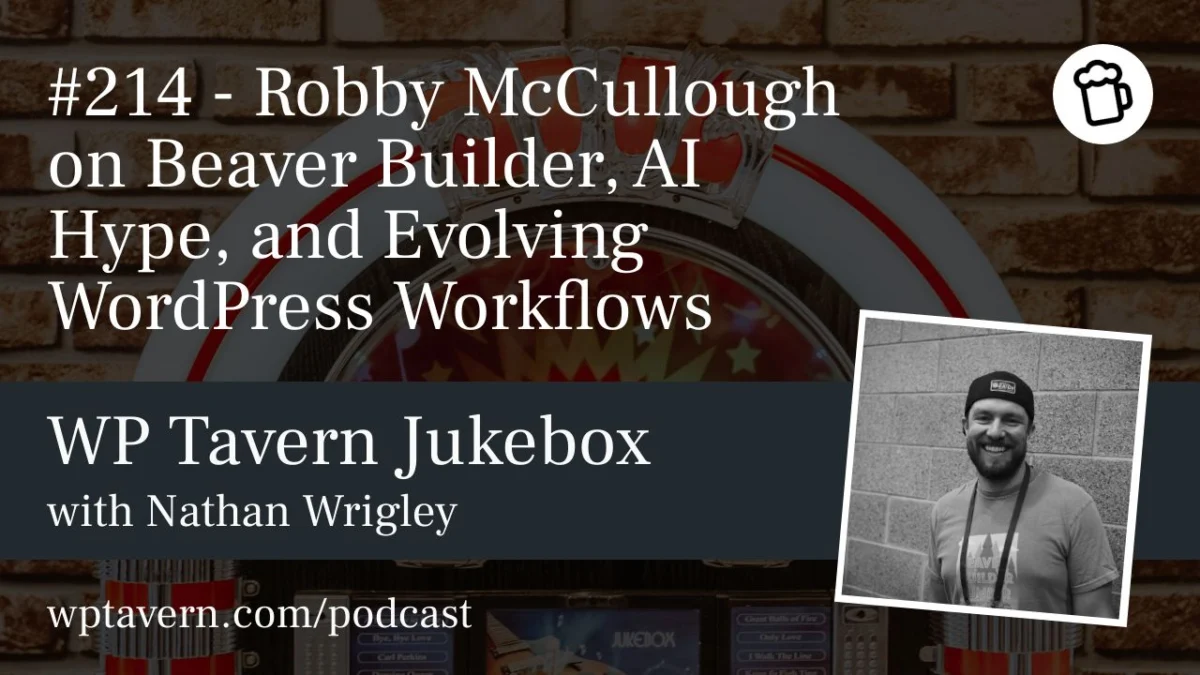
In the fast-paced ecosystem of digital design and web development, few tools have remained as steadfast as Beaver Builder. As the platform approaches its 12th year in the market, co-founder Robby McCullough recently joined Nathan Wrigley on the WP Tavern Jukebox Podcast to reflect on the shifting tides of the industry, navigating the introduction of artificial intelligence, and what the future holds for traditional page builders in an era dominated by large language models (LLMs) and agentic coding workflows.
For over a decade, Beaver Builder has served as a cornerstone of the WordPress ecosystem, enabling non-technical users and professional agencies alike to construct sophisticated websites through intuitive visual interfaces. However, as the web development landscape undergoes its most radical transformation since the advent of open-source content management systems, McCullough offers a candid look at the challenges, anxieties, and exciting new possibilities defining the modern product lifecycle.
Main Facts: Navigating a Maturing Ecosystem
The conversation between Wrigley and McCullough centers heavily on the intersection of legacy web technologies and the sudden explosion of AI-driven development. While many software companies rushed to integrate rudimentary AI features—often described as superficial "GPT wrappers"—at the earliest sign of the trend, Beaver Builder took a deliberate step back.
McCullough notes that the early rush to slap AI-driven headline generators or simple chatbot integrations into enterprise software was largely a superficial exercise meant to appease corporate shareholders. However, as AI technology has matured into sophisticated, agentic coding tools, the narrative has shifted.
Key takeaways from McCullough’s insights include:
- The Maturity of Beaver Builder: Celebrating nearly 12 years of continuous operation, Beaver Builder has survived multiple major shifts in the WordPress market, including the introduction of core blocks (Gutenberg) and the rise of headless architectures.
- The Deliberate AI Strategy: Rather than jumping on the initial hype train, McCullough and his development team waited for LLMs and agentic tools to reach a genuine inflexion point before experimenting with in-product integration.
- The Power of WordPress "Plumbing": Despite the rise of instant static site generators and prompt-based web design, the underlying infrastructure of WordPress—such as native revision management, media handling, and robust extensibility—remains critical for serious business applications.
Chronology: From Hand-Coding to the Page Builder Revolution and Beyond
To understand where web development is heading, McCullough and Wrigley explored the historical trajectory of the industry over the past two decades.
Era 1: The Pre-Builder Dark Ages
Before the proliferation of modern page builders, creating a bespoke website required a deep understanding of HTML, CSS, client-side scripting, and PHP template hierarchies. Visual tools like Adobe Dreamweaver existed, but they frequently produced bloated, unmaintainable spaghetti code that alienated purists and frustrated novices alike. Building a custom layout meant getting your hands dirty in the code editor.
Era 2: The Page Builder Boom
When Beaver Builder launched nearly 12 years ago, it arrived amidst initial skepticism from the traditional WordPress community. Critics argued that theme files and raw code were the "WordPress way." However, page builders ultimately democratized web design. They allowed agencies to hand off manageable visual interfaces to clients, preventing minor text updates from turning into support tickets. This ease of use played a vital role in fueling WordPress’s meteoric rise to powering over 40% of the global web.
Era 3: The Gutenberg Disruption and Existential Threats
Throughout its lifecycle, Beaver Builder has faced repeated predictions of obsolescence. The announcement and eventual release of the WordPress Block Editor (Gutenberg) triggered widespread industry speculation that third-party page builders would disappear overnight. Yet, through consistent iteration, community loyalty, and deep flexibility, page builders maintained their stronghold, carving out an indispensable niche for professional developers and designers.
Era 4: The AI Vibe-Coding Era
Today, the industry stands on the precipice of a new paradigm. Users can prompt an AI to generate an entire landing page from scratch in mere seconds—a phenomenon McCullough describes as "vibe coding." While this represents an unprecedented leap in efficiency, it also forces long-standing software founders to re-evaluate their product roadmaps.
Supporting Data and Technical Realities: The Balance Between Automation and Craftsmanship
As prompt-based web generation accelerates, questions naturally arise regarding the longevity of traditional visual editors. If an AI can whip up a fully styled webpage from a single descriptive sentence, what is the utility of dragging and dropping rows, columns, and modules?
The IKEA vs. Carpenter Analogy
Wrigley draws an insightful analogy comparing AI-generated websites to mass-produced furniture from IKEA, contrasting them against the painstaking craftsmanship of a master carpenter who shapes wood piece by piece. When a user relies entirely on a closed-loop AI prompt to generate a site, they often lose touch with the underlying mechanics of how the page functions.
However, McCullough counters this by emphasizing the educational and functional value of modern tooling:
- Exposing the Code: Rather than locking users into a closed black box where they pay per-token for inaccessible designs, Beaver Builder’s experimental AI workflows aim to expose underlying markup and CSS. This allows developers to learn, tinker, and inspect modern CSS features—such as CSS Grid and fluid typography—generated by agentic tools.
- Bring Your Own Key and Agent: The philosophy moving forward is not to restrict users to a proprietary AI ecosystem, but to allow flexibility. Developers can integrate their preferred AI assistants while retaining the granular visual control offered by Beaver Builder’s interface.
The Maintenance Dilemma
Much of the current tech discourse focuses strictly on creation—what can be built today that was impossible yesterday. However, websites require long-term maintenance, seasonal updates, and continuous optimization over three to five years. McCullough and Wrigley agree that while AI excels at initial creation, page builders will likely serve as the essential maintenance and editing layers that allow businesses to manage their digital assets safely over time.
Official Perspectives and Business Anxieties
Running an independent product business in the tech sector is inherently stressful. When factoring in the compounding pressures of rapid AI advancement, the psychological toll on founders can be immense. McCullough shares a remarkably honest perspective on the anxieties of steering a company through a technological gold rush.
Embracing Optimism Amid Uncertainty
Despite the existential questions surrounding AI, McCullough identifies as a "hopeless optimist." He points out that existential threats are nothing new for page builder founders. The transition from legacy code to visual builders, and later from classic editors to block-based editing, all carried similar fears of displacement.
Nevertheless, the speed of modern advancement is unprecedented. McCullough remarks:
- The Rapid Pace of Change: What was impossible six weeks ago is now standard practice. This dizzying acceleration creates a unique psychological environment where long-term planning feels increasingly fluid.
- The Human Element: McCullough touches on a poignant societal anxiety—the risk of substituting meaningful human collaboration with synthetic interactions. As developers and solo founders spend more hours conversing with AI coding assistants in home offices, the danger of isolation grows. Both podcast hosts underscore the vital importance of real-world community events, such as WordCamps and local meetups, to combat this technological fatigue.
Implications for the Future of Web Development
As the conversation draws to a close, the broader implications for the web design industry become clear. The workflow of tomorrow will look drastically different from the workflows of the past decade.
1. Shift Toward Voice and Natural Language Interfaces
While keyboards and monitors remain the standard for now, the steady march toward dictation-driven workflows and natural language prompting is undeniable. McCullough notes that his own productivity has soared by utilizing voice dictation while balancing family life, illustrating how accessibility and workflow efficiency are merging in unexpected ways.
2. The Redefinition of Developer Skills
The baseline definition of what it means to be a "web developer" is evolving. Syntax memorization is taking a backseat to architectural vision, prompt engineering, and quality assurance. Yet, the foundational need for robust content management systems like WordPress—with all its underlying "plumbing" like metadata management, SEO optimization, and user permissions—remains unchanged.
3. The Enduring Legacy of WordPress
Ultimately, the massive global footprint of WordPress ensures that legacy workflows and established tools will persist for decades. Millions of existing sites cannot and will not update overnight. Beaver Builder’s strategic pivot—blending cutting-edge agentic assistance with the reliable visual editing framework that users have trusted for twelve years—positions the company to navigate the AI era successfully without losing its core identity.
As McCullough prepares for the next chapter of Beaver Builder’s journey, balancing product innovation with personal milestones like welcoming a new child, the overarching message is one of resilience. The tools may change, the syntax may be abstracted, and the pace of innovation may accelerate into the stratosphere, but the fundamental human desire to build, create, and connect will always remain at the heart of the web.