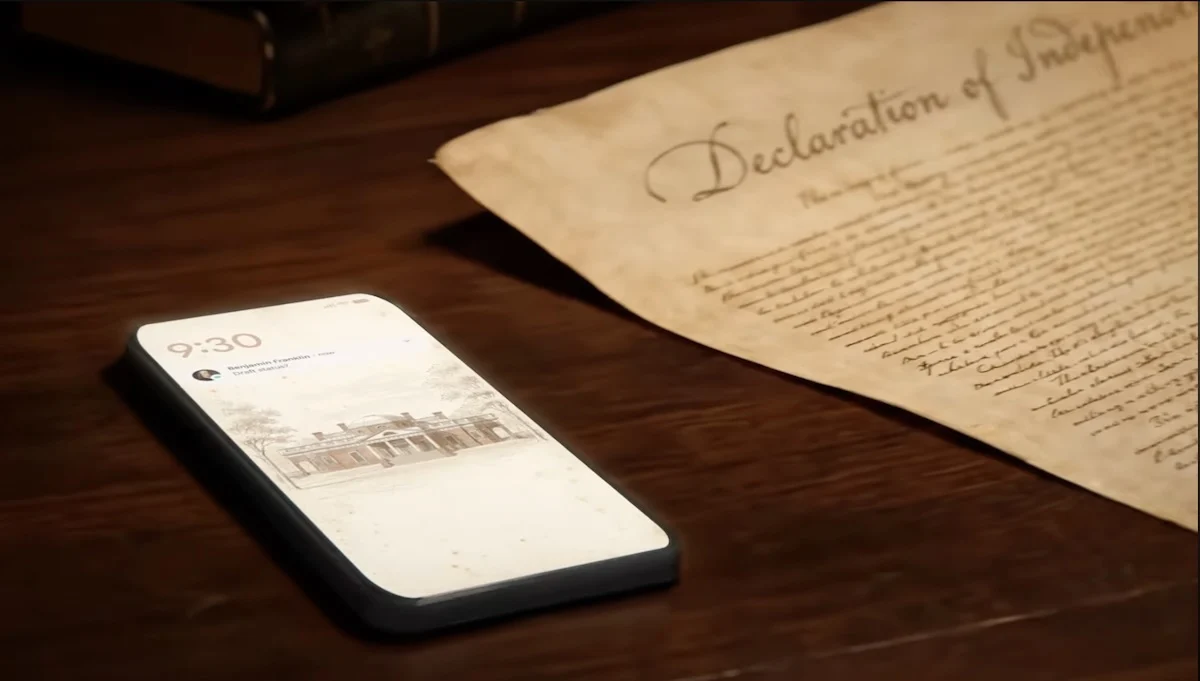
Two hundred and fifty years after the ink dried on the Declaration of Independence, the ghosts of the American Revolution have been recruited for a modern corporate mission. In a high-concept commercial released this week, Google imagines a world where the Founding Fathers were not huddled over parchment by candlelight, but instead maneuvering through the digital architecture of Google Workspace.
The spot, titled "Group project, but make it 1776," serves as both a whimsical brand exercise and a lightning rod for the ongoing discourse surrounding artificial intelligence in the creative sector. As Google attempts to weave its suite of productivity tools into the fabric of American mythology, the reaction has been as fractured as the political landscape the Founding Fathers once helped navigate.
The Chronology of a Corporate Rewrite
The narrative arc of the commercial is deceptively simple, designed to mirror the workflow of any modern marketing or development team. It begins with a largely unseen Thomas Jefferson struggling to draft the seminal document of American history. His solitude is interrupted by a notification—a text message from Ben Franklin—that initiates a rapid-fire sequence of modern office protocols.
The ad follows a familiar beat: suggested edits appear in real-time within a Google Doc, a high-stakes strategy session is orchestrated via Google Calendar, and the revolutionary cohort convenes in a Google Meet. In a nod to the modern "camera-off" malaise, the Founders appear as empty profile pictures, a detail that has drawn both chuckles and criticism for its stark contrast to the gravity of the historical moment. The process culminates in the use of e-signatures, followed by a digital fanfare of fireworks.
Throughout this sequence, the narrative integrates Google’s burgeoning AI ecosystem. The Founders utilize "Help Me Visualize" to brainstorm national seal concepts, rely on Gemini to synthesize meeting notes, and even consult the chatbot for diplomatic advice before formally denying King George III access to their shared documents.
The Role of AI in Creative Marketing
While the ad positions itself as a lighthearted exploration of "what if," it is impossible to divorce the project from the broader climate of AI evangelism currently saturating the tech industry. Compared to previous, more polarizing efforts—most notably the infamous 2024 commercial where a father used Gemini to draft a fan letter for his daughter—this latest spot treads more lightly.
There is a deliberate effort to avoid the implication that the Declaration of Independence itself was generated by a Large Language Model. Instead, Google focuses on the "workflow"—the coordination, the drafting, and the administrative labor of revolution.
However, the visual language of the commercial itself has become a focal point for skepticism. To the observant viewer, the footage possesses the distinctive, uncanny fluidity of AI-generated video. The lighting, the micro-expressions of the actors, and the seamless transition between eras carry the glossy, synthetic sheen that has become the hallmark of the generative video era. This has prompted a secondary conversation: is Google using the ad to sell its tools, or to normalize the aesthetic of AI-generated media?
Supporting Data and Digital Sentiment
The reaction to the commercial has served as a masterclass in modern digital segmentation. On platforms like YouTube and Instagram, the sentiment remains largely positive, leaning into the nostalgia of the Bicentennial era and the inherent humor of seeing historical figures grapple with modern software.
Yet, a visit to Bluesky reveals a starkly different reception. Critics have branded the ad as "cringey" and "stunningly tone-deaf," pointing to the absurdity of applying 21st-century corporate bureaucracy to an 18th-century insurrection.
Perhaps the most significant critique came from historian Angus Johnston, whose analysis resonated widely across social media. Johnston observed the irony inherent in the production, noting, "It’s amazing how little of this is actually AI." He argued that the attempt to frame AI as a revolutionary tool for political organizing is fundamentally disconnected from the reality of history. "Even in a corny fantasy joke, it’s impossible to make the case that AI is a useful tool for political organizing, writing, or human collaboration," Johnston noted, highlighting the tension between the tech industry’s marketing aspirations and the practical, often messy, reality of human cooperation.
Official Responses and Industry Context
Google has remained relatively quiet in the face of the online pushback, likely viewing the controversy as part of the "noise" that inevitably follows high-profile brand campaigns. However, the internal logic of the ad suggests a calculated shift in how Big Tech wants to be perceived. By framing its AI as a "helper" rather than a "creator," Google is attempting to mitigate the existential fears that haunt the creative community—specifically, the fear that AI is intended to replace human ingenuity rather than augment it.
This campaign arrives at a critical juncture for Google. As the company faces increasing pressure from competitors like Anthropic and OpenAI, and as it navigates the regulatory scrutiny surrounding its search dominance, the "1776" ad acts as a soft-power play. It attempts to position Google Workspace as an indispensable, almost historical, necessity of human progress.
The Implications of Historical Revisionism
The implications of the "1776" commercial extend far beyond the immediate debate over AI quality or corporate tone-deafness. It touches upon the broader societal discomfort with the digitization of history. When a corporation uses the most significant document in American history as a backdrop for a product demo, it raises questions about the sanctity of our shared past.
The Dilution of Historical Context
By reducing the drafting of the Declaration of Independence to a "group project" with status updates and cloud-based permissions, the ad risks trivializing the genuine intellectual and physical risks undertaken by the Founders. While the ad is clearly a satire, the frequency with which tech giants co-opt historical milestones suggests a strategy of "historical flattening"—where complex human achievements are rendered into user-friendly, SaaS-based experiences.
The AI-Generated Future
Furthermore, the use of AI to create the ad itself suggests that the industry is entering a phase where the medium is as synthetic as the message. If we are to believe the tech industry’s narrative, we are moving toward a future where "human-led, AI-assisted" is the standard for all communication. Yet, as the critical response highlights, there is a deep-seated resistance to this shift, particularly when the tools are presented as solutions to problems that were never technological in nature.
The "Cringe" Factor as a Marketing Metric
Marketing analysts have noted that "cringe" is often a calculated metric. For a company like Google, sparking a debate—even a negative one—is often preferable to the silence of indifference. By creating an ad that is inherently provocative, Google ensures that its brand remains at the center of the conversation, regardless of whether the audience is laughing with them or at them.
Conclusion: The Disconnect Between Tools and Ideals
Ultimately, the "1776" campaign is a testament to the widening gap between the Silicon Valley worldview and the broader public consciousness. While Google sees a seamless, efficient, and collaborative future enabled by its suite of tools, many observers see a tech-obsessed industry losing touch with the reality of human struggle, history, and the value of non-digital labor.
As we move toward the 250th anniversary of the United States, the ad serves as an unintentional, yet powerful, mirror. It reflects a society that is increasingly reliant on digital interfaces to navigate its own history, even as it struggles to reconcile the convenience of those tools with the enduring, often messy, requirements of democratic participation.
Whether the commercial is viewed as a clever bit of marketing or a misguided foray into historical revisionism, one thing is certain: the debate it has ignited is far from over. As AI continues to evolve, the challenge for companies like Google will be to find a balance between innovation and the preservation of the human stories that underpin our collective identity. For now, however, the Founding Fathers—at least in the eyes of the algorithm—are busy in the cloud, and the notifications are still pinging.