The WordPress ecosystem, a cornerstone of the modern web, is currently undergoing its most significant transformation since the introduction of the Block Editor. As Artificial Intelligence (AI) matures from a novelty into an operational necessity, agency owners are forced to confront a fundamental shift in how they build, manage, and scale their businesses.
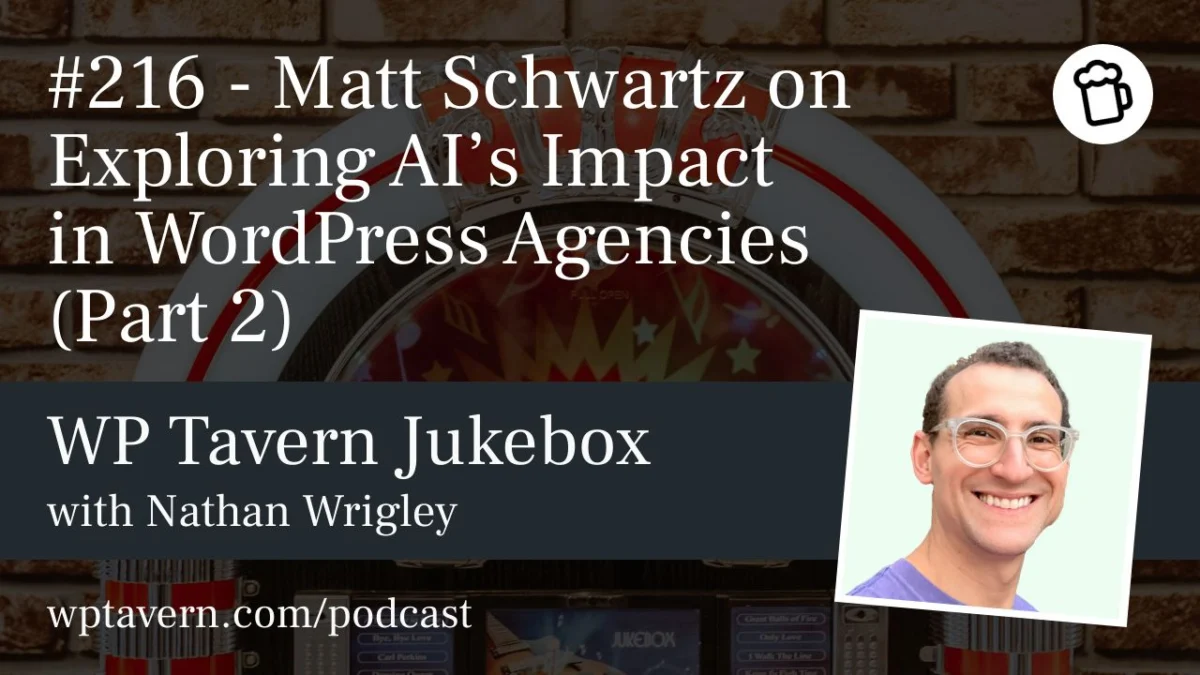
In a recent two-part deep dive on the WP Tavern Jukebox podcast, host Nathan Wrigley sat down with Matt Schwartz, an agency owner and founder of the WordPress QA tool CheckView, to dissect the practicalities, risks, and strategic opportunities presented by AI integration. This report synthesizes their discussion, providing a roadmap for agencies looking to survive and thrive in an AI-augmented landscape.
The Core Shift: Integrating AI into the "Agency Brain"
For many agency owners, AI is still relegated to simple content generation. However, the most successful firms are now moving toward "connecting AI to the agency brain."
Connecting Data Silos
Schwartz argues that the most immediate, low-friction win for any agency is connecting their AI chatbots to their existing project management tools and documentation wikis. By feeding internal SOPs (Standard Operating Procedures) into tools like Claude or ChatGPT, agencies can create a knowledge base that effectively "never forgets."
Instead of relying on a human to remember a niche process or search through outdated PDFs, an AI agent can query the agency’s internal ClickUp or Asana boards in real-time. This reduces "hallucinations"—the AI’s tendency to invent information—by forcing it to ground its responses in the agency’s verified documentation.
The Rise of Model Context Protocol (MCP)
As agencies move beyond simple chatbots, they are encountering the Model Context Protocol (MCP). MCP is an open-source standard that allows AI agents to interact securely with external systems without the need for bespoke, brittle API configurations.
Rather than having every employee manage their own API keys for various services, an agency can create a centralized MCP "bridge." This acts as a secure, gated interface where the AI can perform actions—such as retrieving project statuses or modifying support tickets—while adhering to strict, pre-defined guardrails set by the agency owner. It is the equivalent of having a trusted gatekeeper who ensures the AI performs its tasks without overstepping its permissions.
Chronology of Adoption: From Experimentation to Automation
The adoption of AI in WordPress agencies has followed a distinct progression, moving from "vibe coding" to sophisticated operational automation.
- Phase One: Content and Ideation: The initial wave focused on copy, email drafts, and SEO descriptions.
- Phase Two: Coding Assistance: Developers began using LLMs to generate boilerplate code and debug complex functions.
- Phase Three: Operational Integration: The current phase, where agencies are building "vibe-coded" internal tools. These are bespoke, one-off applications designed to solve specific operational headaches, such as profitability dashboards or time-tracking analyzers.
- Phase Four: The Strategic Pivot: The emerging horizon involves using AI to audit processes and automate quality assurance (QA) checklists.
Supporting Data: Where AI Wins and Where it Risks Failure
Schwartz provides a nuanced view of where AI is a game-changer and where it remains a liability.
High-Value Gains
- Reporting: Combining data from QuickBooks, time-tracking software, and WooCommerce into a unified dashboard. AI can identify patterns in profitability that human managers might miss.
- Onboarding: Using "Claude Skills" to automate client onboarding, ensuring that every step of a site launch is documented and performed consistently.
- Task Automation: Automating binary, "yes/no" checklist items (e.g., checking for the
noindextag).
Areas of High Risk
- Public-Facing Systems: Building custom management dashboards to replace established SaaS products (like ManageWP or WP Remote) is flagged as dangerous. If an AI-generated script fails or is triggered incorrectly, it could lead to catastrophic site downtime.
- The "Disposable" Trap: Agencies often build "one-off" tools to save money. However, if these tools become mission-critical without a corresponding investment in maintenance, the long-term technical debt can quickly outweigh the short-term savings.
- Data Security: Any information entered into a standard AI chat is effectively public record in the eyes of many AI vendors. Agencies must be hyper-vigilant about what sensitive client data they feed into these models.
The Impact on the WordPress Ecosystem
One of the most profound implications of the AI revolution is the potential erosion of the "small plugin" market.
The Decline of Utility Plugins
As agencies find it easier to generate custom code snippets and small utility functions via AI, the market for "one-feature" plugins is shrinking. Larger, complex, platform-level plugins are safer, but the ecosystem’s "long tail" of small developers—who historically used these plugins as a gateway to the community—is facing an existential threat.
Community Attrition
Beyond the economic impact, there is a cultural concern. The WordPress community has thrived on shared learning and collective problem-solving. If agencies turn to AI for all their answers, the engagement levels in forums, Facebook groups, and at WordCamps may continue to wane. This "wicking away" of community interaction could, in the long run, diminish the collaborative spirit that made WordPress the dominant CMS in the first place.
Implications for Agency Owners
The consensus among industry leaders is that the role of the human is shifting. We are entering an era of the "AI Manager."
Hiring and Strategy
Agencies are increasingly cautious about hiring junior staff for purely execution-based tasks. When an AI can handle 80% of a junior developer’s workload, the agency’s value proposition must shift toward high-level strategy, complex problem-solving, and architectural oversight.
The Cost of Convenience
There is a looming financial reality: the current "cheap" era of AI will likely end. As venture capital funding dries up, the costs of utilizing these powerful AI models will rise. Agencies that have built their entire infrastructure on a foundation of "AI-first" dependency may find themselves facing massive cost increases.
Strategic Recommendations
- Document Everything: Build an "AI Vision Document" that clearly defines which tasks are for humans and which are for AI.
- Establish Guardrails: Never let AI touch production code or client data without human review.
- Diversify: While WordPress remains a robust and open-source powerhouse, agencies should use the efficiency gains of AI to experiment with other stacks and frameworks, ensuring they aren’t caught in a vendor lock-in cycle.
- Focus on "The Moat": Double down on services that AI cannot replicate—deep human connection, brand strategy, and complex bespoke development.
Conclusion
The future of the WordPress agency is not about "AI versus Human," but rather "Human plus AI." The technology offers an unprecedented opportunity to streamline operations and eliminate the "grunt work" that has long hampered agency margins. However, as Matt Schwartz emphasizes, this must be approached with "eyes wide open."
Agencies that treat AI as a partner—one that requires supervision, secure protocols, and a clear understanding of its limitations—will thrive. Those that treat it as a magic button, neglecting security and technical debt, risk being replaced by their own automation. The tools are ready; the question is whether the humans are prepared to manage them.