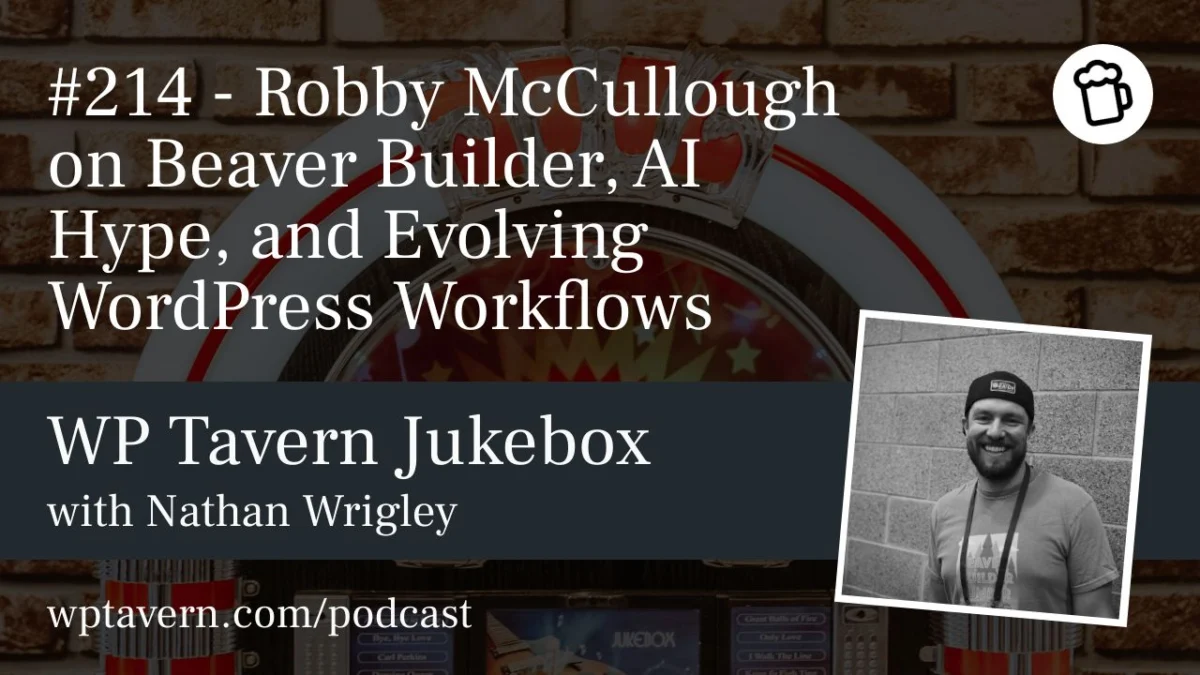
In the rapidly shifting landscape of web development, few platforms have been as central to the democratization of the internet as WordPress. Standing at the intersection of this evolution is Robby McCullough, co-founder of Beaver Builder. For nearly 13 years, Beaver Builder has served as a cornerstone tool for designers and developers, simplifying the complex world of web creation through its intuitive, drag-and-drop page-building interface.
In a recent episode of the WP Tavern Jukebox Podcast, host Nathan Wrigley sat down with McCullough to discuss the trajectory of the WordPress ecosystem, the "AI gold rush," and how long-standing software businesses are navigating an era where websites can be generated by a simple prompt.
The Journey of an Original Innovator
Beaver Builder emerged during a time when creating a website required a formidable mastery of HTML, CSS, PHP, and the intricate templating hierarchy of WordPress. By abstracting these technical barriers, Beaver Builder enabled a new generation of creators to build professional-grade sites without needing to be master coders.
"We were a web design agency," McCullough explained, reflecting on the company’s origin story. "We wanted to use a page builder to build a site so that we could hand it off to a client, and they could make changes themselves instead of having to email us to update an image or a footer."
Over the last 12 years, that mission has scaled into a robust business, even as the platform has faced existential questions—from the rise of competing page builders to the introduction of the Gutenberg block editor. Yet, Beaver Builder remains a "staple" of the ecosystem, proving that there is lasting value in tools that prioritize user agency and visual editing.
Chronology: From Hand-Coding to Agentic AI
The evolution of the web, as recounted by McCullough and Wrigley, follows a distinct path:
- The Hand-Coding Era: The "artisanal" phase, where mastery of code was the only barrier to entry.
- The Page Builder Revolution: The era (circa 2012–2015) where plugins like Beaver Builder abstracted the complexity, allowing for visual, component-based design.
- The Gutenberg Shift: The integration of block-based editing directly into the WordPress core, which many predicted would sound the death knell for third-party page builders.
- The AI Inflection Point: The current, rapid-fire era where Large Language Models (LLMs) and "agentic" coding tools can generate entire site architectures in seconds.
McCullough admits that the current pace of AI development feels different. Unlike previous trends, which were often characterized by "GPT wrappers" meant to impress shareholders, the current generation of tools is genuinely capable of building functional, complex layouts.
The AI Dilemma: Hype vs. Utility
A major focus of the discussion was why Beaver Builder chose not to "jump on the bandwagon" when AI first became the industry buzzword. McCullough expressed relief at this strategic patience.
"It felt like there was a period where every product was just slapping a GPT wrapper on their features to appease C-level executives," McCullough noted. "But now, we’ve reached an inflection point. The friction to build new features is lower, and the capabilities of agentic tools—tools that can actually code and assist in building—are genuinely exciting."
The team at Beaver Builder is currently experimenting with two primary approaches to integrating AI:
- The Conversion Workflow: Allowing users to take a page "vibe-coded" in an AI tool and import it directly into the Beaver Builder interface for professional polish.
- The Chat Agent: An in-editor assistant that allows users to make specific design changes (e.g., "rework this pricing table") within their existing sites.
Implications: The Loss of the "Artisan"
While AI promises immense productivity gains, both McCullough and Wrigley touched upon a pervasive sense of melancholy regarding the "black box" nature of AI-generated web design.
If a website is built entirely by a machine based on a prompt, the human user often lacks the fundamental understanding of how that site functions. This creates a reliance on the tool that may be problematic for business-critical websites.
"WordPress gives you a framework where you can learn about things piece by piece," Wrigley observed. "When you’re using these agentic tools to go from zero to a hundred, you lose that interaction with the tooling and the craftsmanship that is building a webpage."
McCullough agreed, noting that while he enjoys using AI for tedious tasks—like generating lists of radio frequencies for his Ham radio hobby—he worries about the "brute force" nature of AI design. There is a risk, he suggested, that as we move toward "talk-to-the-computer" design interfaces, we might lose the nuanced, human-centric design process that defines high-quality, bespoke work.
The Future of Maintenance and Community
Perhaps the most significant insight from the conversation is the role of page builders in a post-AI world. If AI handles the initial creation, the long-term maintenance of the site becomes the new frontier.
McCullough argues that page builders will transition from purely "creation" tools to "management and editing" tools. When a client needs to update a logo, change a color scheme, or adjust a layout for a holiday campaign, they will still need an intuitive interface—a role that Beaver Builder is perfectly positioned to fill.
Furthermore, the discussion highlighted the need for human connection in an increasingly digital world. Both speakers expressed concern over the decline of in-person WordPress events. As AI mimics human conversation with terrifying accuracy, the value of the "real" community—the social, face-to-face interactions at WordCamps and local meetups—becomes more important than ever.
Summary of Insights
- Business Anxiety: Managing a software company in the face of "vertically-trending" technology is inherently stressful, but an optimistic, iterative approach remains the key to survival.
- The "Plumbing" of WordPress: AI-generated sites often lack the robust backend features (drafts, SEO metadata, extensibility) that have made WordPress the dominant platform for 40% of the web.
- The New Normal: Future generations may never use a keyboard or a mouse in the traditional sense, opting instead for voice-driven, AI-mediated interfaces.
- The Human Upside: As technology becomes more automated, there may be a counter-cultural resurgence in analog hobbies and real-world communities, as people seek to distance themselves from the "simulation" of productivity.
As McCullough looks to the future, he remains a "hopeless optimist." While the tools we use to build the web may change—shifting from PHP and CSS to prompts and voice commands—the underlying desire for connection, customization, and business ownership ensures that platforms like WordPress and tools like Beaver Builder will continue to serve as the scaffolding for the internet for years to come.
"There will be legacy WordPress forever," McCullough concluded. "In the year 2126, there will probably still be WordPress sites out there."