By [Journalist Name]
Updated: July 21, 2026
In the modern SMB landscape, the friction between sales and marketing rarely announces itself with a singular, catastrophic event. Instead, it manifests as a slow, corrosive drain on resources: "qualified" leads that sales refuses to call, marketing campaigns that land with a thud because sales was never briefed, and a pipeline that appears robust on a dashboard but fails to convert into meaningful revenue.
A comprehensive new report from Unbounce, which surveyed over 500 go-to-market (GTM) professionals, confirms that this disconnect is the silent killer of business growth. The headline data is sobering: While 87% of teams acknowledge that better alignment would significantly lift performance, only 56% report that their organizations are "highly aligned." This discrepancy suggests that for nearly half of SMBs, the gears of the revenue engine are grinding against one another rather than working in tandem.
The Mirage of Alignment: Why Communication Isn’t Enough
The report highlights a dangerous trend: many organizations mistake the appearance of alignment for the reality of it. For many, alignment is treated as a calendar problem—if the heads of sales and marketing sit in a weekly meeting, the teams are considered "aligned."
However, the data reveals that this is merely a cosmetic fix. True alignment requires a deep-rooted overhaul of the operating model. It demands shared lead data, synchronized handoff protocols, and, most importantly, unified KPIs. When teams focus only on the "meeting cadence" without addressing the underlying data discrepancies, they are simply holding recurring meetings to discuss why their numbers don’t match.

In this fractured state, marketing counts an MQL (Marketing Qualified Lead) as a win, while sales views it as a waste of time. The result? Marketing claims success based on volume, sales claims failure based on quality, and the business loses the opportunity to convert.
The Perception Gap: An Executive Blind Spot
One of the most striking findings in the Unbounce study is the "perception gap" between leadership and the front lines. Approximately 69% of executives believe their teams are strongly aligned, yet only 47% of non-executive staff share that sentiment.
This disconnect suggests a structural information lag. Executives often view alignment through the lens of strategy decks and organizational charts, while individual contributors experience the daily reality of:
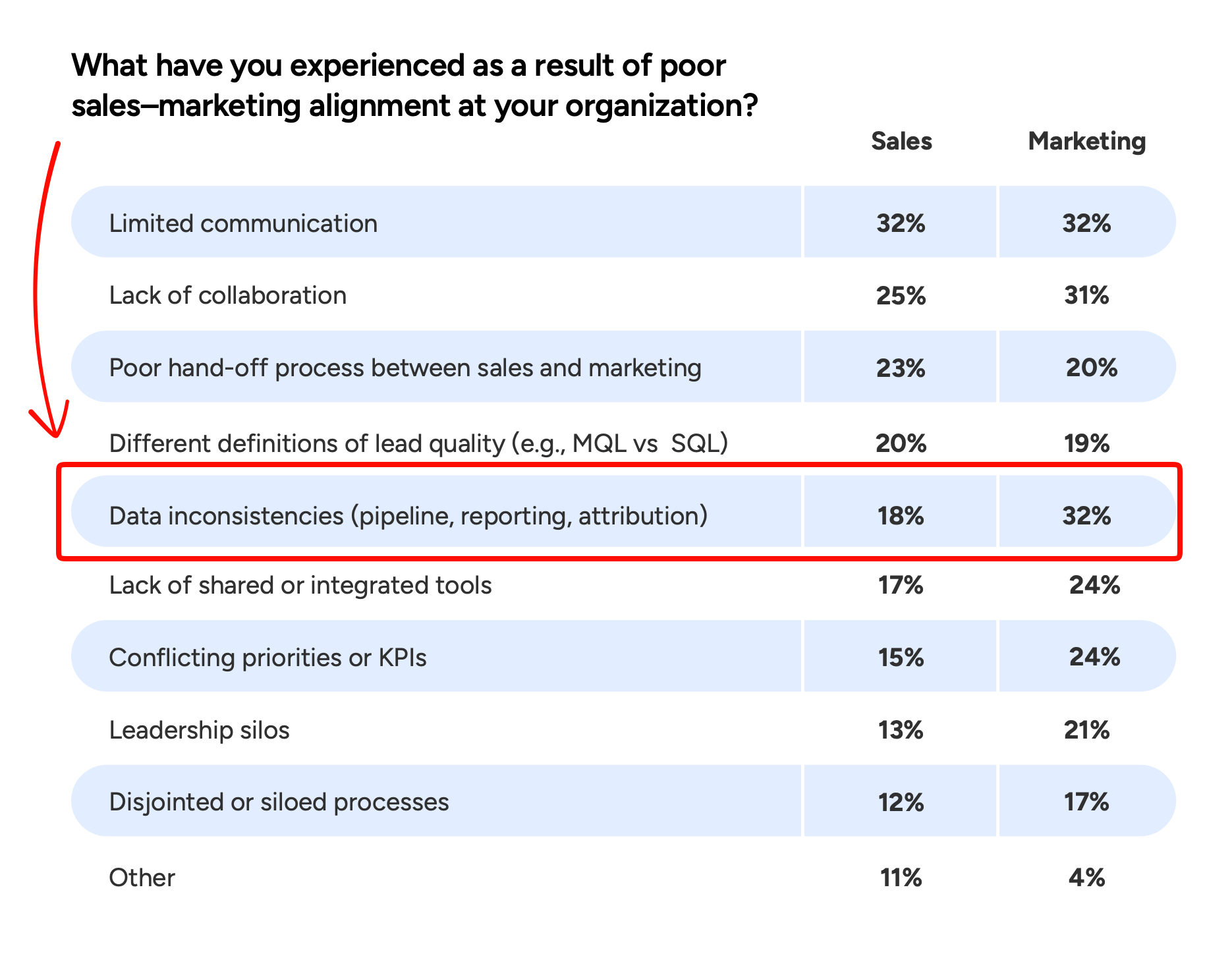
- Data Inconsistencies: 28% of staff report that conflicting data sources prevent them from working effectively.
- Silos: 19% of the workforce identifies rigid departmental silos as a primary barrier.
- Communication Gaps: Nearly one-third of employees feel that communication between departments is insufficient.
When the view from the C-suite doesn’t match the reality on the sales floor, the result is a top-down mandate that fails to solve bottom-up problems.
The Cost of Misalignment: Quantifying the Revenue Leak
Misalignment is often categorized as a "culture problem," but in reality, it is an operational tax on every dollar of revenue. When asked about the consequences of poor alignment, GTM professionals cited employee frustration (29%) as the top outcome, but the financial implications are far more severe.

Delayed follow-up on leads, for instance, is a silent revenue killer. Marketing teams report that they see this delay more sharply (32%) than sales (22%), indicating that leads are being generated but falling into a "black hole" before they can be acted upon. Furthermore, the lack of a unified definition of an "ideal customer" leads to wasted ad spend, as marketing targets the wrong profiles, forcing sales to spend time disqualifying leads that never should have reached them in the first place.
The Root Causes: Why Teams Keep Buying Their Way Out
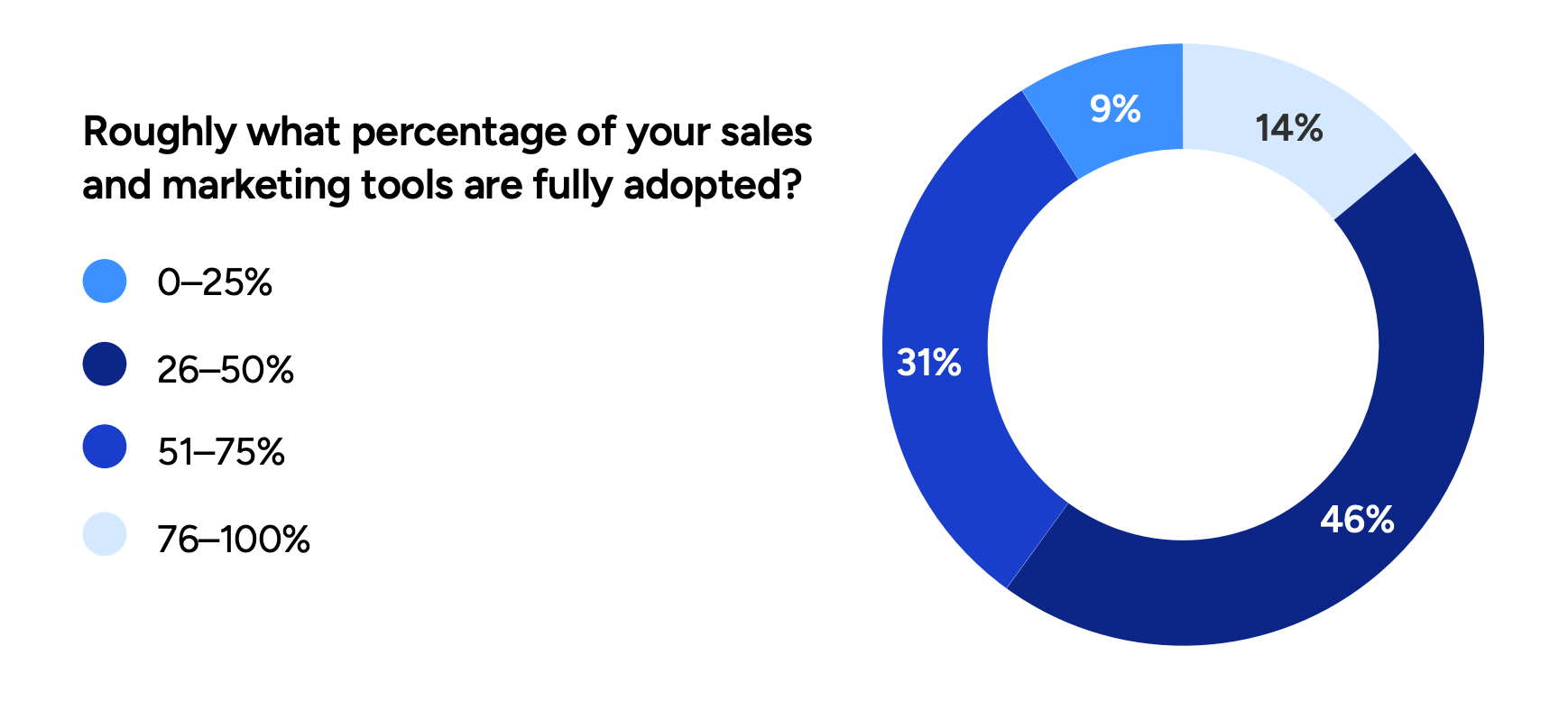
When growth stalls, the instinctive reaction for many SMBs is to "buy their way out of the problem." They invest in new CRM modules, advanced automation layers, or trendy AI tools. However, the data suggests that this "tool bloat" is actually a major inhibitor to success.
- Underutilization: 60% of GTM teams use less than half of the tools in their current tech stack.
- Maintenance Overhead: Unused tools require constant maintenance and often create redundant data silos.
- The Lean Advantage: The report finds that leaner, more focused tech stacks consistently outperform bloated collections. Teams that consolidate their tech are twice as likely to rate their lead quality as "excellent."
The Blueprint for High Performance
What do the top 56% of "highly aligned" teams do differently? The data points to three fundamental operating shifts that allow these organizations to outperform their peers.
1. Data Sharing as a Foundation
Aligned teams are 3.5 times more likely to have strong, cross-functional data sharing. They do not treat data as a departmental asset; they treat it as a shared truth. By utilizing integrated systems where the same pipeline definitions and customer data flow to both marketing and sales, these teams move beyond debating "whose numbers are right" and start making decisions based on a single source of truth.
2. Messaging Consistency Across the Buyer’s Journey
Message drift is a common point of failure. When a marketing campaign promises a specific value proposition that the sales team is unaware of, the customer experience becomes disjointed, eroding trust. High-performing teams ensure that sales reps review campaign messaging before it goes live, and marketers are given access to sales call recordings to understand the actual objections buyers are raising.
3. Shared Accountability through KPIs
The ultimate litmus test for alignment is compensation and goals. If marketing is incentivized on lead volume and sales is incentivized on closed revenue, they will inevitably diverge. Aligned teams prioritize shared metrics—such as Customer Acquisition Cost (CAC) and conversion rates—that hold both departments accountable for the end result: revenue.
Implications for the Future of SMB Growth
The evidence is clear: the era of the "siloed" GTM team is coming to a close. For SMBs looking to scale in 2026 and beyond, the competitive advantage will go to those who can operationalize alignment.
This requires moving away from the "silo mentality" and toward a model where:
- Buyer personas are built as a joint artifact, not a marketing document.
- Lead qualification is governed by a Service Level Agreement (SLA) that defines exactly what happens at each stage of the handoff.
- Tech stacks are pruned to ensure that every tool serves a specific, integrated purpose.
Expert Takeaways: The Road Ahead
As the Unbounce report concludes, the most successful teams stop treating alignment as a "project" and start treating it as their "operating system." Whether it’s integrating reporting systems or standardizing lead definitions, the goal is to create a seamless flow from the first touchpoint to the final contract.
For those struggling to bridge the gap, the first step is simple: stop talking about "alignment" and start auditing your "handoff." When you fix the way a lead moves from marketing to sales, you inevitably fix the way the teams communicate. In the fast-paced world of B2B SaaS and SMB services, clarity in process is the only path to sustainable growth.
For more insights, the full "Anatomy of Aligned Go-to-Market Teams" report is available via Unbounce’s resource center.