Global News Desk | Venture Capital & Enterprise Technology Analysis
Main Facts: The Bifurcated Market Reality
The global technology landscape is currently witnessing an unprecedented economic split. In a single week, the tech sector priced two radically different realities: speculative, high-velocity AI startups commanding multi-billion-dollar valuations with little to no revenue, and mature, cash-flow-positive SaaS stalwarts facing severe valuation compression and limited exit options.
Key developments shaping this ecosystem shift include:
- The AI Valuation Surge: AI-focused agentic startup Instinct reportedly moved to raise a $1 billion funding round at a staggering $10 billion valuation—just months after trading at a fraction of that figure. Concurrently, Discovery Loop—founded by former Google heavyweight Jeff Dean and top researchers—pushed from a $10 billion to a $50 billion valuation within weeks without a commercially launched product.
- Europe’s Sovereignty Play: Mistral AI secured a monumental €3 billion funding round led by industrial giant Samsung, marking the largest tech round in European history as the continent builds indigenous capabilities independent of American labs.
- The B2B SaaS Reality Check: Collaboration platform Miro—pulling in roughly $600 million in Annual Recurring Revenue (ARR) and operating cash-flow positive—was acquired by Bending Spoons for $1.35 billion. This valuation represented a steep drop from its 2021 peak mark of $17.5 billion, underscoring a harsh new baseline for legacy software.
- Meta’s Compute Offensive: Meta officially launched its consumer AI assistant, Muse, providing every user with free virtual machine compute resources (CPUs, GPUs, and substantial storage) at an operational delivery cost of $3 to $4 per user.
Chronology: A Week of Extremes
The convergence of these events highlights a compression of technology market cycles, where strategic pivots and market corrections happen concurrently across different tiers of the ecosystem.
- Early Week — Frontier Pacing Debates: Anthropic CEO Dario Amodei published an open letter calling for external monitoring and capability constraints on frontier AI models, citing cyber risks, economic disruption, and loss of control. Industry leaders swiftly weighed in, while broader markets shrugged off existential threats with a modest tenth-of-a-percent adjustment.
- Mid-Week — Big Tech Deployments and Record Rounds: Meta rolled out its Muse platform, scaling its internal AI division rapidly to match open-source competition. Meanwhile, venture markets digested the meteoric rise of Discovery Loop’s valuation discussions and Instinct’s $10 billion funding negotiations.
- Late Week — M&A Consolidation and Leadership Shifts: Bending Spoons finalized its acquisition of Miro, drawing sharp industry focus on the viability of single-bidder outcomes for once-glorified decacorns. Simultaneously, Automattic navigated a dramatic boardroom showdown involving founder Matt Mullenweg, while Adobe officially named a new internal CEO amidst slowing net-new ARR growth.
Supporting Data & Market Metrics
To contextualize this bifurcated market, analysts point to several critical metrics defining the current valuation paradigm:
- Miro’s Acquisition Multiple: Miro’s $1.35 billion price tag on roughly $600 million in ARR equates to an enterprise multiple of approximately 2.7x revenue, reflecting a severe multiple contraction compared to the 2021 hyper-growth era.
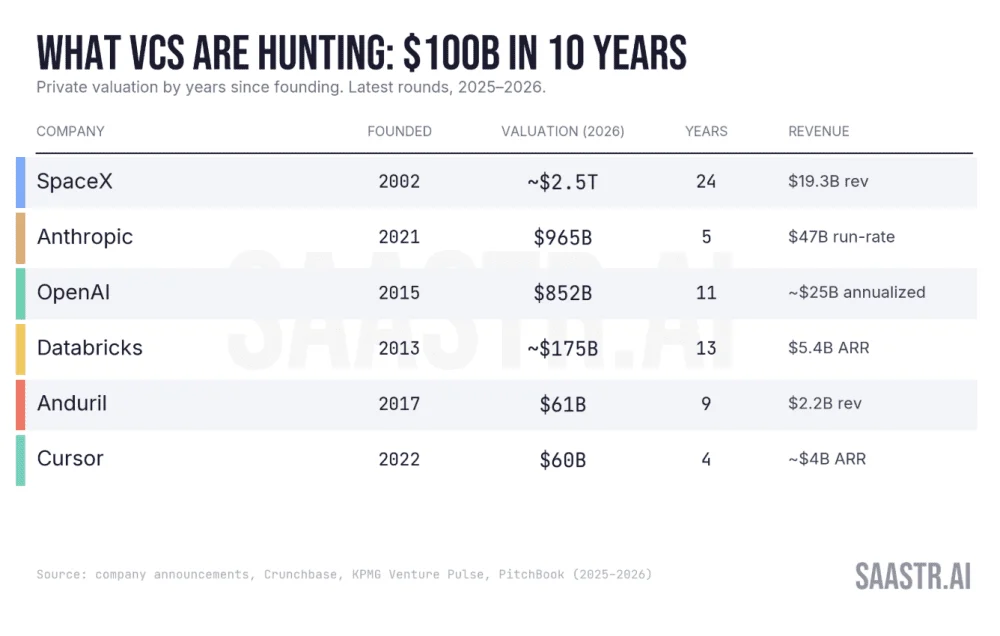
- Menlo Ventures’ Mega-Outcome Thesis: Venture portfolios are increasingly underwriting to extreme tailwinds. Market models show roughly 81 companies valued above $25 billion today, up sharply from just 23 a decade ago, prompting aggressive funds to model portfolios aiming at 100+ mega-outcomes.
- Mistral’s Scale: Mistral is tracking aggressively toward $1 billion in annual revenue by year-end, justifying massive capital injections from global hardware and infrastructure leaders like Samsung and ASML.
- The Adobe Baseline: Adobe commands roughly $25 billion in revenue and a $105 billion market cap, yet trades at a sub-10x cash-flow multiple, illustrating how decelerating growth (dropping below the critical 30% threshold) shifts market valuation entirely from revenue multiples to EBITDA and cash generation.
Official Responses and Industry Commentary
The tension between speculative AI investing and traditional SaaS realities sparked intense debate among prominent industry voices, including venture capitalists Harry Stebbings, Rory O’Driscoll, and Jason Lemkin.
On Frontier AI Governance
The release of Anthropic’s capability-pacing letter drew polarized reactions regarding its practical utility and motivations.
- The Political & Economic Angle: Critics pointed out inconsistencies in the cited risks—noting that cyber capabilities are already present in open-weight ecosystems, and economic arguments run counter to centuries of productivity evolution.
- The IPO Pre-Emption Theory: Market analysts suggested the safety debate serves as a masterclass in S1 risk-factor drafting, getting regulatory and existential debates out of the way ahead of anticipated public offerings. Despite dire warnings of a 10% chance of catastrophic outcomes, public markets priced the risk with minimal disruption—primarily rotating capital into cybersecurity stocks while semiconductor equities experienced minor, temporary contractions.
On Meta’s Muse and the B2B Application Layer
Meta’s deployment of Muse disrupted standard cost-of-goods-sold (COGS) assumptions for application builders.
- The Infrastructure Advantage: While startups must spend heavily to provision user environments, Meta leverages its vertically integrated model, proprietary infrastructure, and immense compute capacity to deliver consumer AI environments at a fraction of traditional costs.
- The Killer App Debate: Opinions remained divided on whether AI assistants require a singular "VisiCalc-style" killer application or if accumulated marginal utility across hundreds of daily micro-tasks will suffice to retain user attention over extended operational hours.
Strategic Implications for Founders and Investors
The divergence between high-flying AI startups and compressed legacy tech assets establishes clear takeaways for industry operators navigating the current economic environment.
1. The Death of the Software Middle
The middle tier of enterprise software—companies growing at single-digit to modest double-digit rates without dominant market ownership—faces an increasingly narrow path. With private equity firms and strategic acquirers largely selective, assets that cannot command competitive bidding syndicates are forced into structural capitulation. Buyers like Bending Spoons exemplify a ruthless new playbook: acquiring solid assets, optimizing cost structures, aggressively raising prices, and extracting maximum cash flow from high-propensity-to-pay customers rather than chasing unprofitable top-line growth.
2. The AI Power Law and Vertical Integration
For early-stage artificial intelligence companies, the competitive moat is narrowing as foundational labs and Big Tech giants rapidly deploy downstream applications. Startups commanding decacorn valuations (such as Instinct or Discovery Loop) must prove an ability to outmaneuver vertically integrated platforms like Meta, which combine proprietary models, infinite compute, and immediate distribution. Underwriting such investments increasingly requires betting on generational talent capable of securing massive, trillion-dollar ecosystem buyers.
3. Operating in the New Regime
Ultimately, the current market reset dictates two distinct playbooks for leadership teams:
- The Frontier Playbook: Aiming exclusively for the "head of the train," building revolutionary agentic or foundational systems that justify extreme venture financing and multi-billion-dollar scale.
- The Cash-Generative Playbook: Managing lean, highly efficient software assets with disciplined cost controls, ensuring profitability and robust cash flow before public markets or private equity scrutinize growth rates.
As the gap between these two worlds widens, founders and investors alike must choose their operational lane carefully—because in today’s tech economy, there are very few seats left in the middle.