The software industry has long treated the "System of Record" as the ultimate corporate fortress. Once a company embeds its core operations—invoices, customer histories, employee directories, and workflow logs—into a single database, it achieves a kind of gravity that is nearly impossible for competitors to escape.
Yet, a high-profile industry clash earlier this year has forced a radical reassessment of this dogma. When field-service giant ServiceTitan abruptly cut off Podium’s integration for roughly 1,000 shared customers after a nine-year partnership, the tech press framed it as a standard platform divorce. In reality, it serves as a masterclass in the structural realities of modern SaaS: what owning the record can do for retention, and what it fundamentally cannot do for growth.
Main Facts: The ServiceTitan-Podium Showdown
The numbers behind the ServiceTitan-Podium split reveal the raw power of the System of Record. ServiceTitan delisted a partner boasting $100 million in AI agent Annual Recurring Revenue (ARR), instantly severing ties across 1,000 joint accounts.
Despite the abrupt cut-off, ServiceTitan retained virtually all of those customers. Why? Because the contractors’ daily survival—their jobs, customer records, technician schedules, and billing cycles—lives securely inside ServiceTitan. Podium, despite its massive scale and AI capabilities, proved to be the removable piece.
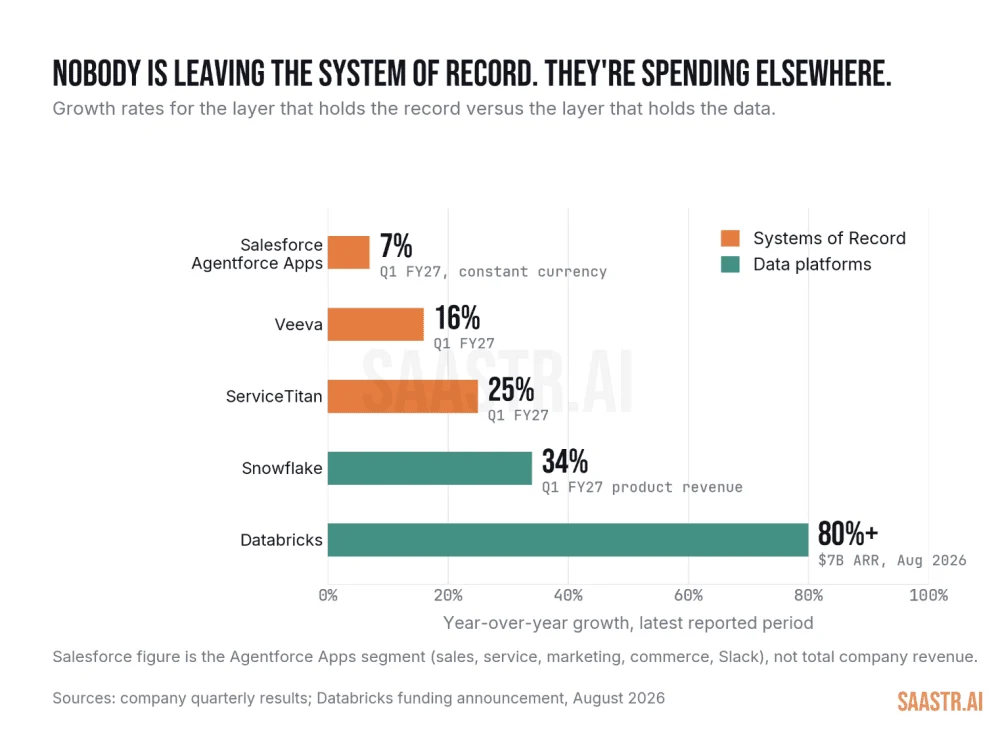
However, this defensive moat has a distinct ceiling. While ServiceTitan’s retention remained bulletproof, its top-line growth rate sat at a respectable 25% last quarter—impressive for a vertical System of Record, but vastly outpaced by infrastructure and data layers. By comparison, Snowflake recently expanded product revenue by 34% with a net revenue retention (NRR) of 126%, while Databricks crossed the $7 billion ARR milestone with growth exceeding 80%.
Owning the record is a formidable retention asset. But growth, it turns out, has to come from somewhere else.
Chronology of a Perimeter Defense
The tensions leading up to the Podium lockout were years in the making, but crystallized in a series of strategic policy shifts:
- April 2026: ServiceTitan rolled out restrictive new API terms. The updated guidelines mandated that all API calls remain within a predefined certified scope, explicitly barring independent AI systems from selecting endpoints on their own. Furthermore, certified status was made contingent on revenue-sharing arrangements.
- June 2026: ServiceTitan formalized its Marketplace policy. The document welcomed competitive partners only if they refrained from using the partnership to slowly chip away at and displace core ServiceTitan modules.
- Summer 2026: The partnership officially dissolved, cutting off mutual users and testing whether contractors would abandon the incumbent platform for specialized AI tools. They did not.
Together, these policy documents draw a hard perimeter. ServiceTitan leveraged its status as the foundational database to defend its territory, knowing the alternative for a contractor would mean ripping out the very software that runs their business.
Supporting Data: Retention vs. The Data Layer
The divergence between application-layer retention and data-layer growth is playing out across the entire enterprise software ecosystem.
Consider Salesforce’s Q1 FY27 financial report. The company posted $11.13 billion in revenue, up 13% (or roughly 8–9% organic growth when stripping out acquisitions). More illuminating is the internal breakdown: Agentforce Apps (spanning sales, service, marketing, commerce, and Slack) brought in $6.91 billion, growing at just 7% year-over-year. Meanwhile, data-centric segments—Data 360, Headless Platform, and Other—surged from $2.95 billion to $3.68 billion.
The application/record layer grew at 7%. The data layer grew at 25%.
+-----------------------------------+------------------------+
| Metric / Segment                  | Growth Rate / Scale    |
+-----------------------------------+------------------------+
| Salesforce Agentforce Apps (App)  | 7% YoY                 |
| Salesforce Data Layer (Data 360)  | ~25% organic/implied   |
| Snowflake Product Revenue         | 34% YoY (126% NRR)     |
| Databricks ARR                    | >80% growth ($7B ARR)  |
+-----------------------------------+------------------------+
Veeva, one of the stickiest life-sciences Systems of Record in history, managed a 16% growth rate last quarter while migrating customers to a new CRM architecture. Retention is universally healthy across incumbents. The issue isn’t churn; it’s that customers are routing their incremental software dollars elsewhere.
Official Responses and Strategic Pivots
Faced with the explosive data volumes generated by autonomous AI agents, major Systems of Record are radically shifting their architectural strategies.
Salesforce’s answer is Zero Copy. Of the staggering 52 trillion records ingested by Data 360 in a single quarter (up 136% year-over-year), 35 trillion arrived via Zero Copy—a 277% jump. Instead of forcing data into Salesforce’s high-cost storage tables, Zero Copy registers external tables residing in Snowflake, Databricks, BigQuery, or Redshift, querying them directly in place.
The software giant willingly surrenders the storage rent to maintain its position as the high-level control plane.
Conversely, infrastructure players are marching upward. Snowflake has positioned itself as the control plane for the "Agentic Enterprise," underscored by its acquisition of enterprise MCP platform Natoma.
As software industry leaders note, two massive forces are converging from opposite directions: one owns the record and is abandoning physical storage to stay relevant; the other owns the storage and is aggressively buying its way toward the record.
Implications: The Death of the Rent-Seeking Database
The economic model of the traditional System of Record faces a profound mismatch with the age of autonomous AI agents.
1. The Storage Trap
Salesforce and other enterprise platforms historically priced data storage for a world bounded by human typing speeds—charging up to $3,000 per GB annually. Autonomous agents break this paradigm entirely. A single agentic workload generates massive amounts of operational "exhaust": tool call traces, intermediate reasoning logs, vector embeddings, and evaluation retries. Storing agent working data inside a traditional System of Record is financially ruinous.
2. The API Bottleneck
Beyond storage costs, API limits pose an existential threat. Traditional SaaS rate limits were calculated per human seat. Because agents operate without human seats, they instantly collide with rate ceilings, forcing enterprises into expensive, empty-seat licensing workarounds or running headfirst into restrictive platform policies.
3. The Meritocratic Agent Sale
Owning the record no longer guarantees agent monetization. Podium built $100 million in AI agent ARR in under two years by selling directly to contractors who were already ServiceTitan customers. Incumbents are finding that having their agent tried first is only an initial advantage; if a third-party tool delivers superior results, an open market will choose the specialist every time.
Conclusion: The Record Stays, the Rent Fades
Systems of Record are not going away. The authoritative source of truth for a customer contract, a medical record, or a plumbing invoice will always command a healthy, high-retention business model—typically humming along at 10% to 16% annual growth.
However, the inflated rent charged for housing agentic data exhaust is unsustainable. As the industry pivots toward Zero Copy architectures and headless integrations, the underlying math is clear: retention keeps a software vendor in the game, but the agent sale must be won on pure merit.
The record stays. The rent does not.