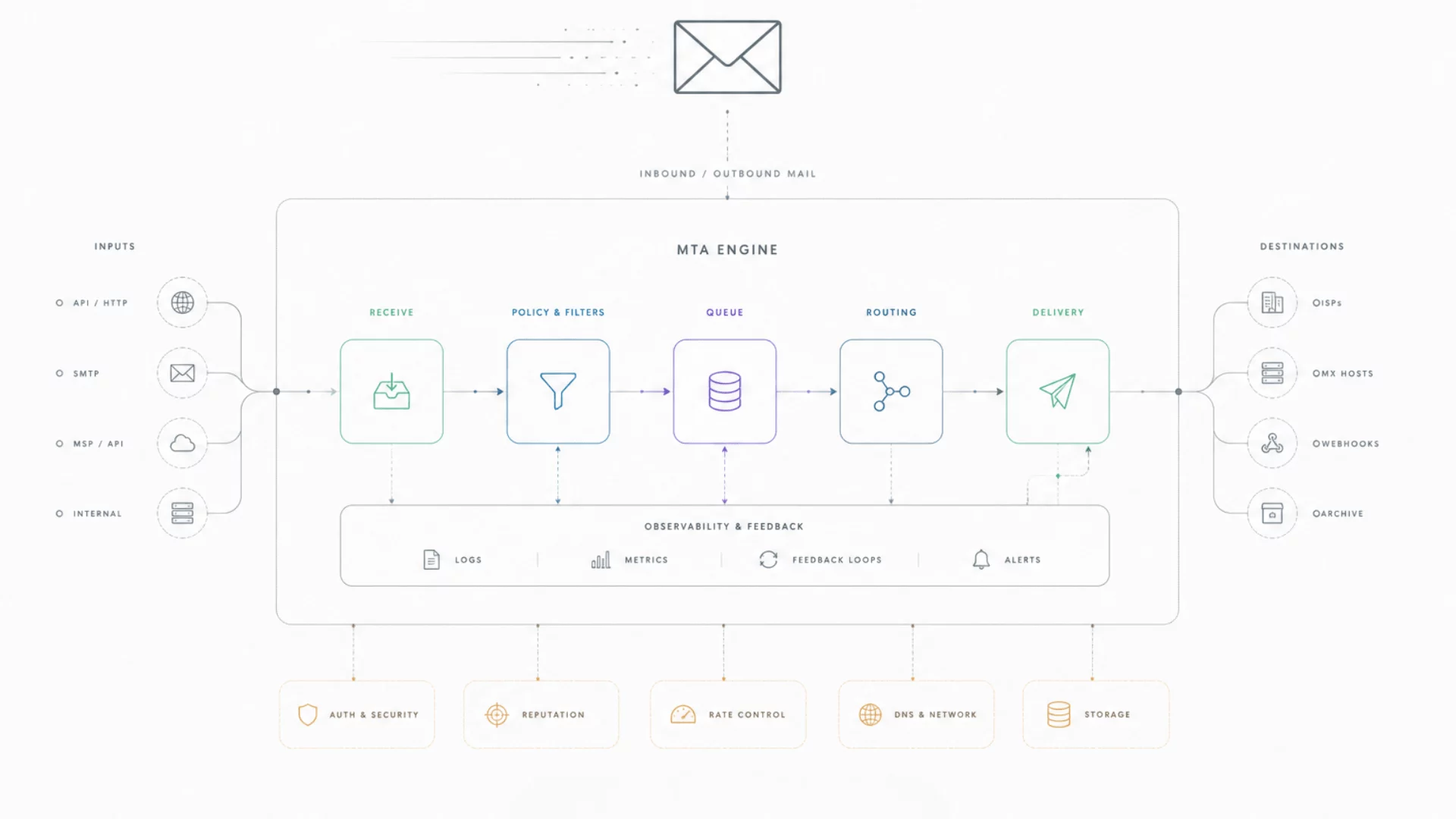
While the broader tech industry spent the spring of 2024 locked in a rhetorical arms race over the utility of generative AI agents and predictive hallucination, the architects of the world’s most critical email infrastructure were quietly busy with a more fundamental task: making the internet’s most load-bearing layer faster, safer, and more intelligent.
The Mail Transfer Agent (MTA)—the engine that powers the backbone of digital communication—rarely receives the headlines afforded to trendy SaaS platforms. Yet, for the operators, ESPs, and enterprises managing high-volume traffic, the recent updates from KumoMTA, Halon, and GreenArrow represent a significant shift in how deliverability and security are managed at scale.
The State of the Engine: A Sectoral Overview
The common theme emerging from this season’s development cycle is not about replacing human operators with black-box AI, but rather about "observability" and "operator ergonomics." Vendors are focusing on providing better diagnostics for classic failures, such as forward-confirmed reverse DNS (FCrDNS) issues, while refining the way they handle the increasingly complex requirements of mobile-first engagement.
These releases suggest that while the "glamour" of the industry remains elsewhere, the actual engineering focus has shifted toward hardening existing systems against a volatile threat landscape and the tightening requirements of major mailbox providers like Google and Yahoo.
KumoMTA: Prioritizing Modular Flexibility
KumoMTA’s recent trajectory—specifically the 2026.05.12 release—highlights a project that is maturing rapidly while maintaining its commitment to transparency.
The Maintenance Philosophy
Unlike many proprietary engines that prefer opaque "under-the-hood" changes, KumoMTA’s latest release is a masterclass in controlled maintenance. By introducing the counter_series module, Kumo is providing operators with in-memory rolling counters. This allows for sophisticated, rate-aware policy logic written in Lua, enabling engineers to build complex throttling rules without needing external database hits.
The April "Gotcha"
Perhaps the most critical operational change occurred in April, when the team removed an implicit DKIM alignment check. Historically, the engine would trigger a policy failure if the From: domain did not align with the DKIM signature. By removing this "baggage," Kumo has moved toward a more modular standard where the operator is responsible for defining these policies.
Implication for Operators: If your infrastructure was relying on the engine to "fail safe" automatically, you must now explicitly iterate your verification results in your policy configuration. Failure to audit this change could lead to unexpected delivery success for unaligned, potentially spoofed mail.
Community-Led Growth
A vital health indicator for the Kumo project is the visibility of community contributors. The emergence of handle kayozaki as a primary contributor to both the May and April releases is a bellwether for the project. In a market dominated by "closed-box" vendors, Kumo’s ability to attract and integrate external code is a significant competitive differentiator that ensures the engine remains grounded in real-world operator problems rather than vendor-specific dogma.
Halon: Moving Beyond "Autonomous" Hype
Halon’s spring releases (Engage 26.1 and Protect 26.1) represent the most ambitious attempt to apply machine learning to the delivery queue.
Flow Dynamics: The End of Hand-Written Backoff?
The standout feature in the Engage 26.1 release is "Flow Dynamics." For two decades, deliverability engineers have spent countless hours writing manual backoff rules to manage how an MTA reacts to provider deferrals. Halon’s new ML-based system automates this classification and response, slowing traffic or moving it into backoff queues in real time based on observed provider feedback.
Crucially, Halon has avoided the trap of making this a "black-box" autonomous system. The architecture maintains a clear separation: the machine learning component proposes the adjustments, but the human-defined policy layer remains the final arbiter. This "Human-in-the-loop" design is refreshing in an era where automation often obscures the underlying mechanics of delivery.
Gateway-Enforced Security
On the security front, the Protect 26.1 release introduces gateway-enforced S/MIME and PGP support. By centralizing encryption at the gateway, Halon allows enterprises in regulated sectors—such as finance and healthcare—to maintain high levels of security without requiring end-users to manage complex key-exchange processes.
Diagnostic Depth
The platform’s 6.10 updates also include a vital improvement to connect hooks: the engine now explicitly surfaces why FCrDNS failed. This move toward "explanatory diagnostics" addresses the findings of recent industry research regarding DNS fragility. By telling the operator the cause of a failure rather than simply reporting the fact of it, Halon is reducing the "Mean Time to Repair" (MTTR) for deliverability issues.
GreenArrow: Integrating with the Mobile Ecosystem
GreenArrow has arguably been the most aggressive in adapting its feature set to modern mobile consumer habits.
Solving the "Deep Link" Problem
The introduction of "Universal Link Tracking" in v4.362.0 addresses a long-standing point of friction for mobile marketers. Historically, email tracking links were often incompatible with Apple’s Universal Links or Android App Links, forcing a jarring redirect through a browser instead of opening the brand’s native app. GreenArrow now manages the hosting of the necessary validation files (apple-app-site-association), streamlining the user experience and significantly boosting engagement metrics for app-centric brands.
Cloud-Native Maturation
GreenArrow’s shift toward a cloud-native architecture—marked by its transition to non-root UID/GID 1000 and support for RHEL/Alma/Rocky 10—signals a shift away from "legacy MTA" perceptions. By standardizing these deployments, GreenArrow is making it easier for DevOps teams to integrate the MTA into modern Kubernetes-orchestrated pipelines.
The Seed-Testing Lesson
The spring releases also included a fix for a bug where SimpleMH seed messages were sent without DKIM signatures. This serves as a cautionary tale for the industry: when placement testing results drop unexpectedly, it is not always a sign of a sender reputation issue. Sometimes, it is a technical failure in the testing harness itself. Operators should treat this as a reminder to always validate the authentication headers of their seed-test traffic before drawing conclusions about inbox placement.
Implications: The Industry at a Crossroads
The "common thread" across these three vendors is a move toward professionalized infrastructure.
- Observability is King: The days of "black-box" MTAs are numbered. Whether it’s Halon’s diagnostic hooks or Kumo’s modular counters, the trend is toward transparency and explicit configuration.
- Compliance as a Feature: As privacy laws tighten and encryption becomes a baseline expectation, vendors that offer gateway-level compliance—like Halon’s S/MIME support—will find themselves with a massive advantage among enterprise clients.
- Human-Centric AI: The industry is signaling a rejection of "AI for the sake of AI." Machine learning is being applied only to the most tedious, data-heavy tasks (like bounce classification and backoff management), while the core decision-making logic is being reinforced as a human-controlled domain.
Final Takeaways for Operators
For those managing these systems, the mandate for the coming quarter is clear:
- Audit your alignment: Ensure your KumoMTA policies are explicitly handling DKIM/From domain alignment.
- Leverage new diagnostics: Move away from generic alert systems and begin utilizing the specific error codes being exposed by platforms like Halon.
- Modernize your deployment: If you are still running legacy, root-based configurations, the shift toward non-root, container-native deployments from vendors like GreenArrow should be a priority for your next maintenance cycle.
As the industry continues to evolve, the MTA remains the most critical, yet often overlooked, component of the digital ecosystem. These vendors are proving that the most important "AI" is the kind that actually keeps the mail flowing, the deliverability stable, and the infrastructure secure.
For more technical specifications and detailed documentation, operators are encouraged to consult the official release notes for KumoMTA, Halon, and GreenArrow. Disclosure: KumoMTA, Halon, and GreenArrow Email are Enterprise Members of Emailexpert; however, all coverage decisions remain independent of commercial relationships.