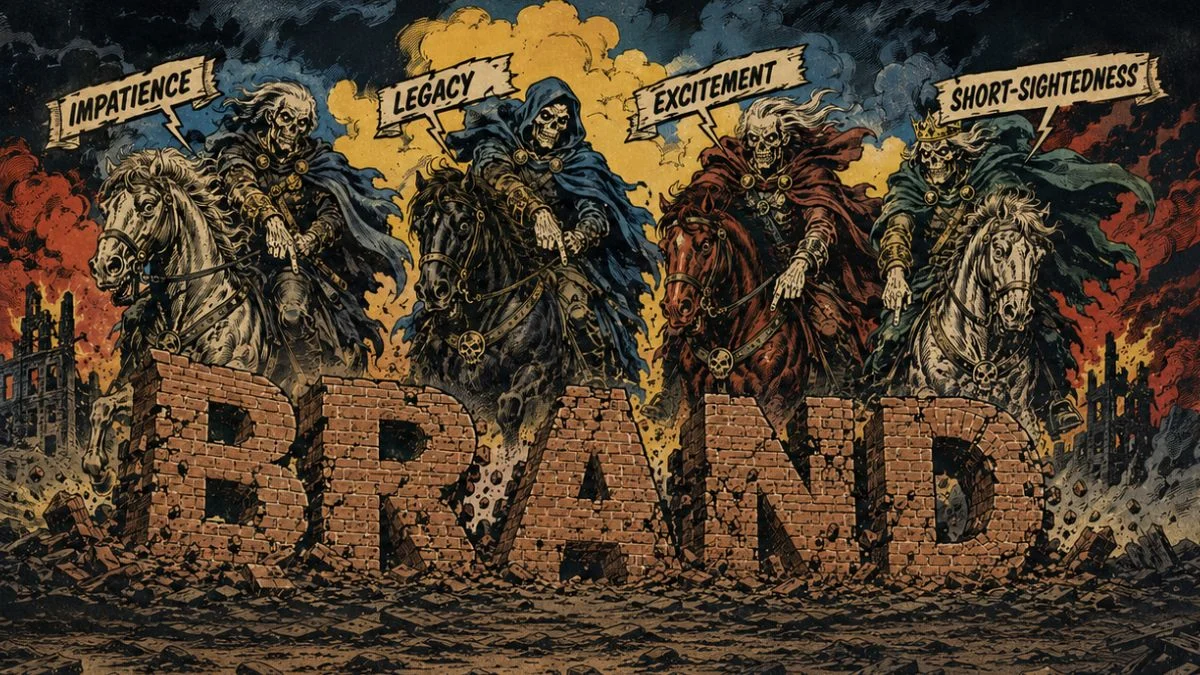
In the high-stakes boardroom of a global consumer goods conglomerate, a newly appointed Chief Marketing Officer (CMO) presented a suite of refreshed slogans to the CEO. The CEO’s reaction was immediate and dismissive: "I have strikes at two factories, retailer pressure on margins, shareholder presentations to prepare, and a budget gap to close. I’m not going to fight my CMO over a few words in a slogan."
To the executive, this was a minor tactical choice, a superficial coat of paint on a complex machine. Yet, this moment serves as a cautionary tale for modern corporate leadership. It illustrates one of the most dangerous paradoxes in contemporary business: while top management subjects capital expenditures, mergers, and structural reorganizations to rigorous scrutiny, the fundamental asset of the company—its brand equity—is often treated as a peripheral concern.
This article explores why brand strategy is not merely a marketing function but a critical CEO-level responsibility, and why the most damaging corporate failures often begin as "harmless" marketing tweaks.
The Anatomy of Brand Erosion
Brand equity is the silent engine of market capitalization. When an organization treats brand positioning, personality, and distinctive assets as "small decisions," it leaves them vulnerable. Like a chronic, asymptomatic disease, the erosion of a brand thrives because it evades the organization’s immune system. By the time the symptoms manifest as declining market share or pricing power, the damage is often irreversible.
The tragedy is that these decisions are rarely made with malicious intent. Instead, they are often cloaked in the noble language of corporate progress: agility, consumer-centricity, creativity, and financial discipline.
1. Impatience Disguised as Agility
In the fast-paced world of digital media, time is experienced differently by the creator than the consumer. Marketing teams, having labored over a campaign for months, often grow bored with their own assets long before the average consumer has even internalized them.
The Cycle of Premature Abandonment
The greatest returns on brand investment occur late in the lifecycle. As research from the Ehrenberg-Bass Institute and System1 has consistently shown, distinctive assets—colors, symbols, sounds, and slogans—accrue value through repetition. When a company pivots to a "fresh" look because the internal team is tired of the old one, they are effectively dismantling their own competitive advantage.
A creative refresh, marketed as "agility," is often just a symptom of corporate impatience. By discarding assets just as they are beginning to yield compounding returns, organizations ensure that they remain in a perpetual state of "re-introduction," never allowing the brand to become a shortcut for the consumer’s brain.
2. Personal Legacy Disguised as Consumer-Centricity
Corporate culture often incentivizes visible change. For a new CMO, the desire to leave a "personal mark" on a brand is a powerful career motivator. This leads to the incremental drift of brand identity, where one leader tweaks the imagery, the next pivots the target demographic, and the third attempts a total personality overhaul.
The Trap of "Listening"
Consumer-centricity is an indispensable pillar of modern business, but it is frequently weaponized to justify subjective, non-strategic decisions. When an organization is already convinced that change is necessary, it often uses consumer research as a shield, cherry-picking data to validate a predetermined path rather than challenging the status quo.
While consumers might express interest in a new, flashy visual identity, that interest rarely translates into long-term value. Consistency is the bedrock of brand equity. Every unnecessary change creates a layer of confusion, diluting the brand’s meaning in the consumer’s mind.
3. Creative Excitement Disguised as Effectiveness
Marketing departments are often seduced by the glamour of the "new." Launching a viral campaign or a limited-edition collaboration generates internal energy, team morale, and an easy narrative for social media. However, the most commercially impactful work is often the most unglamorous.
Prioritizing the Core
Improving pack-price architecture, simplifying product portfolios, strengthening core product offerings, and enhancing distribution efficiency are rarely the topics of glitzy agency presentations. Yet, these initiatives frequently produce the highest return on investment (ROI).
Furthermore, these structural improvements require less "non-working" expenditure. When a company spends its budget on the process of creation—the agency fees, the production costs, and the bureaucracy of a massive redesign—it leaves less capital to actually reach the consumer. The highest-return work is often the quietest, but marketing leadership must resist the urge to prioritize excitement over efficacy.
4. Short-Sightedness Disguised as Financial Discipline
Few corporate mandates sound as responsible as "financial discipline." Every CMO is expected to prove the commercial impact of their budget. However, when financial discipline becomes synonymous with immediate measurability, the long-term health of the brand is sacrificed.
The Dashboard Delusion
Price promotions, retail activations, and lower-funnel digital media provide the kind of immediate data points that satisfy quarterly reports. Brand building, conversely, is an investment in future demand. It creates the memory structures that justify premium pricing and sustain customer loyalty over years, not weeks.
The danger lies in the "planning cycle" trap. By incrementally shifting investment toward measurable, short-term tactics and away from brand-building, companies see their dashboards remain stable for a time. But the foundation is rotting. Eventually, the brand loses its organic pull, forcing the company to spend even more on promotions and advertising just to maintain the same level of demand.
Nike’s recent strategic pivot—admitting that they had over-indexed on performance marketing at the expense of brand storytelling—serves as a high-profile case study. It proves that maximizing short-term efficiency and maximizing long-term value are fundamentally different objectives.
Implications: The Strategic Cost of Neglect
When a CEO tells their CMO that a slogan is "not worth fighting over," they are making a strategic error. A slogan is not just a collection of words; it is a manifestation of the brand’s promise, its positioning, and its place in the market.
The Ripple Effect
- Pricing Power: As brand distinctiveness fades, the product becomes a commodity, leaving the firm at the mercy of retailer margin pressure.
- Operational Efficiency: Weak brands require more marketing spend to move the same amount of product, increasing the burden on the company’s P&L.
- Strategic Drift: When the brand lacks a clear, consistent identity, every department—from R&D to Sales—lacks a "north star," leading to fragmented and conflicting business decisions.
Conclusion: A Call to Executive Stewardship
The future of a brand is not decided in a single, catastrophic event; it is decided in the thousand small, "reasonable-sounding" decisions that go unchallenged by the C-suite.
CEOs must stop viewing marketing as a tactical expense and start viewing it as a core business architecture. They must demand that their marketing teams distinguish between change for the sake of excitement and change for the sake of growth. They must protect their brand equity with the same rigor they apply to their balance sheets.
The next time a marketing leader presents a "small" change, the CEO should ask: Does this reinforce our memory structures, or does it add to the noise?
Because, as the evidence shows, it was never just a slogan. It was the future of the company.